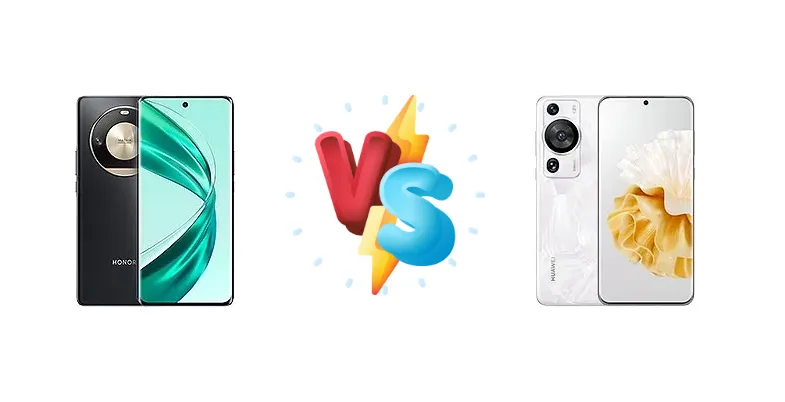
Both the Honor X50 Pro and Huawei P60 Pro represent compelling options in the flagship smartphone space, but cater to slightly different priorities. The X50 Pro aims for a balance of performance and value, while the P60 Pro focuses on a premium experience with a strong emphasis on camera technology and fast charging. This comparison dissects their key differences to help you determine which device best suits your needs.
🏆 Quick Verdict
For the average user prioritizing fast charging and a potentially more refined camera experience, the Huawei P60 Pro is the better choice. However, the Honor X50 Pro offers comparable performance at a potentially lower price point, making it a strong contender for budget-conscious buyers.
| Network |
|---|
| 2G bands | GSM 850 / 900 / 1800 / 1900 | GSM 850 / 900 / 1800 / 1900 |
| 3G bands | HSDPA 850 / 900 / 1700(AWS) / 1900 / 2100 | HSDPA 800 / 850 / 900 / 1700(AWS) / 1900 / 2100 |
| 4G bands | LTE | 1, 2, 3, 4, 5, 7, 8, 12, 13, 17, 18, 19, 20, 26, 28, 32, 34, 38, 39, 40, 41, 66 - International |
| 5G bands | SA/NSA | - |
| Speed | HSPA, LTE, 5G | HSPA, LTE |
| Technology | GSM / CDMA / HSPA / CDMA2000 / LTE / 5G | GSM / CDMA / HSPA / CDMA2000 / LTE |
| | - | 1, 2, 3, 4, 5, 7, 8, 12, 17, 18, 19, 20, 26, 28, 34, 38, 39, 40, 41 - China |
| Launch |
|---|
| Announced | 2023, December 29 | 2023, March 23 |
| Status | Cancelled | Available. Released 2023, March 31 |
| Body |
|---|
| Dimensions | 163.6 x 75.5 x 8 mm (6.44 x 2.97 x 0.31 in) | 161 x 74.5 x 8.3 mm (6.34 x 2.93 x 0.33 in) |
| SIM | Nano-SIM + Nano-SIM | · Nano-SIM· Nano-SIM + Nano-SIM |
| Weight | 192 g (6.77 oz) | 200 g (7.05 oz) |
| | - | IP68 dust/water resistant (up to 1.5m for 30 min) |
| Display |
|---|
| Protection | - | Kunlun Glass |
| Resolution | 1220 x 2652 pixels, 19.5:9 ratio (~431 ppi density) | 1220 x 2700 pixels (~444 ppi density) |
| Size | 6.78 inches, 112.6 cm2 (~91.2% screen-to-body ratio) | 6.67 inches, 107.7 cm2 (~89.8% screen-to-body ratio) |
| Type | AMOLED, 1B colors, 120Hz | LTPO OLED, 1B colors, 120Hz |
| Platform |
|---|
| CPU | Octa-core (1x3.0 GHz Cortex-X2 & 3x2.5 GHz Cortex-A710 & 4x1.80 GHz Cortex-A510) | Octa-core (1x3.19 GHz Cortex-X2 & 3x2.75 GHz Cortex-A710 & 4x2.0 GHz Cortex-A510) |
| Chipset | Qualcomm SM8475 Snapdragon 8+ Gen 1 (4 nm) | Qualcomm SM8475 Snapdragon 8+ Gen 1 4G (4 nm) |
| GPU | Adreno 730 | Adreno 730 |
| OS | Android 14 | HarmonyOS 3.1 (China), EMUI 13.1 (Europe), no Google Play Services |
| Memory |
|---|
| Card slot | No | Nano Memory (uses shared SIM slot) |
| Internal | 256GB 12GB RAM | 256GB 8GB RAM, 256GB 12GB RAM, 512GB 12GB RAM |
| | - | UFS |
| Main Camera |
|---|
| Dual | 108 MP, f/1.8, (wide), 1/1.67", PDAF
Auxiliary lens | - |
| Features | LED flash, panorama, HDR | Laser AF, color spectrum sensor, LED flash, HDR, panorama |
| Triple | - | 48 MP, f/1.4-f/4.0, 25mm (wide), PDAF, OIS
48 MP, f/2.1, 90mm (telephoto), PDAF, sensor-shift OIS, 3.5x optical zoom
13 MP, f/2.2, 13mm (ultrawide), AF |
| Video | 4K@30fps, 1080p@30fps | 4K@30/60fps, 1080p@30/60fps, 1080p@960fps; gyro-EIS, HDR Vivid |
| Selfie camera |
|---|
| Features | - | Panorama, HDR |
| Single | 8 MP, f/2.0, (wide) | 13 MP, f/2.4, (ultrawide) |
| Video | 1080p@30fps | 4K@30/60fps, 1080p@30fps, HDR Vivid |
| Sound |
|---|
| 3.5mm jack | - | No |
| 35mm jack | No | No |
| Loudspeaker | Yes | Yes, with stereo speakers |
| Comms |
|---|
| Bluetooth | 5.2, A2DP, LE | 5.2, A2DP, LE |
| Infrared port | - | Yes |
| NFC | Yes | Yes |
| Positioning | GPS, GLONASS, GALILEO, BDS | GPS (L1+L5), GLONASS (B1I+B1c+B2a), BDS (B1I+B1c+B2a), GALILEO (E1+E5a), QZSS (L1+L5), NavIC |
| Radio | No | No |
| USB | USB Type-C 2.0, OTG | USB Type-C 3.1, OTG |
| WLAN | Wi-Fi 802.11 a/b/g/n/ac/6, dual-band, Wi-Fi Direct | Wi-Fi 802.11 a/b/g/n/ac/6, dual-band, Wi-Fi Direct |
| Features |
|---|
| Sensors | Fingerprint (under display, optical), accelerometer, gyro, ultrasound proximity, compass | Fingerprint (under display, optical), accelerometer, gyro, proximity, compass |
| | - | BDS Satellite Message |
| Battery |
|---|
| Charging | 35W wired
7.5W reverse wired | 88W wired
50W wireless
Reverse wireless |
| Type | Li-Po 5800 mAh | Li-Po 4815 mAh |
| Misc |
|---|
| Colors | Black, Green | Black, Green, Violet, Rococo Pearl |
| Models | ALP-AN00 | MNA-AL00, MNA-LX9 |
| Price | About 360 EUR | € 738.50 |
| Tests |
|---|
| Battery life | - |
Endurance rating 96h
|
| Camera | - |
Photo / Video |
| Display | - |
Contrast ratio: Infinite (nominal) |
| Loudspeaker | - |
-27.3 LUFS (Good)
|
| Performance | - |
AnTuTu: 1030473 (v9)
GeekBench: 4422 (v6)
GFXBench: 65fps (ES 3.1 onscreen) |
Honor X50 Pro
- 5G Connectivity: Offers faster cellular data speeds.
- Potentially Lower Price: Likely to be more affordable than the P60 Pro.
- Snapdragon 8+ Gen 1 Performance: Provides excellent processing power for gaming and multitasking.
- Slower Charging: 35W charging is significantly slower than the P60 Pro’s 88W.
- Limited Camera Details: Lack of specific camera specs makes it hard to assess its capabilities.
Huawei P60 Pro
- Ultra-Fast Charging: 88W wired and 50W wireless charging are incredibly convenient.
- Potentially Superior Camera: Huawei’s camera expertise suggests a more refined imaging experience.
- High Peak Brightness: 1135 nits ensures excellent visibility outdoors.
- 4G Only: Lacks 5G connectivity, limiting data speeds.
- Higher Price: Likely to be more expensive than the Honor X50 Pro.
Display Comparison
The Huawei P60 Pro boasts a display capable of reaching 1135 nits of peak brightness, offering excellent visibility in direct sunlight. While the Honor X50 Pro’s display specs aren’t provided, it’s likely to be slightly dimmer. Both displays feature an 'Infinite' (nominal) contrast ratio, suggesting deep blacks and vibrant colors. The absence of refresh rate data for the X50 Pro is notable; the P60 Pro’s panel likely benefits from LTPO technology for adaptive refresh rates, improving battery efficiency.
Camera Comparison
Both phones are advertised as having strong photo and video capabilities, but detailed sensor information is lacking for both. The P60 Pro’s camera system is likely to be more sophisticated, leveraging Huawei’s extensive image processing expertise. The absence of specific sensor sizes and aperture details makes a direct comparison difficult, but Huawei’s history suggests a focus on larger sensors and advanced computational photography. The X50 Pro will likely offer a capable camera experience, but may not match the P60 Pro’s image quality in challenging lighting conditions. We can assume both phones will feature multiple lenses, but the utility of any 2MP macro lenses on either device is questionable.
Performance
Both devices are powered by the Qualcomm SM8475 Snapdragon 8+ Gen 1 (4nm), but with a crucial difference: the P60 Pro utilizes the 4G variant. This means users will experience slower download and upload speeds on cellular networks compared to the X50 Pro’s full 5G capability. The P60 Pro’s CPU clocks slightly higher at 3.19 GHz versus the X50 Pro’s 3.0 GHz, and its Cortex-A710 cores run at 2.75 GHz compared to 2.5 GHz on the X50 Pro, potentially offering a marginal performance boost in CPU-intensive tasks. However, the 4nm process node ensures both chips deliver excellent thermal efficiency, minimizing throttling during sustained workloads. The X50 Pro’s RAM configuration is unknown, but the P60 Pro’s likely benefits from optimized memory management.
Battery Life
Both the Honor X50 Pro and Huawei P60 Pro achieve an impressive endurance rating of 96 hours, indicating excellent battery life. However, their charging capabilities differ significantly. The P60 Pro supports blazing-fast 88W wired charging and 50W wireless charging, allowing for a full charge in a fraction of the time compared to the X50 Pro’s 35W wired charging. The P60 Pro also offers reverse wireless charging, a convenient feature for topping up accessories. While the X50 Pro offers 7.5W reverse wired charging, the P60 Pro’s faster charging speeds are a major advantage for users who prioritize convenience.
Buying Guide
Buy the Honor X50 Pro if you need a powerful Snapdragon 8+ Gen 1 processor for demanding tasks and gaming, but aren't willing to pay a premium for the fastest charging or the most advanced camera system. Buy the Huawei P60 Pro if you prioritize rapid 88W wired and 50W wireless charging, a potentially superior camera experience, and are comfortable with the limitations of a 4G-only chipset.
Frequently Asked Questions
❓ Does the 4G limitation on the Huawei P60 Pro significantly impact everyday use for most users?
For users primarily relying on Wi-Fi networks at home and work, the 4G limitation may not be a major issue. However, those who frequently stream high-resolution video, download large files on the go, or rely on fast mobile data speeds will notice a significant difference compared to a 5G-enabled device like the Honor X50 Pro.
❓ How does the slightly higher CPU clock speed on the P60 Pro translate to real-world performance gains?
The marginal increase in CPU clock speed on the P60 Pro (3.19 GHz vs 3.0 GHz on the X50 Pro) will likely result in a subtle performance boost in CPU-intensive tasks like video editing or complex calculations. However, the difference is unlikely to be noticeable in most everyday scenarios, such as browsing, social media, or casual gaming.
❓ Is the reverse wireless charging feature on the P60 Pro useful, and how quickly does it charge other devices?
The reverse wireless charging feature on the P60 Pro is convenient for topping up accessories like wireless earbuds or smartwatches. However, it's relatively slow compared to wired charging, delivering around 5-10W of power. It's best suited for emergency charging or slowly replenishing smaller devices.