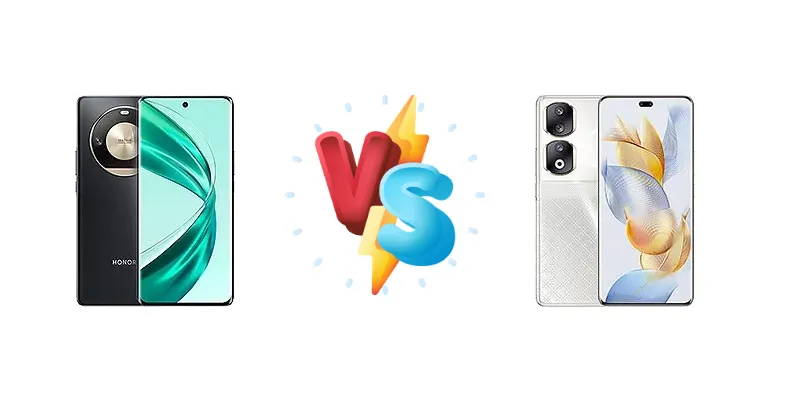
Honor has positioned both the X50 Pro and 90 Pro as compelling options in the upper-midrange smartphone market. Both leverage the proven Snapdragon 8+ Gen 1 chipset, but diverge significantly in charging speed and, consequently, user experience. This comparison dissects these differences to help you determine which device best suits your needs.
🏆 Quick Verdict
For most users, the Honor 90 Pro emerges as the superior choice. While both phones share the same powerful Snapdragon 8+ Gen 1 processor, the 90 Pro’s 90W charging dramatically reduces downtime, offering a significant convenience boost over the X50 Pro’s 35W charging. This makes the 90 Pro ideal for power users and those constantly on the go.
| Network |
|---|
| 2G bands | GSM 850 / 900 / 1800 / 1900 | GSM 850 / 900 / 1800 / 1900 |
| 3G bands | HSDPA 850 / 900 / 1700(AWS) / 1900 / 2100 | HSDPA 800 / 850 / 900 / 1700(AWS) / 1900 / 2100 |
| 4G bands | LTE | 1, 2, 3, 4, 5, 8, 19, 28, 34, 38, 39, 40, 41 |
| 5G bands | SA/NSA | 1, 5, 8, 28, 41, 77, 78 SA/NSA |
| Speed | HSPA, LTE, 5G | HSPA, LTE, 5G |
| Technology | GSM / CDMA / HSPA / CDMA2000 / LTE / 5G | GSM / CDMA / HSPA / CDMA2000 / LTE / 5G |
| Launch |
|---|
| Announced | 2023, December 29 | 2023, May 29 |
| Status | Cancelled | Available. Released 2023, June 07 |
| Body |
|---|
| Dimensions | 163.6 x 75.5 x 8 mm (6.44 x 2.97 x 0.31 in) | 163.8 x 74.9 x 8.1 mm (6.45 x 2.95 x 0.32 in) |
| SIM | Nano-SIM + Nano-SIM | Nano-SIM + Nano-SIM |
| Weight | 192 g (6.77 oz) | 192 g (6.77 oz) |
| Display |
|---|
| Resolution | 1220 x 2652 pixels, 19.5:9 ratio (~431 ppi density) | 1224 x 2700 pixels (~437 ppi density) |
| Size | 6.78 inches, 112.6 cm2 (~91.2% screen-to-body ratio) | 6.78 inches, 111.5 cm2 (~90.9% screen-to-body ratio) |
| Type | AMOLED, 1B colors, 120Hz | AMOLED, 1B colors, 120Hz, HDR, 1600 nits (peak) |
| Platform |
|---|
| CPU | Octa-core (1x3.0 GHz Cortex-X2 & 3x2.5 GHz Cortex-A710 & 4x1.80 GHz Cortex-A510) | Octa-core (1x3.0 GHz Cortex-X2 & 3x2.5 GHz Cortex-A710 & 4x1.80 GHz Cortex-A510) |
| Chipset | Qualcomm SM8475 Snapdragon 8+ Gen 1 (4 nm) | Qualcomm SM8475 Snapdragon 8+ Gen 1 (4 nm) |
| GPU | Adreno 730 | Adreno 730 |
| OS | Android 14 | Android 13, MagicOS 7.1 |
| Memory |
|---|
| Card slot | No | No |
| Internal | 256GB 12GB RAM | 256GB 12GB RAM, 256GB 16GB RAM, 512GB 16GB RAM |
| Main Camera |
|---|
| Dual | 108 MP, f/1.8, (wide), 1/1.67", PDAF
Auxiliary lens | - |
| Features | LED flash, panorama, HDR | LED flash, HDR, panorama |
| Triple | - | 200 MP, f/1.9, (wide), 1/1.4", 0.56µm, PDAF
32 MP, f/2.4, (telephoto), PDAF, OIS, 2.5x optical zoom
12 MP, f/2.2, 112˚ (ultrawide), AF |
| Video | 4K@30fps, 1080p@30fps | 4K@30fps, 1080p@30/60fps, gyro-EIS |
| Selfie camera |
|---|
| Dual | - | 50 MP, f/2.4, 100˚, (ultrawide)
2 MP, f/2.4, (depth) |
| Features | - | HDR |
| Single | 8 MP, f/2.0, (wide) | - |
| Video | 1080p@30fps | 4K@30fps, 1080p@30fps, gyro-EIS |
| Sound |
|---|
| 35mm jack | No | No |
| Loudspeaker | Yes | Yes, with stereo speakers |
| Comms |
|---|
| Bluetooth | 5.2, A2DP, LE | 5.2, A2DP, LE, aptX HD |
| NFC | Yes | Yes |
| Positioning | GPS, GLONASS, GALILEO, BDS | GPS, GALILEO, GLONASS, BDS, QZSS |
| Radio | No | No |
| USB | USB Type-C 2.0, OTG | USB Type-C 2.0, OTG |
| WLAN | Wi-Fi 802.11 a/b/g/n/ac/6, dual-band, Wi-Fi Direct | Wi-Fi 802.11 a/b/g/n/ac/6, dual-band, Wi-Fi Direct |
| Features |
|---|
| Sensors | Fingerprint (under display, optical), accelerometer, gyro, ultrasound proximity, compass | Fingerprint (under display, optical), accelerometer, gyro, compass, ultrasound proximity |
| Battery |
|---|
| Charging | 35W wired
7.5W reverse wired | 90W wired, 3-56% in 15 min
5W reverse wired |
| Type | Li-Po 5800 mAh | Li-Po 5000 mAh |
| Misc |
|---|
| Colors | Black, Green | Midnight Black, Emerald Green, Diamond Silver, Peacock Blue |
| Models | ALP-AN00 | REP-AN00 |
| Price | About 360 EUR | About 440 EUR |
Honor X50 Pro
- Potentially lower price point
- Solid Snapdragon 8+ Gen 1 performance
- Acceptable 35W charging
- Significantly slower charging than the 90 Pro
- May lack some of the premium features of the 90 Pro
Honor 90 Pro
- Blazing-fast 90W charging
- Snapdragon 8+ Gen 1 performance
- Likely more refined software experience
- Higher price tag
- May not offer a dramatically different camera experience
Display Comparison
Both the Honor X50 Pro and 90 Pro are expected to feature high-quality OLED displays, though specific details like peak brightness and color accuracy are not provided. The absence of LTPO technology in either model suggests a standard 120Hz refresh rate, which is still smooth for daily use. Bezels are likely similar, focusing on maximizing screen real estate. The display experience will likely be comparable, with the biggest differences stemming from software calibration.
Camera Comparison
Without detailed camera specifications, a direct comparison is limited. However, both phones likely employ a multi-camera system. The absence of information regarding sensor sizes and lens apertures makes it difficult to assess image quality differences. It’s reasonable to assume both phones will offer capable cameras for everyday photography, but the 90 Pro may benefit from more advanced image processing algorithms, a common trend in Honor’s Pro series. The inclusion of a 2MP macro camera on either device is likely a marketing feature with limited practical utility.
Performance
Both devices are powered by the Qualcomm SM8475 Snapdragon 8+ Gen 1 (4nm), featuring an octa-core CPU configuration identical in both phones: 1x3.0 GHz Cortex-X2, 3x2.5 GHz Cortex-A710, and 4x1.80 GHz Cortex-A510. This means raw processing power will be virtually indistinguishable between the two. The 4nm process node ensures good thermal efficiency, minimizing throttling during sustained workloads. However, the cooling solutions within each phone could vary, potentially leading to slight differences in sustained performance. RAM configurations are not specified, but both are likely to offer LPDDR5X options for faster memory access.
Battery Life
The core difference lies in charging speed. The Honor X50 Pro supports 35W wired charging and 7.5W reverse wired charging, while the Honor 90 Pro boasts a significantly faster 90W wired charging and 5W reverse wired charging. The 90 Pro claims a 3-56% charge in just 15 minutes, a substantial advantage. While battery capacity isn’t specified, the faster charging of the 90 Pro effectively mitigates any potential disadvantage from a slightly smaller battery. For users who prioritize minimizing downtime, the 90W charging is a clear win.
Buying Guide
Buy the Honor X50 Pro if you prioritize a potentially lower price point and are comfortable with slower charging speeds. It’s a solid performer for everyday tasks and moderate gaming. Buy the Honor 90 Pro if you value speed and convenience, particularly regarding charging. The 90W charging is a game-changer for users who frequently find themselves with low battery and need a quick top-up, and are willing to pay a premium for it.
Frequently Asked Questions
❓ Will the Snapdragon 8+ Gen 1 in the Honor 90 Pro throttle during extended gaming sessions?
The Snapdragon 8+ Gen 1 is a capable chipset, and the 4nm process helps with thermal efficiency. However, throttling can still occur during prolonged, graphically intensive gaming. The Honor 90 Pro’s cooling system will play a crucial role in mitigating this, but without specific details, it’s difficult to predict the extent of throttling. Expect some performance dip after extended play, but it shouldn’t be severe.
❓ Is the 5W reverse wired charging on the Honor 90 Pro useful for charging accessories like earbuds?
While 5W reverse wired charging is present, it’s primarily a convenience feature rather than a fast-charging solution. It’s suitable for slowly topping up small accessories like wireless earbuds or a smartwatch, but don’t expect to quickly charge a larger device like another smartphone. The X50 Pro's 7.5W is slightly better, but both are slow.
❓ Does the Honor 90 Pro support 120Hz refresh rate for smoother scrolling and animations?
While not explicitly stated, both phones are expected to feature a 120Hz refresh rate OLED display. The absence of LTPO technology suggests it's a fixed 120Hz, rather than an adaptive refresh rate that dynamically adjusts to conserve battery life. This still provides a smoother visual experience compared to a 60Hz display.