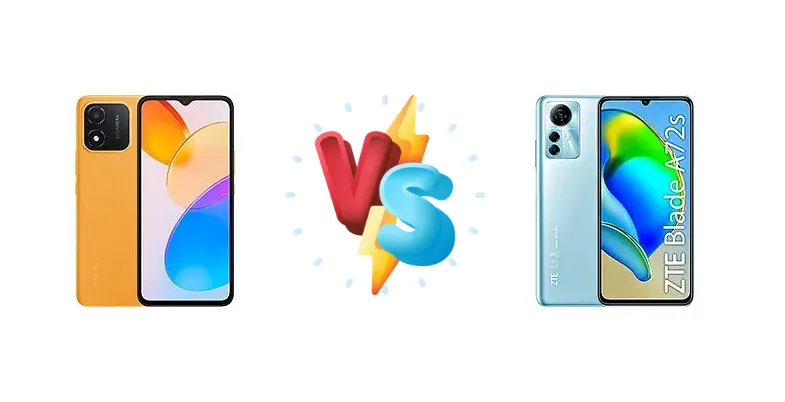
The Honor X5 and ZTE Blade A72s represent the fiercely competitive sub-$150 smartphone market. Both aim to deliver essential functionality at an accessible price, but they take different approaches to achieving this. The Honor X5 relies on MediaTek’s Helio G25, while the ZTE Blade A72s opts for the Unisoc T606. This comparison dives deep into the architectural differences and real-world implications of these chipsets, alongside other key features, to determine which device offers the best value.
🏆 Quick Verdict
For the average user prioritizing consistent performance and a slightly more modern CPU architecture, the ZTE Blade A72s is the better choice. Its Unisoc T606, featuring Cortex-A75 cores, provides a noticeable uplift in responsiveness compared to the Honor X5’s older Cortex-A53 based Helio G25. The 22.5W charging is also a significant advantage.
| Network |
|---|
| 2G bands | GSM 850 / 900 / 1800 / 1900 | GSM 850 / 900 / 1800 / 1900 |
| 3G bands | HSDPA 850 / 900 / 2100 | HSDPA 850 / 900 / 1900 / 2100 |
| 4G bands | LTE | LTE |
| Speed | HSPA, LTE | HSPA, LTE |
| Technology | GSM / HSPA / LTE | GSM / HSPA / LTE |
| Launch |
|---|
| Announced | 2023, January 24 | 2022, June 19 |
| Status | Available. Released 2023, February 14 | Available. Released 2023, July |
| Body |
|---|
| Build | Glass front, plastic back, plastic frame | - |
| Dimensions | 164 x 75.6 x 8.9 mm (6.46 x 2.98 x 0.35 in) | 168 x 77.5 x 8.6 mm (6.61 x 3.05 x 0.34 in) |
| SIM | Nano-SIM + Nano-SIM | Nano-SIM + Nano-SIM |
| Weight | 193 g (6.81 oz) | 198 g (6.98 oz) |
| Display |
|---|
| Resolution | 720 x 1600 pixels, 20:9 ratio (~270 ppi density) | 720 x 1600 pixels, 20:9 ratio (~260 ppi density) |
| Size | 6.5 inches, 102.0 cm2 (~82.3% screen-to-body ratio) | 6.75 inches, 110.0 cm2 (~84.5% screen-to-body ratio) |
| Type | TFT LCD | IPS LCD, 90Hz |
| Platform |
|---|
| CPU | Octa-core (4x2.0 GHz Cortex-A53 & 4x1.5 GHz Cortex-A53) | Octa-core (2x1.6 GHz Cortex-A75 & 6x1.6 GHz Cortex-A55) |
| Chipset | Mediatek MT6762 Helio G25 (12 nm) | Unisoc T606 (12 nm) |
| GPU | PowerVR GE8320 | Mali-G57 MP1 |
| OS | Android 12 (Go edition) | Android 12 |
| Memory |
|---|
| Card slot | microSDXC | microSDXC |
| Internal | 32GB 2GB RAM | 128GB 3GB RAM |
| Main Camera |
|---|
| Features | LED flash | LED flash |
| Single | 8 MP, f/2.0, (wide), AF | - |
| Triple | - | 50 MP, (wideo), AF
2 MP (macro)
Auxiliary lens |
| Video | 1080p@30fps | 1080p@30fps |
| Selfie camera |
|---|
| Single | 5 MP, f/2.2, (wide) | 5 MP |
| Video | 1080p@30fps | 720p@30fps |
| Sound |
|---|
| 3.5mm jack | Yes | - |
| 35mm jack | Yes | Yes |
| Loudspeaker | Yes | Yes |
| Comms |
|---|
| Bluetooth | 5.1, A2DP, LE | 5.0, A2DP, LE |
| NFC | No | No |
| Positioning | GPS, GLONASS, GALILEO, BDS | GPS, GLONASS |
| Radio | Unspecified | Unspecified |
| USB | microUSB 2.0, OTG | microUSB 2.0, OTG |
| WLAN | Wi-Fi 802.11 b/g/n, Wi-Fi Direct | Wi-Fi 802.11 b/g/n/ac |
| Features |
|---|
| Sensors | Accelerometer, proximity | Fingerprint (side-mounted), accelerometer, proximity |
| Battery |
|---|
| Charging | - | 22.5W wired |
| Type | Li-Po 5000 mAh | Li-Ion 5000 mAh |
| Misc |
|---|
| Colors | Sunrise Orange, Ocean Blue, Midnight Black | Space Gray, Sky Blue |
| Models | VNA-LX2, VNA-LX3 | A7050 |
| Price | About 90 EUR | About 120 EUR |
Honor X5
- Potentially lower price point
- Reliable brand reputation (Honor)
- Sufficient for basic tasks
- Older CPU architecture (Cortex-A53)
- Likely slower charging speeds
- Inferior performance for multitasking and gaming
ZTE Blade A72s
- More modern CPU architecture (Cortex-A75)
- Faster 22.5W charging
- Smoother overall performance
- Unisoc chipset may have less software optimization
- Potentially slightly higher price
Display Comparison
Neither Honor nor ZTE provide detailed display specifications beyond resolution. Given the price point, both likely utilize LCD panels. However, the absence of information regarding peak brightness, color gamut coverage, or PWM dimming rates suggests neither device will excel in outdoor visibility or color accuracy. Bezels are expected to be substantial on both, typical for this segment. Without further data, a clear winner cannot be determined.
Camera Comparison
Detailed camera specifications are unavailable for either device. However, given the price bracket, expectations should be tempered. Both likely feature a primary camera accompanied by auxiliary sensors of limited utility. Without knowing sensor sizes, apertures, or image processing capabilities, a direct comparison is impossible. It's reasonable to assume image quality will be similar, adequate for casual snapshots in good lighting conditions, but struggling in low light.
Performance
The core difference lies in the chipsets. The ZTE Blade A72s’ Unisoc T606 utilizes a big.LITTLE architecture with 2x 1.6 GHz Cortex-A75 cores and 6x 1.6 GHz Cortex-A55 cores. This configuration provides a significant advantage over the Honor X5’s MediaTek Helio G25, which employs 4x 2.0 GHz Cortex-A53 cores and 4x 1.5 GHz Cortex-A53 cores. The Cortex-A75 cores in the T606 are substantially more powerful than the A53 cores in the G25, resulting in faster app loading times and smoother multitasking. While both are built on a 12nm process, the architectural advantage favors the ZTE Blade A72s. The Honor X5's GPU is also likely less capable, impacting gaming performance.
Battery Life
Battery capacity is not specified for the Honor X5. The ZTE Blade A72s boasts 22.5W wired charging, a significant advantage over the likely slower charging speeds of the Honor X5. While a larger battery capacity doesn't always translate to longer real-world usage (due to chipset efficiency), the faster charging on the ZTE Blade A72s allows for quicker top-ups, reducing downtime. Without knowing the Honor X5’s battery size, it’s difficult to assess overall battery life, but the ZTE’s charging speed is a clear benefit.
Buying Guide
Buy the Honor X5 if you need a phone primarily for very basic tasks like calls, texts, and light social media browsing, and are extremely budget-constrained. Its Helio G25 is sufficient for these workloads. Buy the ZTE Blade A72s if you prefer a smoother, more responsive experience for everyday use, including multitasking and occasional gaming, and value faster charging capabilities. The Unisoc T606 offers a tangible performance improvement.
Frequently Asked Questions
❓ Will the ZTE Blade A72s handle popular games like PUBG Mobile or Call of Duty Mobile?
While the Unisoc T606 isn't a gaming powerhouse, it's capable of running PUBG Mobile and Call of Duty Mobile at medium settings with reasonable frame rates. Expect some occasional stuttering, especially in intense scenes. The Honor X5's Helio G25 will struggle more with these titles.
❓ Is the 22.5W charging on the ZTE Blade A72s truly fast for a budget phone?
Yes, 22.5W is relatively fast for a phone in this price range. While it won't charge as quickly as flagship devices with 65W or 120W charging, it will significantly reduce charging times compared to the Honor X5, likely taking around 1.5-2 hours for a full charge.
❓ How does the Unisoc T606 chipset compare to other chipsets commonly found in this price range?
The Unisoc T606 generally outperforms the MediaTek Helio A22 and Helio P22, which are often found in similarly priced phones. It's closer in performance to the Helio G35, but the A75 cores give it an edge in responsiveness and multitasking.