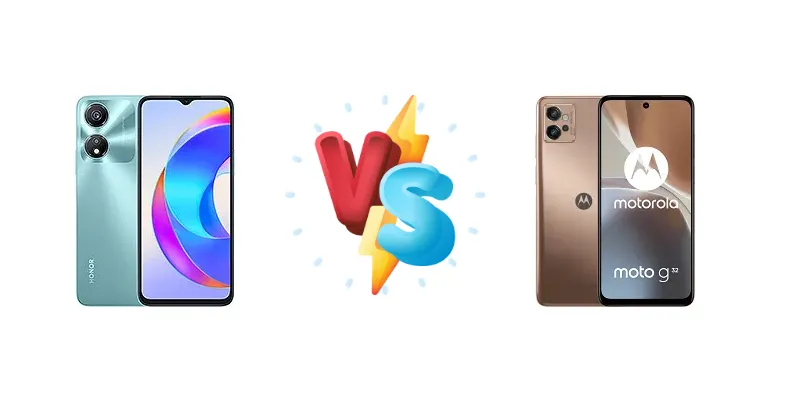
The Honor X5 Plus and Motorola Moto G32 represent two compelling options in the crowded budget smartphone market. While both aim to deliver essential smartphone functionality at an accessible price point, they diverge significantly in their core hardware, particularly the chipset and charging capabilities. This comparison dives deep into these differences to determine which device offers the best value for your money.
🏆 Quick Verdict
For most users, the Motorola Moto G32 emerges as the stronger choice. Its Snapdragon 680, built on a more efficient 6nm process, provides a noticeable performance advantage and better thermal management compared to the Honor X5 Plus’s Helio G36. The 30W charging is a game-changer in this segment, significantly reducing downtime.
| Network |
|---|
| 2G bands | GSM 850 / 900 / 1800 / 1900 | GSM 850 / 900 / 1800 / 1900 |
| 3G bands | HSDPA 850 / 900 / 1900 / 2100 | HSDPA 850 / 900 / 1900 / 2100 |
| 4G bands | LTE | 1, 3, 5, 7, 8, 20, 28, 38, 40, 41 |
| Speed | HSPA, LTE | HSPA, LTE |
| Technology | GSM / HSPA / LTE | GSM / HSPA / LTE |
| Launch |
|---|
| Announced | 2023, August 16 | 2022, July 28 |
| Status | Available. Released 2023, August | Available. Released 2022, August 16 |
| Body |
|---|
| Build | - | Glass front, plastic frame, plastic back |
| Dimensions | 163.3 x 75.1 x 8.4 mm (6.43 x 2.96 x 0.33 in) | 161.8 x 73.8 x 8.5 mm (6.37 x 2.91 x 0.33 in) |
| SIM | Nano-SIM + Nano-SIM | · Nano-SIM· Nano-SIM + Nano-SIM |
| Weight | 188 g (6.63 oz) | 184 g (6.49 oz) |
| | - | Water-repellent design |
| Display |
|---|
| Resolution | 720 x 1612 pixels, 20:9 ratio (~269 ppi density) | 1080 x 2400 pixels, 20:9 ratio (~405 ppi density) |
| Size | 6.56 inches, 103.4 cm2 (~84.3% screen-to-body ratio) | 6.5 inches, 102.0 cm2 (~85.4% screen-to-body ratio) |
| Type | TFT LCD, 90Hz | IPS LCD, 90Hz |
| Platform |
|---|
| CPU | Octa-core (4x2.2 GHz Cortex-A53 & 4x1.6 GHz Cortex-A53) | Octa-core (4x2.4 GHz Kryo 265 Gold & 4x1.9 GHz Kryo 265 Silver) |
| Chipset | Mediatek Helio G36 (12 nm) | Qualcomm SM6225 Snapdragon 680 4G (6 nm) |
| GPU | PowerVR GE8320 | Adreno 610 |
| OS | Android 13, MagicOS 7.1 | Android 12, upgradable to Android 13 |
| Memory |
|---|
| Card slot | microSDXC | microSDXC (dedicated slot) |
| Internal | 64GB 4GB RAM, 128GB 4GB RAM | 64GB 4GB RAM, 128GB 4GB RAM, 128GB 6GB RAM, 128GB 8GB RAM, 256GB 8GB RAM |
| Main Camera |
|---|
| Dual | 50 MP, f/1.8, (wide), PDAF
Auxiliary lens | - |
| Features | LED flash, HDR, panorama | LED flash, HDR, panorama |
| Triple | - | 50 MP, f/1.8 (wide), 1/2.76", 0.64µm, PDAF
8 MP, f/2.2, 118˚ (ultrawide), 1/4.0", 1.12µm
2 MP, f/2.4, (macro/depth) |
| Video | 1080p@30fps | 1080p@30fps |
| Selfie camera |
|---|
| Single | 5 MP, f/2.2, (wide) | 16 MP, f/2.4, (wide), 1.0µm |
| Video | 1080p@30fps | 1080p@30fps |
| Sound |
|---|
| 3.5mm jack | - | Yes |
| 35mm jack | Yes | Yes |
| Loudspeaker | Yes | Yes, with stereo speakers |
| Comms |
|---|
| Bluetooth | 5.1, A2DP, LE, aptX HD | 5.2, A2DP, LE |
| NFC | Yes (market/region dependent) | Yes (market/region dependent) |
| Positioning | GPS, GLONASS, GALILEO, BDS | GPS, GLONASS, GALILEO |
| Radio | Unspecified | FM radio |
| USB | USB Type-C 2.0, OTG | USB Type-C 2.0 |
| WLAN | Wi-Fi 802.11 a/b/g/n/ac, dual-band, Wi-Fi Direct | Wi-Fi 802.11 a/b/g/n/ac, dual-band, Wi-Fi Direct |
| Features |
|---|
| Sensors | Fingerprint (side-mounted), accelerometer, proximity | Fingerprint (side-mounted), accelerometer, gyro, proximity, compass |
| Battery |
|---|
| Charging | 10W wired | 30W wired |
| Type | Li-Po 5200 mAh | Li-Po 5000 mAh |
| Misc |
|---|
| Colors | Cyan Lake, Midnight Black | Mineral Grey, Satin Silver, Rose Gold |
| Models | WOD-LX1, WOD-LX2, WOD-LX3 | XT2235-2, XT2235-3 |
| Price | About 100 EUR | ₹ 8,990 |
Honor X5 Plus
- Potentially lower price point
- Acceptable for basic tasks
- Simple and straightforward user experience
- Less powerful chipset
- Slow 10W charging
- Likely inferior thermal management
Motorola Moto G32
- More efficient Snapdragon 680 chipset
- Significantly faster 30W charging
- Better multitasking and gaming performance
- Slightly higher price
- May not offer substantial camera improvements
- Still a budget device with inherent limitations
Display Comparison
Neither device boasts a standout display. Specifications are not provided, so we must rely on market positioning. Both likely feature 720p+ LCD panels. However, the Moto G32, being a slightly more premium offering, may have a marginally better panel with slightly improved color accuracy and viewing angles. Bezels are expected to be similar on both devices, reflecting their budget nature.
Camera Comparison
Without detailed camera specifications, a direct comparison is difficult. However, it’s safe to assume both phones feature a primary camera and potentially a depth or macro sensor. The Moto G32, given its slightly higher price point, may have a larger sensor or a wider aperture, resulting in better low-light performance. Image processing algorithms will also play a role, and Qualcomm’s ISP (Image Signal Processor) is generally considered more refined than MediaTek’s in this price bracket. The presence of Optical Image Stabilization (OIS) is unlikely on either device, but the Moto G32 has a higher probability.
Performance
The core difference lies in the chipsets. The Motorola Moto G32’s Qualcomm Snapdragon 680 (6nm) is a clear upgrade over the Honor X5 Plus’s MediaTek Helio G36 (12nm). The 6nm process node translates to significantly improved power efficiency, meaning the Moto G32 will run cooler and potentially sustain performance for longer periods. The Snapdragon 680’s CPU, with 4x2.4 GHz Kryo 265 Gold cores, also offers a performance edge over the Helio G36’s 4x2.2 GHz Cortex-A53 cores. While both are octa-core CPUs, the architectural differences and process node give the Snapdragon a distinct advantage in demanding tasks. The G36's Cortex-A53 cores are older and less efficient.
Battery Life
Battery capacity is not specified for either device. However, the Motorola Moto G32’s 30W wired charging is a massive advantage. The Honor X5 Plus is limited to 10W charging, meaning significantly longer charging times. Even with a similar battery capacity, the Moto G32 will offer a more convenient user experience, allowing for quick top-ups throughout the day. The faster charging also mitigates the impact of any potential battery degradation over time.
Buying Guide
Buy the Honor X5 Plus if your primary need is a phone for extremely basic tasks – calls, texts, and light social media – and you prioritize minimizing upfront cost above all else. Buy the Motorola Moto G32 if you value smoother multitasking, occasional gaming, and significantly faster charging, even if it means a slightly higher initial investment. The Moto G32 is the better all-rounder for the average user.
Frequently Asked Questions
❓ Will the Helio G36 in the Honor X5 Plus struggle with modern mobile games?
Yes, the Helio G36 is a basic chipset. While it can handle less demanding games, you'll likely experience significant frame drops and lag in more graphically intensive titles like PUBG or Call of Duty Mobile, even on low settings. The Snapdragon 680 in the Moto G32 offers a much smoother gaming experience.
❓ How long does it realistically take to charge the Honor X5 Plus from 0% to 100%?
With only 10W charging, expect a full charge to take well over 3 hours, potentially closer to 4 hours. This is a significant drawback compared to the Moto G32's 30W charging, which can achieve a full charge in around an hour or less.
❓ Is the Snapdragon 680 in the Moto G32 sufficient for everyday tasks like browsing and social media?
Absolutely. The Snapdragon 680 is more than capable of handling everyday tasks smoothly and efficiently. You'll experience quick app loading times and seamless multitasking, making it a pleasant daily driver.
❓ Does the Moto G32 support VoLTE and VoWiFi for improved call quality?
While not explicitly stated, Motorola generally includes VoLTE (Voice over LTE) and VoWiFi (Voice over Wi-Fi) support in their devices, including the Moto G32, to ensure optimal call quality and network connectivity. Check with your carrier for compatibility.