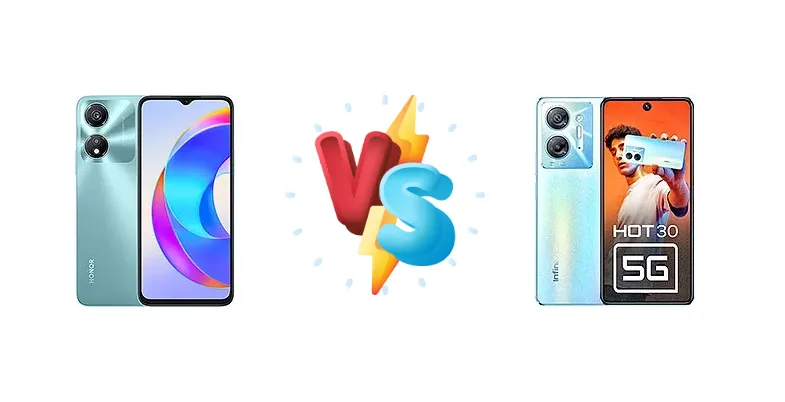
The sub-$200 smartphone market is fiercely competitive, and the Honor X5 Plus and Infinix Hot 30 5G represent compelling options for budget-conscious buyers. However, they take distinctly different approaches. The Honor X5 Plus focuses on a basic, reliable experience, while the Infinix Hot 30 5G aggressively targets users demanding 5G connectivity and improved performance. This comparison dissects the key differences to help you choose the right device.
🏆 Quick Verdict
For the average user prioritizing future-proofing and smoother performance, the Infinix Hot 30 5G is the clear winner. Its Dimensity 6020 chipset and 18W charging offer a substantial upgrade over the Honor X5 Plus’s Helio G36 and 10W charging, justifying the potentially slight price premium.
| Network |
|---|
| 2G bands | GSM 850 / 900 / 1800 / 1900 | GSM 850 / 900 / 1800 / 1900 |
| 3G bands | HSDPA 850 / 900 / 1900 / 2100 | HSDPA 850 / 900 / 1700(AWS) / 1900 / 2100 |
| 4G bands | LTE | LTE |
| 5G bands | - | 1, 3, 5, 8, 28, 38, 40, 41, 77, 78 SA/NSA |
| Speed | HSPA, LTE | HSPA, LTE, 5G |
| Technology | GSM / HSPA / LTE | GSM / HSPA / LTE / 5G |
| Launch |
|---|
| Announced | 2023, August 16 | 2023, July 14 |
| Status | Available. Released 2023, August | Available. Released 2023, July 18 |
| Body |
|---|
| Build | - | Glass front, plastic frame, plastic back |
| Dimensions | 163.3 x 75.1 x 8.4 mm (6.43 x 2.96 x 0.33 in) | 168.5 x 76.5 x 9.2 mm (6.63 x 3.01 x 0.36 in) |
| SIM | Nano-SIM + Nano-SIM | Nano-SIM + Nano-SIM |
| Weight | 188 g (6.63 oz) | 215 g (7.58 oz) |
| Display |
|---|
| Resolution | 720 x 1612 pixels, 20:9 ratio (~269 ppi density) | 1080 x 2460 pixels (~396 ppi density) |
| Size | 6.56 inches, 103.4 cm2 (~84.3% screen-to-body ratio) | 6.78 inches, 109.2 cm2 (~84.7% screen-to-body ratio) |
| Type | TFT LCD, 90Hz | IPS LCD, 120Hz, 580 nits (peak) |
| Platform |
|---|
| CPU | Octa-core (4x2.2 GHz Cortex-A53 & 4x1.6 GHz Cortex-A53) | Octa-core (2x2.2 GHz Cortex-A76 & 6x2.0 GHz Cortex-A55) |
| Chipset | Mediatek Helio G36 (12 nm) | Mediatek Dimensity 6020 (7 nm) |
| GPU | PowerVR GE8320 | Mali-G57 MC2 |
| OS | Android 13, MagicOS 7.1 | Android 13, XOS 13 |
| Memory |
|---|
| Card slot | microSDXC | microSDXC (dedicated slot) |
| Internal | 64GB 4GB RAM, 128GB 4GB RAM | 128GB 4GB RAM, 128GB 8GB RAM |
| Main Camera |
|---|
| Dual | 50 MP, f/1.8, (wide), PDAF
Auxiliary lens | - |
| Features | LED flash, HDR, panorama | Quad-LED flash, HDR, panorama |
| Single | - | 50 MP, f/1.6, (wide), 1/2.55", AF
Auxiliary lens |
| Video | 1080p@30fps | 1440p@30fps, 1080p@30fps |
| Selfie camera |
|---|
| Features | - | Dual-LED flash |
| Single | 5 MP, f/2.2, (wide) | 8 MP, f/2.0, (wide) |
| Video | 1080p@30fps | 1080p@30fps |
| Sound |
|---|
| 35mm jack | Yes | Yes |
| Loudspeaker | Yes | Yes, with stereo speakers |
| Comms |
|---|
| Bluetooth | 5.1, A2DP, LE, aptX HD | 5.1, A2DP, LE |
| NFC | Yes (market/region dependent) | No |
| Positioning | GPS, GLONASS, GALILEO, BDS | GPS, GLONASS, GALILEO, BDS |
| Radio | Unspecified | FM radio |
| USB | USB Type-C 2.0, OTG | USB Type-C 2.0 |
| WLAN | Wi-Fi 802.11 a/b/g/n/ac, dual-band, Wi-Fi Direct | Wi-Fi 802.11 a/b/g/n/ac, dual-band |
| Features |
|---|
| Sensors | Fingerprint (side-mounted), accelerometer, proximity | Fingerprint (side-mounted), accelerometer, proximity, compass |
| Battery |
|---|
| Charging | 10W wired | 18W wired |
| Type | Li-Po 5200 mAh | 5000 mAh |
| Misc |
|---|
| Colors | Cyan Lake, Midnight Black | Knight Black, Aurora Blue |
| Models | WOD-LX1, WOD-LX2, WOD-LX3 | X6832 |
| Price | About 100 EUR | About 140 EUR |
Honor X5 Plus
- Potentially longer battery life due to less powerful chipset
- Simple and reliable user experience
- Likely more affordable
- Significantly slower performance
- No 5G connectivity
- Slow 10W charging
Infinix Hot 30 5G
- Faster and more responsive performance with Dimensity 6020
- 5G connectivity for future-proofing
- Faster 18W charging
- Potentially shorter battery life
- May be slightly more expensive
- Aggressive image processing may not appeal to all users
Display Comparison
Neither device boasts a standout display. Both likely utilize LCD panels, a common cost-saving measure in this segment. However, details like peak brightness and color gamut coverage are unavailable. The focus here is on the internal hardware. The display quality will likely be adequate for everyday use, but not ideal for media consumption in bright sunlight.
Camera Comparison
Without detailed camera specs, a direct comparison is difficult. However, it’s safe to assume both phones feature basic camera setups geared towards social media sharing. The presence of a 2MP macro camera on either device is largely a marketing tactic, offering limited real-world benefit due to the small sensor size and lack of optical image stabilization (OIS). Image processing will likely be the differentiating factor, with Infinix often employing more aggressive sharpening and color boosting algorithms. The larger sensor (if present on the Infinix) will capture more light, resulting in better low-light performance.
Performance
The core difference lies in the chipsets. The Infinix Hot 30 5G’s Mediatek Dimensity 6020, fabricated on a more efficient 7nm process, significantly outperforms the Honor X5 Plus’s Mediatek Helio G36 (12nm). The Dimensity 6020’s CPU configuration – 2x2.2 GHz Cortex-A76 and 6x2.0 GHz Cortex-A55 – provides a substantial leap in single-core and multi-core performance compared to the Helio G36’s 4x2.2 GHz Cortex-A53 & 4x1.6 GHz Cortex-A53. This translates to faster app loading times, smoother multitasking, and a more enjoyable gaming experience. The 7nm process also contributes to better thermal management, reducing the likelihood of performance throttling under sustained load. While both phones likely feature similar RAM configurations, the superior chipset will be the bottleneck for the Honor X5 Plus.
Battery Life
Both phones likely feature batteries in the 5000mAh range, typical for this price point. However, the Infinix Hot 30 5G’s 18W wired charging is a significant advantage over the Honor X5 Plus’s 10W charging. This translates to a much faster 0-100% charge time, reducing downtime. While the Honor X5 Plus may offer slightly longer battery life due to the less power-hungry chipset, the convenience of faster charging on the Infinix is a compelling benefit for users who are constantly on the go.
Buying Guide
Buy the Honor X5 Plus if you need a simple, dependable smartphone for basic tasks like calls, messaging, and light social media use, and battery life is paramount. You’re willing to sacrifice performance and 5G connectivity for extended runtime. Buy the Infinix Hot 30 5G if you prioritize 5G connectivity, smoother multitasking, and a more responsive user experience, even if it means slightly faster battery drain and a potentially higher price point. This is the better choice for mobile gamers and those who stream content.
Frequently Asked Questions
❓ Will the Dimensity 6020 in the Infinix Hot 30 5G overheat during prolonged gaming sessions?
The Dimensity 6020’s 7nm process is more efficient than the Helio G36’s 12nm process, leading to better thermal management. While some heat is inevitable during gaming, the Infinix Hot 30 5G is less likely to experience significant performance throttling compared to the Honor X5 Plus.
❓ Is the 5G connectivity on the Infinix Hot 30 5G actually useful, or is it just a marketing gimmick?
5G connectivity provides significantly faster download and upload speeds compared to 4G, especially in areas with good 5G coverage. This benefits users who stream high-resolution video, download large files, or engage in online gaming. While 5G coverage is still expanding, the Infinix Hot 30 5G future-proofs your investment.
❓ How much faster is the charging on the Infinix Hot 30 5G compared to the Honor X5 Plus?
The Infinix Hot 30 5G’s 18W charging is nearly double the speed of the Honor X5 Plus’s 10W charging. This translates to a significantly reduced charging time, potentially shaving off an hour or more to reach a full charge.