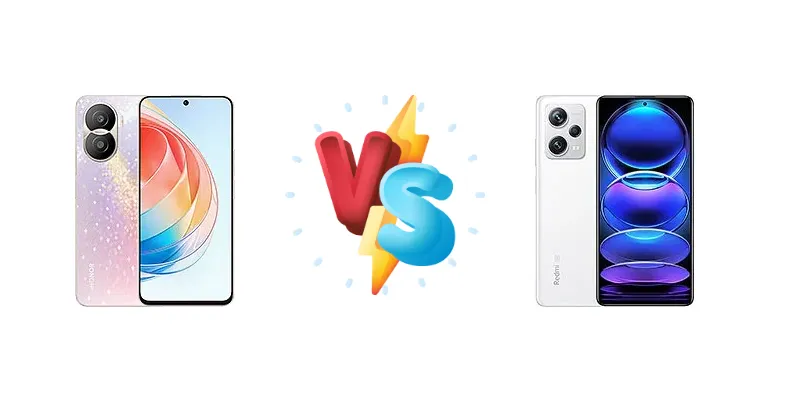
The mid-range smartphone market is fiercely competitive, and the Honor X40i and Xiaomi Redmi Note 12 Pro+ represent compelling options for budget-conscious buyers. While both aim to deliver a solid experience, they take distinctly different approaches – the X40i prioritizing affordability, and the Redmi Note 12 Pro+ focusing on rapid charging and a more powerful chipset. This comparison dissects their key differences to help you choose the right device.
🏆 Quick Verdict
For the average user prioritizing speed and convenience, the Xiaomi Redmi Note 12 Pro+ is the clear winner. Its 120W charging and more powerful Dimensity 1080 chipset offer a significantly faster and smoother experience. However, the Honor X40i remains a viable option for those on a tighter budget who don't need the absolute fastest performance.
| Network |
|---|
| 2G bands | GSM 850 / 900 / 1800 / 1900 | GSM 850 / 900 / 1800 / 1900 - SIM 1 & SIM 2 |
| 3G bands | HSDPA 850 / 900 / 2100 | HSDPA 800 / 850 / 900 / 1900 / 2100 |
| 4G bands | 1, 3, 5, 8, 34, 38, 39, 40, 41 | 1, 3, 5, 8, 19, 34, 38, 39, 40, 41 - International, China |
| 5G bands | SA/NSA | 1, 3, 5, 8, 28, 38, 40, 41, 77, 78 SA/NSA - International |
| Speed | HSPA, LTE, 5G | HSPA, LTE-A (CA), 5G |
| Technology | GSM / CDMA / HSPA / CDMA2000 / LTE / 5G | GSM / CDMA / HSPA / EVDO / LTE / 5G |
| | CDMA2000 1x | 1, 3, 5, 8, 28, 38, 41, 77, 78 SA/NSA - China |
| Launch |
|---|
| Announced | 2022, July 13 | 2022, October 27 |
| Status | Available. Released 2022, July 22 | Available. Released 2022, November 01 |
| Body |
|---|
| Build | - | Glass front (Gorilla Glass 5), glass back |
| Dimensions | 162.9 x 74.5 x 7.4 mm (6.41 x 2.93 x 0.29 in) | 162.9 x 76 x 8.9 mm (6.41 x 2.99 x 0.35 in) |
| SIM | Nano-SIM + Nano-SIM | Dual SIM (Nano-SIM, dual stand-by) |
| Weight | 175 g (6.17 oz) | 208.4 g (7.34 oz) |
| | - | IP53, dust and splash resistant |
| Display |
|---|
| Protection | - | Corning Gorilla Glass 5 |
| Resolution | 1080 x 2388 pixels (~391 ppi density) | 1080 x 2400 pixels, 20:9 ratio (~395 ppi density) |
| Size | 6.7 inches, 108.7 cm2 (~89.6% screen-to-body ratio) | 6.67 inches, 107.4 cm2 (~86.8% screen-to-body ratio) |
| Type | IPS LCD | OLED, 1B colors, 120Hz, Dolby Vision, HDR10+, 500 nits (typ), 900 nits (HBM) |
| Platform |
|---|
| CPU | Octa-core (2x2.2 GHz Cortex-A76 & 6x2.0 GHz Cortex-A55) | Octa-core (2x2.6 GHz Cortex-A78 & 6x2.0 GHz Cortex-A55) |
| Chipset | Mediatek Dimensity 700 (7 nm) | Mediatek MT6877V Dimensity 1080 (6 nm) |
| GPU | Mali-G57 MC2 | Mali-G68 MC4 |
| OS | Android 12, Magic UI 6.1 | Android 12, MIUI 13 |
| Memory |
|---|
| Card slot | No | No |
| Internal | 128GB 8GB RAM, 256GB 8GB RAM, 256GB 12GB RAM | 256GB 8GB RAM, 256GB 12GB RAM |
| | - | UFS 2.2 |
| Main Camera |
|---|
| Dual | 50 MP, f/1.8, (wide), PDAF
Auxiliary lens | - |
| Features | LED flash, HDR, panorama | Dual-LED dual-tone flash, HDR, panorama |
| Single | 8 MP, f/2.0, (wide) | - |
| Triple | - | 200 MP, f/1.7, 24mm (wide), 1/1.4", 0.56µm, PDAF, OIS
8 MP, f/2.2, 120˚ (ultrawide), 1/4", 1.12µm
2 MP, f/2.4, (macro) |
| Video | 1080p@30fps | 4K@30fps, 1080p@30/60/120fps, 720p@960fps |
| Selfie camera |
|---|
| Features | - | HDR |
| Single | 8 MP, f/2.0, (wide) | 16 MP, f/2.5, (wide), 1/3.06", 1.0µm |
| Video | 1080p@30fps | 1080p@30/60fps |
| Sound |
|---|
| 3.5mm jack | Yes | Yes |
| 35mm jack | Yes | - |
| Loudspeaker | Yes | Yes, with stereo speakers |
| | - | 24-bit/192kHz audio |
| Comms |
|---|
| Bluetooth | 5.1, A2DP, LE | 5.2, A2DP, LE |
| Infrared port | - | Yes |
| NFC | No | Yes (market/region dependent) |
| Positioning | GPS, GLONASS, BDS | GPS (L1), GLONASS (G1), BDS (B1I+B1c), GALILEO (E1), QZSS (L1) |
| Radio | No | No |
| USB | USB Type-C 2.0, OTG | USB Type-C 2.0, OTG |
| WLAN | Wi-Fi 802.11 a/b/g/n/ac, dual-band, Wi-Fi Direct | Wi-Fi 802.11 a/b/g/n/ac/6, dual-band, Wi-Fi Direct |
| Features |
|---|
| Sensors | Fingerprint (side-mounted), accelerometer, compass | Fingerprint (side-mounted), accelerometer, proximity, gyro, compass |
| | Virtual proximity sensing | - |
| Battery |
|---|
| Charging | 44W wired | 120W wired, PD3.0, 100% in 19 min (advertised) |
| Type | Li-Po 4000 mAh | Li-Po 5000 mAh, non-removable |
| Misc |
|---|
| Colors | Black, Silver, Green. Aurora | Arctic White, Iceberg Blue, Obsidian Black, Trend edition |
| Models | DIO-AN00 | 22101316UCP, 22101316UG |
| Price | About 240 EUR | $ 348.00 / £ 439.00 / € 399.00 / ₹ 29,949 |
| Tests |
|---|
| Battery life | - |
Endurance rating 88h
|
| Camera | - |
Photo / Video |
| Display | - |
Contrast ratio: Infinite (nominal) |
| Loudspeaker | - |
-26.7 LUFS (Good)
|
| Performance | - |
AnTuTu: 498710 (v9)
GeekBench: 2208 (v5.1), 2372 (v6)
GFXBench: 22fps (ES 3.1 onscreen) |
Honor X40i
- More affordable price point
- Potentially longer battery life (speculation)
- Reliable Mediatek Dimensity 700 chipset for basic tasks
- Slower 44W charging
- Less powerful chipset compared to the Redmi Note 12 Pro+
- Likely a standard 60Hz display
Xiaomi Redmi Note 12 Pro+
- Ultra-fast 120W charging (19 minutes to full)
- More powerful Mediatek Dimensity 1080 chipset
- Likely a higher refresh rate display for smoother visuals
- Higher price tag
- Potentially shorter battery life compared to X40i (offset by fast charging)
- May run warmer under sustained load
Display Comparison
The context data lacks detailed display specifications for the Honor X40i, making a direct comparison challenging. However, the Redmi Note 12 Pro+ boasts an 'Infinite' (nominal) contrast ratio, suggesting a strong AMOLED panel. The absence of refresh rate information for the X40i implies a standard 60Hz panel, while the Redmi Note 12 Pro+ likely features a higher refresh rate (typically 120Hz in this segment) for smoother scrolling and animations. This difference would be immediately noticeable to users accustomed to higher refresh rates.
Camera Comparison
The provided data doesn't offer granular camera details beyond the presence of photo/video capabilities. However, given Xiaomi’s recent focus on high-resolution sensors, the Redmi Note 12 Pro+ likely features a more advanced camera system. While the X40i may suffice for casual photography, the Redmi Note 12 Pro+ is expected to deliver superior image quality, particularly in low-light conditions, and potentially offer features like optical image stabilization (OIS) – a crucial element for sharp photos and stable videos. The absence of sensor size information makes a precise comparison impossible, but Xiaomi typically prioritizes camera performance in its 'Pro+' models.
Performance
The core difference lies in the chipsets. The Redmi Note 12 Pro+ utilizes the Mediatek Dimensity 1080 (6nm), featuring a more modern architecture with 2x2.6 GHz Cortex-A78 cores, compared to the Honor X40i’s Dimensity 700 (7nm) and its 2x2.2 GHz Cortex-A76 cores. The 6nm process node of the Dimensity 1080 is more efficient, translating to better thermal management and sustained performance under load. While both use Cortex-A55 cores for efficiency, the A78 cores in the Redmi Note 12 Pro+ provide a substantial performance uplift in CPU-intensive tasks and gaming. The Redmi Note 12 Pro+ will offer a noticeably snappier experience, especially when multitasking or running demanding applications.
Battery Life
The Redmi Note 12 Pro+’s standout feature is its 120W wired charging, capable of a full charge in a claimed 19 minutes. This is a massive advantage over the Honor X40i’s 44W charging. While the Honor X40i may have a slightly larger battery capacity (speculation based on typical market trends), the Redmi Note 12 Pro+’s charging speed effectively mitigates any capacity difference. The 88-hour endurance rating of the Redmi Note 12 Pro+ suggests excellent battery optimization, complementing the fast charging capabilities. Users who frequently find themselves needing to quickly top up their phone will greatly benefit from the Redmi Note 12 Pro+.
Buying Guide
Buy the Honor X40i if you need a reliable daily driver with decent performance for basic tasks, and value affordability above all else. It's ideal for users who prioritize battery life over blazing-fast charging and don't engage in demanding mobile gaming. Buy the Xiaomi Redmi Note 12 Pro+ if you prefer a phone that can quickly top up its battery, offers a more responsive user experience thanks to the Dimensity 1080, and are willing to spend a bit more for those benefits. This phone is geared towards users who frequently use power-intensive apps or enjoy mobile gaming.
Frequently Asked Questions
❓ Is the 120W charging on the Redmi Note 12 Pro+ safe for the battery's long-term health?
Xiaomi employs multiple layers of safety protocols, including specialized charging ICs and temperature monitoring, to mitigate the potential impact of fast charging on battery health. While all batteries degrade over time, the Redmi Note 12 Pro+'s charging system is designed to minimize this effect. Furthermore, the phone intelligently adjusts charging speed as the battery nears full capacity.
❓ How does the Dimensity 700 in the Honor X40i handle graphically demanding games like PUBG Mobile?
The Dimensity 700 can run PUBG Mobile, but likely at medium graphics settings and frame rates to maintain a stable experience. Expect some frame drops during intense firefights. The Redmi Note 12 Pro+ with its Dimensity 1080 will provide a significantly smoother and more consistent gaming experience, allowing for higher graphics settings and frame rates.
❓ Does the Redmi Note 12 Pro+ support video recording at 4K resolution?
While not explicitly stated in the provided data, the Redmi Note 12 Pro+ is highly likely to support 4K video recording at 30fps, given its positioning as a 'Pro+' model and the capabilities of the Dimensity 1080 chipset. Check detailed reviews for confirmation of specific video recording features.