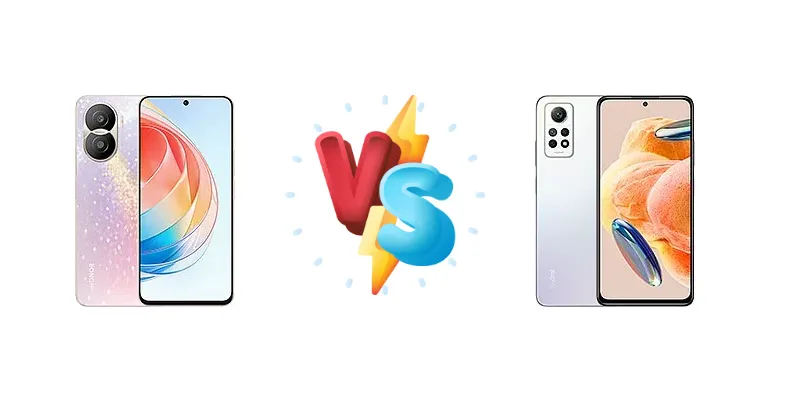
The Honor X40i and Xiaomi Redmi Note 12 Pro 4G represent compelling options in the increasingly competitive mid-range 4G smartphone market. Both aim to deliver a balanced experience, but diverge in their core hardware choices, particularly in their chipsets and charging capabilities. This comparison dissects these differences to determine which device offers the best value for your money.
🏆 Quick Verdict
For the average user prioritizing fast charging and potentially slightly smoother performance in sustained tasks, the Xiaomi Redmi Note 12 Pro 4G is the better choice. Its 67W charging significantly reduces downtime, and the Snapdragon 732G, built on an 8nm process, offers a slight edge in efficiency. However, the Honor X40i remains a viable option for those seeking a more affordable device.
| Network |
|---|
| 2G bands | GSM 850 / 900 / 1800 / 1900 | GSM 850 / 900 / 1800 / 1900 |
| 3G bands | HSDPA 850 / 900 / 2100 | HSDPA 850 / 900 / 1700(AWS) / 1900 / 2100 |
| 4G bands | 1, 3, 5, 8, 34, 38, 39, 40, 41 | 1, 2, 3, 4, 5, 7, 8, 20, 28, 38, 40, 41, 66 |
| 5G bands | SA/NSA | - |
| Speed | HSPA, LTE, 5G | HSPA, LTE |
| Technology | GSM / CDMA / HSPA / CDMA2000 / LTE / 5G | GSM / HSPA / LTE |
| | CDMA2000 1x | - |
| Launch |
|---|
| Announced | 2022, July 13 | 2023, March 03 |
| Status | Available. Released 2022, July 22 | Available. Released 2023, April 11 |
| Body |
|---|
| Dimensions | 162.9 x 74.5 x 7.4 mm (6.41 x 2.93 x 0.29 in) | 164.2 x 76.1 x 8.1 mm (6.46 x 3.00 x 0.32 in) |
| SIM | Nano-SIM + Nano-SIM | Nano-SIM + Nano-SIM |
| Weight | 175 g (6.17 oz) | 201.8 g (7.13 oz) |
| Display |
|---|
| Resolution | 1080 x 2388 pixels (~391 ppi density) | 1080 x 2400 pixels, 20:9 ratio (~395 ppi density) |
| Size | 6.7 inches, 108.7 cm2 (~89.6% screen-to-body ratio) | 6.67 inches, 107.4 cm2 (~86.0% screen-to-body ratio) |
| Type | IPS LCD | AMOLED, 120Hz, Dolby Vision, 700 nits (HBM), 1100 nits (peak) |
| Platform |
|---|
| CPU | Octa-core (2x2.2 GHz Cortex-A76 & 6x2.0 GHz Cortex-A55) | Octa-core (2x2.2 GHz Kryo 470 Gold & 6x1.8 GHz Kryo 470 Silver) |
| Chipset | Mediatek Dimensity 700 (7 nm) | Qualcomm SM7150 Snapdragon 732G (8 nm) |
| GPU | Mali-G57 MC2 | Adreno 618 |
| OS | Android 12, Magic UI 6.1 | Android 11, MIUI 13 |
| Memory |
|---|
| Card slot | No | microSDXC (uses shared SIM slot) |
| Internal | 128GB 8GB RAM, 256GB 8GB RAM, 256GB 12GB RAM | 128GB 6GB RAM, 128GB 8GB RAM, 256GB 8GB RAM |
| | - | UFS 2.2 |
| Main Camera |
|---|
| Dual | 50 MP, f/1.8, (wide), PDAF
Auxiliary lens | - |
| Features | LED flash, HDR, panorama | LED flash, HDR, panorama |
| Quad | - | 108 MP, f/1.9, (wide), 1/1.52", 0.7µm, PDAF
8 MP, 120˚, (ultrawide)
2 MP (macro)
Auxiliary lens |
| Single | 8 MP, f/2.0, (wide) | - |
| Video | 1080p@30fps | 4K@30fps, 1080p@30/60fps |
| Selfie camera |
|---|
| Single | 8 MP, f/2.0, (wide) | 16 MP, f/2.4, (wide) |
| Video | 1080p@30fps | 1080p@30fps |
| Sound |
|---|
| 3.5mm jack | Yes | Yes |
| 35mm jack | Yes | Yes |
| Loudspeaker | Yes | Yes, with stereo speakers |
| Comms |
|---|
| Bluetooth | 5.1, A2DP, LE | 5.0, A2DP, LE |
| Infrared port | - | Yes |
| NFC | No | Yes (market/region dependent) |
| Positioning | GPS, GLONASS, BDS | GPS, GLONASS, GALILEO, BDS |
| Radio | No | Unspecified |
| USB | USB Type-C 2.0, OTG | USB Type-C 2.0, OTG |
| WLAN | Wi-Fi 802.11 a/b/g/n/ac, dual-band, Wi-Fi Direct | Wi-Fi 802.11 a/b/g/n/ac, dual-band |
| Features |
|---|
| Sensors | Fingerprint (side-mounted), accelerometer, compass | Fingerprint (side-mounted), accelerometer, gyro, compass |
| | Virtual proximity sensing | - |
| Battery |
|---|
| Charging | 44W wired | 67W wired |
| Type | Li-Po 4000 mAh | Li-Po 5000 mAh |
| Misc |
|---|
| Colors | Black, Silver, Green. Aurora | Star Blue, Graphite Gray, Polar White, Ice blue |
| Models | DIO-AN00 | 2209116AG, 2209116AG |
| Price | About 240 EUR | About 150 EUR |
Honor X40i
- More affordable price point
- Clean and streamlined user interface (likely)
- Decent performance for everyday tasks
- Slower charging speed (44W)
- Chipset built on a less efficient process (7nm)
- Potentially less refined camera performance
Xiaomi Redmi Note 12 Pro 4G
- Faster 67W wired charging
- Chipset built on a more efficient process (8nm)
- Potentially better sustained performance
- Generally slightly higher price
- MIUI software can be feature-rich but also bloated
- May not offer significant camera improvements over the Honor
Display Comparison
Neither device boasts a standout display. Both are likely to feature LCD panels, common in this price bracket. While specific details like peak brightness and color gamut coverage are unavailable, the focus here is on the core processing power. Bezels are expected to be similar, and color accuracy will likely be adequate for everyday use, but not professional color work.
Camera Comparison
Without detailed camera specs, a direct comparison is difficult. However, given the market segment, both phones likely feature a primary camera around the 50MP mark. The Redmi Note 12 Pro 4G, historically, tends to prioritize camera features in its 'Pro' models, potentially offering slightly better image processing algorithms and potentially a larger sensor size. The inclusion of Optical Image Stabilization (OIS) on the Redmi Note 12 Pro 4G would be a significant advantage, improving low-light performance and video stabilization. The 2MP macro cameras found on many phones in this class are largely marketing features and offer limited practical benefit.
Performance
The core difference lies in the chipsets: the Honor X40i utilizes the Mediatek Dimensity 700 (7nm) while the Redmi Note 12 Pro 4G features the Qualcomm Snapdragon 732G (8nm). The Snapdragon 732G’s 8nm process generally translates to better thermal efficiency compared to the Dimensity 700’s 7nm node, meaning less throttling during prolonged gaming or demanding tasks. Both CPUs feature a similar core configuration – 2x high-performance cores and 6x efficiency cores – but the Snapdragon’s Kryo 470 Gold cores are clocked slightly lower (2.2 GHz vs 2.2 GHz) while the efficiency cores are clocked lower (1.8 GHz vs 2.0 GHz). This suggests a focus on sustained performance over burst speeds on the Snapdragon side. The impact will be most noticeable in graphically intensive games and multitasking.
Battery Life
The Redmi Note 12 Pro 4G’s 67W wired charging is a clear advantage over the Honor X40i’s 44W charging. This translates to significantly faster top-up times – potentially going from 0-100% in under an hour compared to potentially over 90 minutes on the Honor. While battery capacity isn’t specified, the faster charging speed effectively mitigates any potential disadvantage from a slightly smaller battery size. Users who frequently find themselves needing to quickly recharge will greatly benefit from the Redmi Note 12 Pro 4G’s charging capabilities.
Buying Guide
Buy the Honor X40i if you need a highly affordable 4G smartphone and prioritize a clean user experience with Honor's software. Buy the Xiaomi Redmi Note 12 Pro 4G if you prefer faster charging speeds, a potentially more refined software experience with MIUI, and a chipset built on a more efficient manufacturing process, potentially leading to better sustained performance.
Frequently Asked Questions
❓ Will the Snapdragon 732G in the Redmi Note 12 Pro 4G handle demanding games like PUBG Mobile smoothly?
The Snapdragon 732G is capable of running PUBG Mobile at medium to high settings with stable frame rates. Its 8nm process and optimized CPU/GPU architecture contribute to better thermal management, reducing the likelihood of significant frame drops during extended gaming sessions compared to the Dimensity 700.
❓ How much faster is the 67W charging on the Redmi Note 12 Pro 4G compared to the 44W charging on the Honor X40i?
The 67W charging on the Redmi Note 12 Pro 4G can realistically reduce charging times by 30-40% compared to the 44W charging on the Honor X40i. Expect a full charge in under an hour with the Redmi, while the Honor may take over 90 minutes.
❓ Is the difference in chipset performance between the Dimensity 700 and Snapdragon 732G noticeable in everyday tasks like browsing and social media?
For basic tasks like browsing, social media, and messaging, the difference in performance between the two chipsets will be minimal and likely unnoticeable to the average user. The more significant difference will be apparent during more demanding tasks like gaming or video editing.