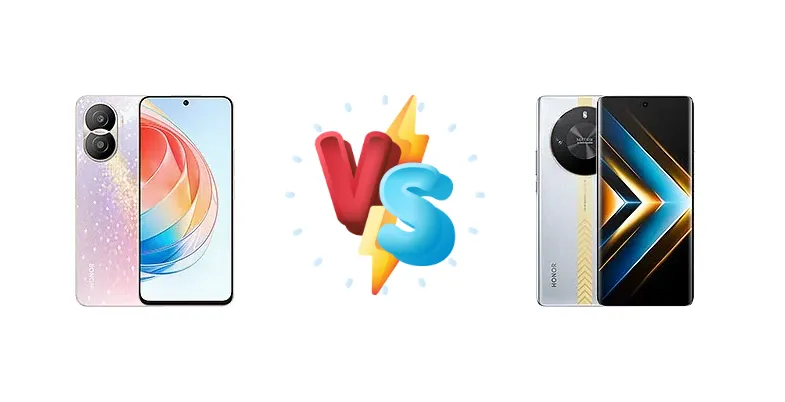
Honor's X series consistently delivers compelling value, but the X50 GT and X40i represent distinct approaches. The X40i focuses on a balanced experience, while the X50 GT aggressively targets performance with a flagship-tier chipset. This comparison dissects the key differences to determine which phone best suits your needs.
🏆 Quick Verdict
For users prioritizing raw performance and gaming capabilities, the Honor X50 GT is the clear winner. Its Snapdragon 8+ Gen 1 offers a substantial leap over the X40i’s Dimensity 700. However, the X40i remains a viable option for everyday tasks and media consumption, offering a more efficient processor.
| Network |
|---|
| 2G bands | GSM 850 / 900 / 1800 / 1900 | GSM 850 / 900 / 1800 / 1900 |
| 3G bands | HSDPA 850 / 900 / 2100 | HSDPA 850 / 900 / 1700(AWS) / 1900 / 2100 |
| 4G bands | 1, 3, 5, 8, 34, 38, 39, 40, 41 | LTE |
| 5G bands | SA/NSA | SA/NSA |
| Speed | HSPA, LTE, 5G | HSPA, LTE, 5G |
| Technology | GSM / CDMA / HSPA / CDMA2000 / LTE / 5G | GSM / CDMA / HSPA / CDMA2000 / LTE / 5G |
| | CDMA2000 1x | - |
| Launch |
|---|
| Announced | 2022, July 13 | 2024, January 04 |
| Status | Available. Released 2022, July 22 | Available. Released 2024, January 09 |
| Body |
|---|
| Dimensions | 162.9 x 74.5 x 7.4 mm (6.41 x 2.93 x 0.29 in) | 163.6 x 75.5 x 8 mm (6.44 x 2.97 x 0.31 in) |
| SIM | Nano-SIM + Nano-SIM | Nano-SIM + Nano-SIM |
| Weight | 175 g (6.17 oz) | 192 g (6.77 oz) |
| Display |
|---|
| Resolution | 1080 x 2388 pixels (~391 ppi density) | 1220 x 2652 pixels, 19.5:9 ratio (~431 ppi density) |
| Size | 6.7 inches, 108.7 cm2 (~89.6% screen-to-body ratio) | 6.78 inches, 112.6 cm2 (~91.2% screen-to-body ratio) |
| Type | IPS LCD | AMOLED, 1B colors, 120Hz |
| Platform |
|---|
| CPU | Octa-core (2x2.2 GHz Cortex-A76 & 6x2.0 GHz Cortex-A55) | Octa-core (1x3.0 GHz Cortex-X2 & 3x2.5 GHz Cortex-A710 & 4x1.80 GHz Cortex-A510) |
| Chipset | Mediatek Dimensity 700 (7 nm) | Qualcomm SM8475 Snapdragon 8+ Gen 1 (4 nm) |
| GPU | Mali-G57 MC2 | Adreno 730 |
| OS | Android 12, Magic UI 6.1 | Android 13, MagicOS 7.2 |
| Memory |
|---|
| Card slot | No | No |
| Internal | 128GB 8GB RAM, 256GB 8GB RAM, 256GB 12GB RAM | 256GB 12GB RAM, 256GB 16GB RAM, 512GB 16GB RAM, 1TB 16GB RAM |
| Main Camera |
|---|
| Dual | 50 MP, f/1.8, (wide), PDAF
Auxiliary lens | 108 MP, f/1.8, (wide), 1/1.67", PDAF
Auxiliary lens |
| Features | LED flash, HDR, panorama | LED flash, panorama, HDR |
| Single | 8 MP, f/2.0, (wide) | - |
| Video | 1080p@30fps | 4K@30fps, 1080p@30fps |
| Selfie camera |
|---|
| Single | 8 MP, f/2.0, (wide) | 8 MP, f/2.0, (wide) |
| Video | 1080p@30fps | 1080p@30fps |
| Sound |
|---|
| 3.5mm jack | Yes | - |
| 35mm jack | Yes | No |
| Loudspeaker | Yes | Yes |
| Comms |
|---|
| Bluetooth | 5.1, A2DP, LE | 5.2, A2DP, LE, aptX HD |
| NFC | No | Yes |
| Positioning | GPS, GLONASS, BDS | GPS, GLONASS, GALILEO, BDS |
| Radio | No | No |
| USB | USB Type-C 2.0, OTG | USB Type-C 2.0, OTG |
| WLAN | Wi-Fi 802.11 a/b/g/n/ac, dual-band, Wi-Fi Direct | Wi-Fi 802.11 a/b/g/n/ac/6, dual-band, Wi-Fi Direct |
| Features |
|---|
| Sensors | Fingerprint (side-mounted), accelerometer, compass | Fingerprint (under display, optical), accelerometer, gyro, ultrasound proximity, compass |
| | Virtual proximity sensing | - |
| Battery |
|---|
| Charging | 44W wired | 35W wired
7.5W reverse wired |
| Type | Li-Po 4000 mAh | Li-Po 5800 mAh |
| Misc |
|---|
| Colors | Black, Silver, Green. Aurora | Black, Silver |
| Models | DIO-AN00 | ALP-AN00 |
| Price | About 240 EUR | About 260 EUR |
Honor X40i
- Faster 44W wired charging
- More power-efficient Dimensity 700 chipset
- Potentially lower price point
- Significantly weaker CPU and GPU performance
- Likely less capable camera system
- Less future-proof
Honor X50 GT
- Flagship-level Snapdragon 8+ Gen 1 performance
- Superior gaming capabilities
- 7.5W reverse wired charging
- Slower 35W wired charging
- Less battery efficient
- Potentially higher price
Display Comparison
While display specifications are not provided, the X40i likely features an LCD panel typical of its price bracket. The X50 GT, positioned as a more premium device, may incorporate an AMOLED panel for richer colors and deeper blacks. The absence of LTPO technology in either device suggests standard refresh rates, likely 60Hz or 90Hz. Bezels are expected to be moderate on both, reflecting their mid-range positioning. Color accuracy will likely be adequate for general use on both, but the X50 GT’s potential AMOLED panel will offer a superior viewing experience.
Camera Comparison
Without detailed camera specs, it’s difficult to make precise comparisons. However, the X50 GT’s positioning suggests a more capable camera system. The Snapdragon 8+ Gen 1’s ISP (Image Signal Processor) is more advanced, enabling better image processing and low-light performance. We can assume the X50 GT will have a larger main sensor and potentially optical image stabilization (OIS), features less common in the X40i’s segment. The presence of a 2MP macro camera on either device is unlikely to significantly impact image quality; these sensors are often included for marketing purposes rather than practical benefit.
Performance
The core difference lies in the chipsets. The Honor X50 GT’s Qualcomm Snapdragon 8+ Gen 1 (4nm) is a significant upgrade over the X40i’s MediaTek Dimensity 700 (7nm). The Snapdragon 8+ Gen 1’s Cortex-X2 prime core clocked at 3.0 GHz, coupled with Cortex-A710 performance cores, delivers substantially higher CPU and GPU performance. The 4nm process node also contributes to improved thermal efficiency, reducing throttling during sustained workloads. The Dimensity 700, while capable for everyday tasks, will struggle with graphically intensive games and demanding applications. The X50 GT will benefit gamers and power users, while the X40i is suited for less demanding tasks.
Battery Life
The Honor X50 GT features 35W wired charging, while the X40i supports 44W wired charging. While the X40i has faster charging on paper, the Snapdragon 8+ Gen 1 in the X50 GT is more power-hungry. The X40i’s Dimensity 700 is more efficient, potentially leading to longer battery life during typical usage. The X50 GT also includes 7.5W reverse wired charging, a feature absent on the X40i, allowing it to charge other devices wirelessly. The actual 0-100% charge times will depend on battery capacity, which is not provided, but the X40i will likely achieve a full charge faster.
Buying Guide
Buy the Honor X40i if you need a reliable daily driver for basic tasks, social media, and light gaming, prioritizing battery efficiency and a lower price point. Buy the Honor X50 GT if you prefer a significantly faster processor for demanding games, multitasking, and future-proofing, and are willing to accept slightly reduced battery life in exchange for that performance.
Frequently Asked Questions
❓ Will the Snapdragon 8+ Gen 1 in the X50 GT get noticeably hot during extended gaming sessions?
While the Snapdragon 8+ Gen 1 is efficient for its performance class, it can generate heat under sustained load. However, the 4nm process node and Honor's thermal management system should mitigate throttling, providing consistent performance for longer gaming sessions compared to older generation chips.
❓ Is the difference in charging speed between 35W and 44W significant in real-world use?
The difference is noticeable, but not dramatic. The X40i’s 44W charging will likely shave off 15-20 minutes from a full 0-100% charge compared to the X50 GT’s 35W. However, the X50 GT’s larger battery (if present) could partially offset this difference.
❓ Can the Honor X50 GT handle demanding games like Genshin Impact at high settings?
Yes, the Snapdragon 8+ Gen 1 is more than capable of running Genshin Impact at high settings with stable frame rates. You can expect a smooth gaming experience with reduced loading times compared to the Dimensity 700-powered X40i.
❓ Does the Honor X40i have a headphone jack?
While not explicitly stated in the provided data, Honor has historically included a 3.5mm headphone jack in their X-series devices. It's highly probable the X40i retains this feature, offering convenience for users with wired headphones.