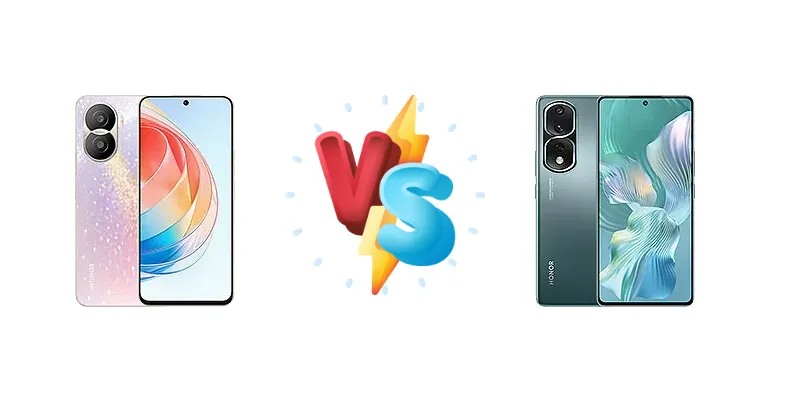
The Honor X40i and Honor 80 Pro Flat represent distinct approaches within Honor’s lineup. The X40i focuses on delivering a solid experience at a competitive price point, while the 80 Pro Flat aims for a more premium feel with significantly boosted performance. This comparison dissects the key differences to help you determine which device best suits your needs and budget.
🏆 Quick Verdict
For the average user prioritizing everyday tasks and media consumption, the Honor X40i offers excellent value. However, the Honor 80 Pro Flat is the clear winner for power users, gamers, and those demanding faster charging and a more responsive experience thanks to its Snapdragon 8+ Gen 1 chipset.
| Network |
|---|
| 2G bands | GSM 850 / 900 / 1800 / 1900 | GSM 850 / 900 / 1800 / 1900 |
| 3G bands | HSDPA 850 / 900 / 2100 | HSDPA 800 / 850 / 900 / 1700(AWS) / 1900 / 2100 |
| 4G bands | 1, 3, 5, 8, 34, 38, 39, 40, 41 | LTE |
| 5G bands | SA/NSA | SA/NSA |
| Speed | HSPA, LTE, 5G | HSPA, LTE, 5G |
| Technology | GSM / CDMA / HSPA / CDMA2000 / LTE / 5G | GSM / CDMA / HSPA / CDMA2000 / LTE / 5G |
| | CDMA2000 1x | CDMA2000 1x |
| Launch |
|---|
| Announced | 2022, July 13 | 2023, January 06 |
| Status | Available. Released 2022, July 22 | Available. Released 2023, January 06 |
| Body |
|---|
| Dimensions | 162.9 x 74.5 x 7.4 mm (6.41 x 2.93 x 0.29 in) | 162.3 x 75.3 x 7.9 mm (6.39 x 2.96 x 0.31 in) |
| SIM | Nano-SIM + Nano-SIM | Nano-SIM + Nano-SIM |
| Weight | 175 g (6.17 oz) | 186 g or 193 g (6.56 oz) |
| Display |
|---|
| Resolution | 1080 x 2388 pixels (~391 ppi density) | 1080 x 2400 pixels, 20:9 ratio (~395 ppi density) |
| Size | 6.7 inches, 108.7 cm2 (~89.6% screen-to-body ratio) | 6.67 inches, 107.4 cm2 (~87.9% screen-to-body ratio) |
| Type | IPS LCD | OLED, 1B colors, 120Hz, HDR, 1000 nits (peak) |
| Platform |
|---|
| CPU | Octa-core (2x2.2 GHz Cortex-A76 & 6x2.0 GHz Cortex-A55) | Octa-core (1x3.0 GHz Cortex-X2 & 3x2.5 GHz Cortex-A710 & 4x1.80 GHz Cortex-A510) |
| Chipset | Mediatek Dimensity 700 (7 nm) | Qualcomm SM8475 Snapdragon 8+ Gen 1 (4 nm) |
| GPU | Mali-G57 MC2 | Adreno 730 |
| OS | Android 12, Magic UI 6.1 | Android 12, MagicOS 7 |
| Memory |
|---|
| Card slot | No | No |
| Internal | 128GB 8GB RAM, 256GB 8GB RAM, 256GB 12GB RAM | 256GB 12GB RAM |
| Main Camera |
|---|
| Dual | 50 MP, f/1.8, (wide), PDAF
Auxiliary lens | - |
| Features | LED flash, HDR, panorama | LED flash, HDR, panorama |
| Single | 8 MP, f/2.0, (wide) | 32 MP, f/2.4, (wide) |
| Triple | - | 160 MP, f/1.8, (wide), 1/1.56", 0.75µm, PDAF
8 MP, f/2.2, (ultrawide)
Auxiliary lens |
| Video | 1080p@30fps | 4K@30fps, 1080p@30/60fps, gyro-EIS |
| Selfie camera |
|---|
| Features | - | HDR |
| Single | 8 MP, f/2.0, (wide) | 32 MP, f/2.4, (wide) |
| Video | 1080p@30fps | 1080p@30fps, gyro-EIS |
| Sound |
|---|
| 3.5mm jack | Yes | No |
| 35mm jack | Yes | No |
| Loudspeaker | Yes | Yes, with stereo speakers |
| Comms |
|---|
| Bluetooth | 5.1, A2DP, LE | 5.2, A2DP, LE, aptX HD |
| NFC | No | Yes |
| Positioning | GPS, GLONASS, BDS | GPS, GALILEO, GLONASS, BDS, QZSS |
| Radio | No | No |
| USB | USB Type-C 2.0, OTG | USB Type-C 2.0, OTG |
| WLAN | Wi-Fi 802.11 a/b/g/n/ac, dual-band, Wi-Fi Direct | Wi-Fi 802.11 a/b/g/n/ac/6, dual-band, Wi-Fi Direct |
| Features |
|---|
| Sensors | Fingerprint (side-mounted), accelerometer, compass | Fingerprint (under display, optical), accelerometer, gyro, compass |
| | Virtual proximity sensing | Virtual proximity sensing |
| Battery |
|---|
| Charging | 44W wired | 66W wired, 3-50% in 15 min
5W reverse wired |
| Type | Li-Po 4000 mAh | Li-Po 4800 mAh |
| Misc |
|---|
| Colors | Black, Silver, Green. Aurora | Black, Green, Pink |
| Models | DIO-AN00 | - |
| Price | About 240 EUR | About 450 EUR |
Honor X40i
- More affordable price point
- Decent performance for everyday tasks
- Reliable battery life for basic usage
- Significantly slower performance than the 80 Pro Flat
- Slower charging speeds
- Less capable camera system
Honor 80 Pro Flat
- Flagship-level Snapdragon 8+ Gen 1 performance
- Faster 66W charging with 3-50% in 15 minutes
- Superior camera capabilities with advanced ISP
- Higher price tag
- Potentially more heat generation under heavy load (though 4nm helps)
- May be overkill for basic users
Display Comparison
While both devices likely feature OLED panels (based on Honor’s typical offerings), specific details like resolution and refresh rate are missing. However, the core difference lies in the processing power driving them. The Snapdragon 8+ Gen 1 in the 80 Pro Flat will deliver a more fluid experience, especially when paired with a higher refresh rate (likely 120Hz). The X40i’s Dimensity 700, while capable, will struggle to maintain high frame rates in graphically intensive applications. Bezels and color accuracy are likely comparable given the similar market positioning, but the 80 Pro Flat’s superior processing allows for more advanced display features like HDR10+ support.
Camera Comparison
Without specific camera sensor details, it’s difficult to make a definitive judgment. However, the 80 Pro Flat’s more powerful ISP (Image Signal Processor) within the Snapdragon 8+ Gen 1 will likely result in superior image processing, particularly in low-light conditions. The 80 Pro Flat is also more likely to support advanced features like 8K video recording. While the X40i will likely offer a decent camera experience for casual photography, the 80 Pro Flat provides a more capable and versatile camera system. We can assume both phones will have a multi-camera setup, but the 80 Pro Flat will likely have a larger main sensor and potentially optical image stabilization (OIS).
Performance
The performance gap is substantial. The Qualcomm Snapdragon 8+ Gen 1 (4nm) in the Honor 80 Pro Flat is a flagship-level chipset, featuring a Cortex-X2 prime core clocked at 3.0 GHz. This contrasts sharply with the Mediatek Dimensity 700 (7nm) in the X40i, which utilizes older Cortex-A76 cores. The 4nm fabrication process of the Snapdragon offers significantly improved power efficiency and thermal management, meaning the 80 Pro Flat will sustain peak performance for longer periods without throttling. The 80 Pro Flat will excel in demanding tasks like gaming and video editing, while the X40i is better suited for everyday use.
Battery Life
The Honor 80 Pro Flat’s 66W wired charging is a significant advantage, capable of charging from 3-50% in just 15 minutes. The X40i’s 44W charging is slower, requiring more time to reach a full charge. While battery capacity isn’t specified, the Snapdragon 8+ Gen 1’s superior power efficiency could offset a potentially smaller battery in the 80 Pro Flat, resulting in comparable real-world battery life. The 80 Pro Flat also includes 5W reverse wired charging, a feature absent in the X40i, allowing it to top up other devices.
Buying Guide
Buy the Honor X40i if you need a reliable daily driver for basic tasks, social media, and streaming, and prioritize affordability. It’s ideal for users who don’t heavily game or require demanding app performance. Buy the Honor 80 Pro Flat if you prefer a smoother, faster experience for gaming, multitasking, and content creation, and are willing to invest more for the superior chipset and faster 66W charging.
Frequently Asked Questions
❓ Will the Dimensity 700 in the Honor X40i struggle with graphically demanding games like Genshin Impact?
Yes, the Dimensity 700 is not designed for high-end gaming. While you can run Genshin Impact, you’ll likely need to lower the graphics settings significantly to achieve playable frame rates. Expect noticeable frame drops and potential stuttering during intense gameplay.
❓ Does the Snapdragon 8+ Gen 1 in the Honor 80 Pro Flat get excessively hot during prolonged gaming sessions?
The Snapdragon 8+ Gen 1 is known for its efficiency, and the 4nm process helps mitigate heat. While it will get warm during extended gaming, the 80 Pro Flat should manage thermal throttling better than older flagship chips. Honor likely incorporates cooling solutions to further improve thermal performance.
❓ Is the 5W reverse wired charging on the Honor 80 Pro Flat useful for topping up accessories like earbuds?
Absolutely. While 5W is slow, it's perfectly adequate for charging smaller accessories like wireless earbuds or a smartwatch overnight. It's a convenient feature for users who frequently use Bluetooth devices.
❓ How much faster is the 66W charging on the Honor 80 Pro Flat compared to the 44W charging on the Honor X40i in real-world use?
The 66W charging on the 80 Pro Flat will significantly reduce charging times. Expect a full charge in around 45-60 minutes, compared to potentially 75-90 minutes for the X40i. The 3-50% in 15 minutes claim is a substantial benefit for users who need a quick power boost.