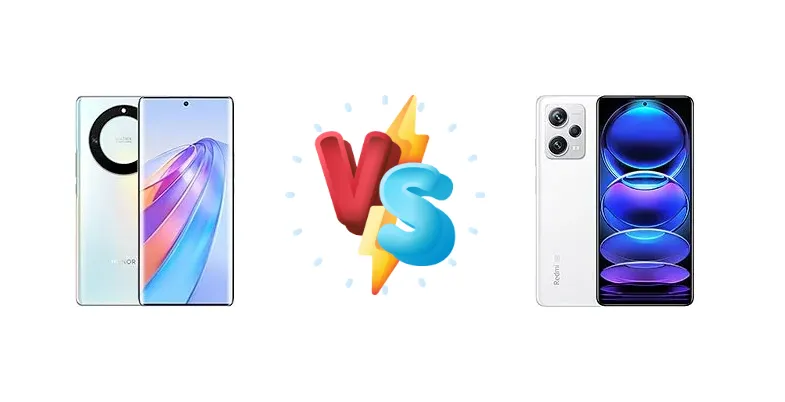
The mid-range smartphone market is fiercely competitive, and the Honor X40 and Xiaomi Redmi Note 12 Pro+ represent compelling options for users seeking a balance of features and affordability. While both devices operate within a similar price bracket, they diverge significantly in their core components, particularly in chipset and charging technology. This comparison dissects these differences to determine which phone best suits your needs.
🏆 Quick Verdict
For the average user prioritizing speed and convenience, the Xiaomi Redmi Note 12 Pro+ is the clear winner. Its Dimensity 1080 chipset delivers noticeably better performance than the Snapdragon 695 in the Honor X40, and the groundbreaking 120W charging dramatically reduces downtime. However, the Honor X40 remains a viable option for those on a tighter budget or with less demanding usage patterns.
| Network |
|---|
| 2G bands | GSM 850 / 900 / 1800 / 1900 | GSM 850 / 900 / 1800 / 1900 - SIM 1 & SIM 2 |
| 3G bands | HSDPA 850 / 900 / 1700(AWS) / 1900 / 2100 | HSDPA 800 / 850 / 900 / 1900 / 2100 |
| 4G bands | LTE | 1, 3, 5, 8, 19, 34, 38, 39, 40, 41 - International, China |
| 5G bands | SA/NSA | 1, 3, 5, 8, 28, 38, 40, 41, 77, 78 SA/NSA - International |
| Speed | HSPA, LTE, 5G | HSPA, LTE-A (CA), 5G |
| Technology | GSM / CDMA / HSPA / CDMA2000 / LTE / 5G | GSM / CDMA / HSPA / EVDO / LTE / 5G |
| | CDMA2000 1x | 1, 3, 5, 8, 28, 38, 41, 77, 78 SA/NSA - China |
| Launch |
|---|
| Announced | 2022, September 15 | 2022, October 27 |
| Status | Available. Released 2022, September 15 | Available. Released 2022, November 01 |
| Body |
|---|
| Build | - | Glass front (Gorilla Glass 5), glass back |
| Dimensions | 161.6 x 73.9 x 7.9 mm (6.36 x 2.91 x 0.31 in) | 162.9 x 76 x 8.9 mm (6.41 x 2.99 x 0.35 in) |
| SIM | Nano-SIM + Nano-SIM | Dual SIM (Nano-SIM, dual stand-by) |
| Weight | 172 g (6.07 oz) | 208.4 g (7.34 oz) |
| | - | IP53, dust and splash resistant |
| Display |
|---|
| Protection | - | Corning Gorilla Glass 5 |
| Resolution | 1080 x 2400 pixels, 20:9 ratio (~395 ppi density) | 1080 x 2400 pixels, 20:9 ratio (~395 ppi density) |
| Size | 6.67 inches, 107.4 cm2 (~89.9% screen-to-body ratio) | 6.67 inches, 107.4 cm2 (~86.8% screen-to-body ratio) |
| Type | AMOLED, 1B colors, 120Hz, 800 nits (HBM) | OLED, 1B colors, 120Hz, Dolby Vision, HDR10+, 500 nits (typ), 900 nits (HBM) |
| Platform |
|---|
| CPU | Octa-core (2x2.2 GHz Kryo 660 Gold & 6x1.7 GHz Kryo 660 Silver) | Octa-core (2x2.6 GHz Cortex-A78 & 6x2.0 GHz Cortex-A55) |
| Chipset | Qualcomm SM6375 Snapdragon 695 5G (6 nm) | Mediatek MT6877V Dimensity 1080 (6 nm) |
| GPU | Adreno 619 | Mali-G68 MC4 |
| OS | Android 12, Magic UI 6.1 | Android 12, MIUI 13 |
| Memory |
|---|
| Card slot | No | No |
| Internal | 128GB 6GB RAM, 128GB 8GB RAM, 256GB 8GB RAM, 256GB 12GB RAM | 256GB 8GB RAM, 256GB 12GB RAM |
| | - | UFS 2.2 |
| Main Camera |
|---|
| Dual | 50 MP, f/1.8, (wide), PDAF
2 MP (macro) | - |
| Features | LED flash, panorama, HDR | Dual-LED dual-tone flash, HDR, panorama |
| Single | 8 MP, f/2.0, (wide) | - |
| Triple | - | 200 MP, f/1.7, 24mm (wide), 1/1.4", 0.56µm, PDAF, OIS
8 MP, f/2.2, 120˚ (ultrawide), 1/4", 1.12µm
2 MP, f/2.4, (macro) |
| Video | 1080p@30fps | 4K@30fps, 1080p@30/60/120fps, 720p@960fps |
| Selfie camera |
|---|
| Features | - | HDR |
| Single | 8 MP, f/2.0, (wide) | 16 MP, f/2.5, (wide), 1/3.06", 1.0µm |
| Video | 1080p@30fps | 1080p@30/60fps |
| Sound |
|---|
| 3.5mm jack | No | Yes |
| 35mm jack | No | - |
| Loudspeaker | Yes | Yes, with stereo speakers |
| | - | 24-bit/192kHz audio |
| Comms |
|---|
| Bluetooth | 5.1, A2DP, LE, aptX HD | 5.2, A2DP, LE |
| Infrared port | Yes | Yes |
| NFC | No | Yes (market/region dependent) |
| Positioning | GPS, GLONASS, BDS | GPS (L1), GLONASS (G1), BDS (B1I+B1c), GALILEO (E1), QZSS (L1) |
| Radio | No | No |
| USB | USB Type-C 2.0, OTG | USB Type-C 2.0, OTG |
| WLAN | Wi-Fi 802.11 a/b/g/n/ac, dual-band, Wi-Fi Direct | Wi-Fi 802.11 a/b/g/n/ac/6, dual-band, Wi-Fi Direct |
| Features |
|---|
| Sensors | Fingerprint (under display, optical), accelerometer, gyro, proximity, compass | Fingerprint (side-mounted), accelerometer, proximity, gyro, compass |
| | 24-bit/192kHz audio | - |
| Battery |
|---|
| Charging | 40W wired | 120W wired, PD3.0, 100% in 19 min (advertised) |
| Type | Li-Po 5100 mAh | Li-Po 5000 mAh, non-removable |
| Misc |
|---|
| Colors | Black, Green, Silver | Arctic White, Iceberg Blue, Obsidian Black, Trend edition |
| Models | RMO-AN00 | 22101316UCP, 22101316UG |
| Price | About 210 EUR | $ 348.00 / £ 439.00 / € 399.00 / ₹ 29,949 |
| Tests |
|---|
| Battery life | - |
Endurance rating 88h
|
| Camera | - |
Photo / Video |
| Display | - |
Contrast ratio: Infinite (nominal) |
| Loudspeaker | - |
-26.7 LUFS (Good)
|
| Performance | - |
AnTuTu: 498710 (v9)
GeekBench: 2208 (v5.1), 2372 (v6)
GFXBench: 22fps (ES 3.1 onscreen) |
Honor X40
- More affordable price point
- Decent 5G connectivity
- Potentially longer battery life (depending on capacity)
- Slower Snapdragon 695 processor
- Significantly slower 40W charging
- Limited camera information
Xiaomi Redmi Note 12 Pro+
- Faster Dimensity 1080 processor
- Ultra-fast 120W charging with PD3.0
- Likely superior display quality (AMOLED)
- Potentially higher price
- May require more frequent charging (depending on usage)
- Camera details are limited
Display Comparison
The Redmi Note 12 Pro+ boasts an 'Infinite' (nominal) contrast ratio, suggesting a strong AMOLED panel, though specific brightness figures are absent. The Honor X40’s display specifications are not provided, leaving its panel type and brightness unknown. Without concrete data, it’s difficult to assess color accuracy or viewing angles, but the Redmi Note 12 Pro+'s likely AMOLED panel offers superior contrast and potentially better color reproduction. The lack of LTPO technology on either device suggests standard refresh rate management, impacting battery efficiency during dynamic content.
Camera Comparison
The Redmi Note 12 Pro+’s camera system is highlighted by its potential for high-resolution photography, though specific sensor details beyond 'Photo / Video' are missing. The Honor X40’s camera specifications are also absent. Without knowing sensor sizes, apertures, or the presence of Optical Image Stabilization (OIS), a direct comparison is challenging. However, the Redmi Note 12 Pro+'s brand positioning suggests a greater emphasis on camera capabilities, potentially offering more advanced features and image processing algorithms. The absence of information on the Honor X40’s camera makes it difficult to assess its image quality or low-light performance.
Performance
The core difference lies in the chipsets. The Xiaomi Redmi Note 12 Pro+ utilizes the Mediatek Dimensity 1080 (6nm), featuring a more powerful CPU configuration with 2x2.6 GHz Cortex-A78 cores and 6x2.0 GHz Cortex-A55 cores. This contrasts with the Honor X40’s Qualcomm Snapdragon 695 5G (6nm) which has 2x2.2 GHz Kryo 660 Gold and 6x1.7 GHz Kryo 660 Silver cores. The Cortex-A78 cores in the Dimensity 1080 offer a significant architectural advantage, translating to faster application loading and smoother multitasking. While both are 6nm chips, the Dimensity 1080’s superior core design and clock speeds will result in a more responsive user experience, particularly in demanding applications and games. The Redmi Note 12 Pro+ is likely to handle graphically intensive games at higher settings with fewer frame drops.
Battery Life
The Redmi Note 12 Pro+’s 120W wired charging is a game-changer, advertised to reach 100% in just 19 minutes. This is a massive advantage over the Honor X40’s 40W wired charging. While the Honor X40’s battery capacity is not specified, the Redmi Note 12 Pro+’s endurance rating of 88 hours suggests a substantial battery size. The faster charging speed of the Redmi Note 12 Pro+ effectively mitigates any potential disadvantage in battery capacity, allowing users to quickly replenish their power and minimize downtime. The inclusion of PD3.0 further enhances charging compatibility and efficiency.
Buying Guide
Buy the Honor X40 if you need a reliable daily driver with decent battery life and 5G connectivity, and prioritize value over raw performance. It's ideal for users who primarily browse, use social media, and make occasional calls. Buy the Xiaomi Redmi Note 12 Pro+ if you prefer a smoother, more responsive experience for gaming and multitasking, and absolutely value the convenience of incredibly fast charging. This phone is geared towards power users and those who frequently find themselves needing to top up their battery quickly.
Frequently Asked Questions
❓ Is the Dimensity 1080 in the Redmi Note 12 Pro+ prone to overheating during extended gaming sessions?
While the Dimensity 1080 is a capable processor, sustained high loads can generate heat. However, Xiaomi typically implements thermal management solutions, such as vapor chamber cooling, to mitigate throttling. Real-world performance will depend on the specific implementation and ambient temperature, but it's generally well-managed for its class.
❓ How does the 120W charging of the Redmi Note 12 Pro+ affect long-term battery health?
Ultra-fast charging can potentially accelerate battery degradation over time. However, Xiaomi employs charging algorithms and battery protection features to minimize this effect. The phone dynamically adjusts charging speed as the battery fills, reducing stress on the cells. While some degradation is inevitable with any rechargeable battery, the Redmi Note 12 Pro+'s charging system is designed to prolong battery lifespan.
❓ Does the Honor X40 support carrier aggregation for improved 5G speeds?
The Snapdragon 695 5G chipset supports carrier aggregation, but the specific bands and configurations supported by the Honor X40 will vary depending on the region and carrier. Check with your local carrier to confirm compatibility and supported 5G bands.
❓ What type of display technology does the Honor X40 use, and what is its refresh rate?
Unfortunately, the display technology (LCD or AMOLED) and refresh rate of the Honor X40 are not publicly available. This lack of information makes it difficult to assess its visual quality compared to the Redmi Note 12 Pro+.