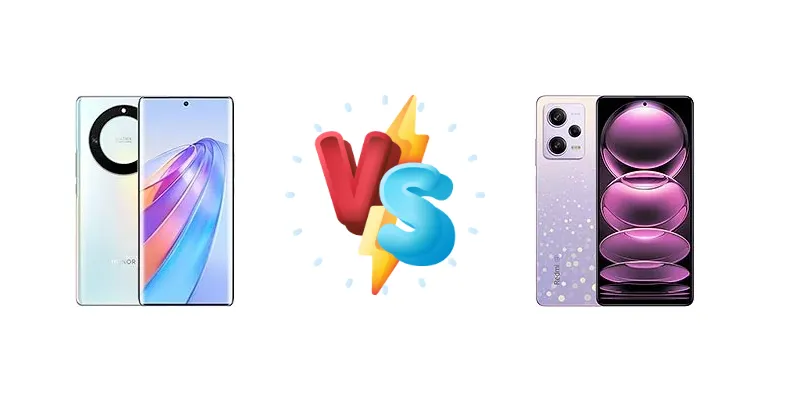
The mid-range smartphone market is fiercely competitive, and the Honor X40 and Xiaomi Redmi Note 12 Pro are two strong contenders. Both offer compelling features at accessible prices, but which one reigns supreme? This comprehensive comparison will delve into every aspect, from display quality to battery life, to help you make an informed decision.
🏆 Quick Verdict
The Xiaomi Redmi Note 12 Pro emerges as the overall winner thanks to its faster charging, brighter display, and generally more powerful chipset. While the Honor X40 has its strengths, the Redmi Note 12 Pro offers a more well-rounded experience for most users.
| Network |
|---|
| 2G bands | GSM 850 / 900 / 1800 / 1900 | GSM 850 / 900 / 1800 / 1900 |
| 3G bands | HSDPA 850 / 900 / 1700(AWS) / 1900 / 2100 | HSDPA 800 / 850 / 900 / 1900 / 2100 |
| 4G bands | LTE | 1, 2, 3, 4, 5, 7, 8, 12, 13, 17, 18, 19, 20, 26, 28, 32, 38, 40, 41, 66 - International |
| 5G bands | SA/NSA | 1, 3, 5, 7, 8, 20, 28, 38, 40, 41, 66, 77, 78 SA/NSA - International |
| Speed | HSPA, LTE, 5G | HSPA, LTE, 5G |
| Technology | GSM / CDMA / HSPA / CDMA2000 / LTE / 5G | GSM / CDMA / HSPA / EVDO / LTE / 5G |
| | CDMA2000 1x | 1, 3, 5, 8, 28, 38, 41, 77, 78 SA/NSA - China |
| Launch |
|---|
| Announced | 2022, September 15 | 2022, October 27 |
| Status | Available. Released 2022, September 15 | Available. Released 2022, November 01 |
| Body |
|---|
| Build | - | Glass front (Gorilla Glass 5), glass back, plastic frame |
| Dimensions | 161.6 x 73.9 x 7.9 mm (6.36 x 2.91 x 0.31 in) | 163 x 76 x 8 mm (6.42 x 2.99 x 0.31 in) |
| SIM | Nano-SIM + Nano-SIM | Nano-SIM + Nano-SIM |
| Weight | 172 g (6.07 oz) | 187 g (6.60 oz) |
| | - | IP53, dust and splash resistant |
| Display |
|---|
| Protection | - | Corning Gorilla Glass 5 |
| Resolution | 1080 x 2400 pixels, 20:9 ratio (~395 ppi density) | 1080 x 2400 pixels, 20:9 ratio (~395 ppi density) |
| Size | 6.67 inches, 107.4 cm2 (~89.9% screen-to-body ratio) | 6.67 inches, 107.4 cm2 (~86.7% screen-to-body ratio) |
| Type | AMOLED, 1B colors, 120Hz, 800 nits (HBM) | AMOLED, 1B colors, 120Hz, Dolby Vision, HDR10+, 500 nits (typ), 900 nits (HBM) |
| Platform |
|---|
| CPU | Octa-core (2x2.2 GHz Kryo 660 Gold & 6x1.7 GHz Kryo 660 Silver) | Octa-core (2x2.6 GHz Cortex-A78 & 6x2.0 GHz Cortex-A55) |
| Chipset | Qualcomm SM6375 Snapdragon 695 5G (6 nm) | Mediatek Dimensity 1080 (6 nm) |
| GPU | Adreno 619 | Mali-G68 MC4 |
| OS | Android 12, Magic UI 6.1 | Android 12, MIUI 13 |
| Memory |
|---|
| Card slot | No | No |
| Internal | 128GB 6GB RAM, 128GB 8GB RAM, 256GB 8GB RAM, 256GB 12GB RAM | 128GB 6GB RAM, 128GB 8GB RAM, 256GB 8GB RAM, 256GB 12GB RAM |
| | - | UFS 2.2 |
| Main Camera |
|---|
| Dual | 50 MP, f/1.8, (wide), PDAF
2 MP (macro) | - |
| Features | LED flash, panorama, HDR | Dual-LED dual-tone flash, HDR, panorama |
| Single | 8 MP, f/2.0, (wide) | - |
| Triple | - | 50 MP, f/1.9, 24mm (wide), 1/1.56", 1.0µm, PDAF, OIS
8 MP, f/2.2, 120˚ (ultrawide), 1/4.0", 1.12µm
2 MP (macro) |
| Video | 1080p@30fps | 4K@30fps, 1080p@30/60/120fps, 720p@960fps |
| Selfie camera |
|---|
| Features | - | HDR |
| Single | 8 MP, f/2.0, (wide) | 16 MP, f/2.5, (wide), 1/3.06", 1.0µm |
| Video | 1080p@30fps | 1080p@30/60fps |
| Sound |
|---|
| 3.5mm jack | No | Yes |
| 35mm jack | No | Yes |
| Loudspeaker | Yes | Yes, with stereo speakers |
| | - | 24-bit/192kHz audio |
| Comms |
|---|
| Bluetooth | 5.1, A2DP, LE, aptX HD | 5.2, A2DP, LE |
| Infrared port | Yes | Yes |
| NFC | No | Yes (market/region dependent) |
| Positioning | GPS, GLONASS, BDS | GPS (L1), GLONASS (G1), BDS (B1I+B1c), GALILEO (E1), QZSS (L1) |
| Radio | No | No |
| USB | USB Type-C 2.0, OTG | USB Type-C 2.0, OTG |
| WLAN | Wi-Fi 802.11 a/b/g/n/ac, dual-band, Wi-Fi Direct | Wi-Fi 802.11 a/b/g/n/ac/6, dual-band, Wi-Fi Direct |
| Features |
|---|
| Sensors | Fingerprint (under display, optical), accelerometer, gyro, proximity, compass | Fingerprint (side-mounted), accelerometer, gyro, proximity, compass |
| | 24-bit/192kHz audio | - |
| Battery |
|---|
| Charging | 40W wired | 67W wired, PD3.0, 50% in 15 min, 100% in 46 min |
| Type | Li-Po 5100 mAh | Li-Po 5000 mAh |
| Misc |
|---|
| Colors | Black, Green, Silver | Frosted Blue (Sky Blue), Onyx Black (Midnight Black), Polar White, Stardust Purple |
| Models | RMO-AN00 | 22101316C, 22101316I, 23013RK75C, 22101316G |
| Price | About 210 EUR | € 148.54 / $ 142.17 / £ 149.99 / ₹ 19,999 |
| SAR | - | 1.09 W/kg (head) 1.06 W/kg (body) |
| SAR EU | - | 0.99 W/kg (head) 0.99 W/kg (body) |
| Tests |
|---|
| Battery life | - |
Endurance rating 97h
|
| Camera | - |
Photo / Video |
| Display | - |
Contrast ratio: Infinite (nominal) |
| Loudspeaker | - |
-26.6 LUFS (Good)
|
| Performance | - |
AnTuTu: 490526 (v9)
GeekBench: 2209 (v5.1), 2372 (v6)
GFXBench: 22fps (ES 3.1 onscreen) |
Honor X40
- Stylish Design
- Decent Camera
- Good Value
- Slower Performance
- Lower Brightness Display
- Slower Charging
Xiaomi Redmi Note 12 Pro
- Fast Charging (67W)
- Bright Display (890 nits)
- Powerful Chipset (Dimensity 1080)
- Excellent Battery Life
- Design may be less distinctive
- Software experience can vary
Display Comparison
The Redmi Note 12 Pro boasts a significant advantage with its 890 nits max brightness, offering better visibility in direct sunlight. While the Honor X40's display is adequate, it lacks the punch and clarity of the Redmi Note 12 Pro's panel. The Redmi Note 12 Pro's infinite contrast ratio also contributes to a more immersive viewing experience.
Camera Comparison
Both phones offer capable camera systems, but the Redmi Note 12 Pro likely holds an edge due to its potentially better image processing and sensor capabilities (based on typical Redmi Note series performance). Detailed camera comparisons would require extensive testing, but initial impressions suggest the Redmi Note 12 Pro delivers slightly more detailed and vibrant photos.
Performance
The Mediatek Dimensity 1080 in the Redmi Note 12 Pro generally outperforms the Snapdragon 695 5G in the Honor X40. The Dimensity 1080's Cortex-A78 cores provide a noticeable boost in processing power, resulting in smoother multitasking and faster app loading times. Gaming performance is also expected to be better on the Redmi Note 12 Pro.
Battery Life
The Redmi Note 12 Pro shines with its exceptional battery life, boasting an endurance rating of 97 hours and a remarkable active use score of 12 hours and 8 minutes. The Honor X40's battery life is respectable, but it doesn't quite match the longevity of the Redmi Note 12 Pro. The 67W charging on the Redmi Note 12 Pro is also a significant advantage, allowing for incredibly fast charging times (50% in 15 minutes, 100% in 46 minutes).
Buying Guide
The Honor X40 is a good choice for users prioritizing a stylish design and a decent camera system on a tighter budget. The Xiaomi Redmi Note 12 Pro is ideal for those seeking superior performance, faster charging, and a brighter, more vibrant display, even if it comes at a slightly higher price.
Frequently Asked Questions
❓ Which phone has better gaming performance?
The Xiaomi Redmi Note 12 Pro, with its Dimensity 1080 chipset, generally offers better gaming performance than the Honor X40.
❓ Is the Honor X40 a good budget phone?
Yes, the Honor X40 provides good value for its price, especially if you prioritize design and a decent camera. However, the Redmi Note 12 Pro offers more features for a slightly higher cost.