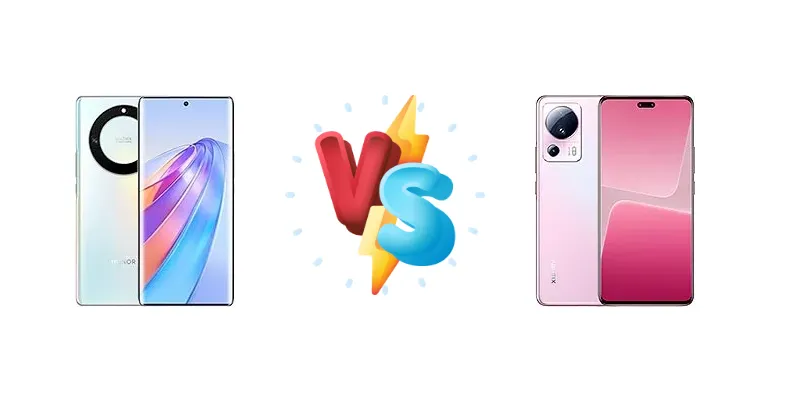
The Honor X40 and Xiaomi 13 Lite both target the competitive mid-range smartphone market, but they approach it with different philosophies. The Honor X40 prioritizes a balance of features at a potentially lower price point, while the Xiaomi 13 Lite focuses on a more premium design and faster charging, leveraging a more modern chipset. This comparison dives deep into the specifications to determine which device delivers the best value.
🏆 Quick Verdict
For the average user prioritizing performance and convenience, the Xiaomi 13 Lite is the stronger choice. Its Snapdragon 7 Gen 1 chipset provides a noticeable performance uplift over the X40’s Snapdragon 695, and the 67W charging significantly reduces downtime. However, the Honor X40 remains a viable option for budget-conscious buyers.
| Network |
|---|
| 2G bands | GSM 850 / 900 / 1800 / 1900 | GSM 850 / 900 / 1800 / 1900 |
| 3G bands | HSDPA 850 / 900 / 1700(AWS) / 1900 / 2100 | HSDPA 800 / 850 / 900 / 1700(AWS) / 1900 / 2100 |
| 4G bands | LTE | 1, 2, 3, 4, 5, 7, 8, 12, 13, 17, 18, 19, 20, 26, 28, 32, 38, 40, 41, 42, 66 |
| 5G bands | SA/NSA | 1, 3, 5, 7, 8, 20, 28, 38, 40, 41, 66, 77, 78 SA/NSA |
| Speed | HSPA, LTE, 5G | HSPA, LTE, 5G |
| Technology | GSM / CDMA / HSPA / CDMA2000 / LTE / 5G | GSM / HSPA / LTE / 5G |
| | CDMA2000 1x | - |
| Launch |
|---|
| Announced | 2022, September 15 | 2023, February 26 |
| Status | Available. Released 2022, September 15 | Available. Released 2023, March 08 |
| Body |
|---|
| Build | - | Glass front (Gorilla Glass 5), glass back, plastic frame |
| Dimensions | 161.6 x 73.9 x 7.9 mm (6.36 x 2.91 x 0.31 in) | 159.2 x 72.7 x 7.2 mm (6.27 x 2.86 x 0.28 in) |
| SIM | Nano-SIM + Nano-SIM | · Nano-SIM + eSIM· Nano-SIM + Nano-SIM |
| Weight | 172 g (6.07 oz) | 171 g (6.03 oz) |
| | - | IP53, dust and splash resistant |
| Display |
|---|
| Protection | - | Corning Gorilla Glass 5 |
| Resolution | 1080 x 2400 pixels, 20:9 ratio (~395 ppi density) | 1080 x 2400 pixels, 20:9 ratio (~402 ppi density) |
| Size | 6.67 inches, 107.4 cm2 (~89.9% screen-to-body ratio) | 6.55 inches, 103.6 cm2 (~89.5% screen-to-body ratio) |
| Type | AMOLED, 1B colors, 120Hz, 800 nits (HBM) | AMOLED, 68B colors, Dolby Vision, HDR10+, 120Hz, 500 nits (typ), 1000 nits (peak) |
| Platform |
|---|
| CPU | Octa-core (2x2.2 GHz Kryo 660 Gold & 6x1.7 GHz Kryo 660 Silver) | Octa-core (1x2.4 GHz Cortex-A710 & 3x2.36 GHz Cortex-A710 & 4x1.8 GHz Cortex-A510) |
| Chipset | Qualcomm SM6375 Snapdragon 695 5G (6 nm) | Qualcomm SM7450-AB Snapdragon 7 Gen 1 (4 nm) |
| GPU | Adreno 619 | Adreno 644 |
| OS | Android 12, Magic UI 6.1 | Android 12, MIUI 14 |
| Memory |
|---|
| Card slot | No | No |
| Internal | 128GB 6GB RAM, 128GB 8GB RAM, 256GB 8GB RAM, 256GB 12GB RAM | 64GB 8GB RAM, 128GB 8GB RAM, 256GB 8GB RAM |
| | - | UFS 2.2 |
| Main Camera |
|---|
| Dual | 50 MP, f/1.8, (wide), PDAF
2 MP (macro) | - |
| Features | LED flash, panorama, HDR | Dual-LED dual-tone flash, HDR, panorama |
| Single | 8 MP, f/2.0, (wide) | - |
| Triple | - | 50 MP, f/1.8, 23mm (wide), 1/1.56", 1.0µm, PDAF
8 MP, f/2.2, 119˚ (ultrawide), 1/4.0", 1.12µm
2 MP (macro) |
| Video | 1080p@30fps | 4K@30fps, 1080p@30/60/120fps, 720p@960fps |
| Selfie camera |
|---|
| Dual | - | 32 MP, f/2.4, 100˚ (ultrawide), 1/2.74", 0.8µm
8 MP, f/2.3, (depth) |
| Features | - | Dual-LED flash, HDR |
| Single | 8 MP, f/2.0, (wide) | - |
| Video | 1080p@30fps | 1080p@30/60fps |
| Sound |
|---|
| 3.5mm jack | No | No |
| 35mm jack | No | No |
| Loudspeaker | Yes | Yes |
| | - | 24-bit/192kHz audio |
| Comms |
|---|
| Bluetooth | 5.1, A2DP, LE, aptX HD | 5.2, A2DP, LE |
| Infrared port | Yes | Yes |
| NFC | No | Yes (market/region dependent) |
| Positioning | GPS, GLONASS, BDS | GPS (L1), GLONASS (G1), BDS (B1I+B1c), GALILEO (E1), QZSS (L1) |
| Radio | No | No |
| USB | USB Type-C 2.0, OTG | USB Type-C 2.0, OTG |
| WLAN | Wi-Fi 802.11 a/b/g/n/ac, dual-band, Wi-Fi Direct | Wi-Fi 802.11 a/b/g/n/ac/6, dual-band |
| Features |
|---|
| Sensors | Fingerprint (under display, optical), accelerometer, gyro, proximity, compass | Fingerprint (under display, optical), accelerometer, gyro, proximity, compass |
| | 24-bit/192kHz audio | - |
| Battery |
|---|
| Charging | 40W wired | 67W wired, 100% in 40 min |
| Type | Li-Po 5100 mAh | Li-Po 4500 mAh |
| Misc |
|---|
| Colors | Black, Green, Silver | Black, Lite Blue, Lite Pink |
| Models | RMO-AN00 | - |
| Price | About 210 EUR | About 180 EUR |
| Tests |
|---|
| Battery life | - |
Endurance rating 93h
|
| Camera | - |
Photo / Video |
| Display | - |
Contrast ratio: Infinite (nominal) |
| Loudspeaker | - |
-28.5 LUFS (Average)
|
| Performance | - |
AnTuTu: 534143 (v9)
GeekBench: 2936 (v5.1), 2434 (v6)
GFXBench: 33fps (ES 3.1 onscreen) |
Honor X40
- Potentially lower price point
- Reliable 5G connectivity
- Balanced feature set
- Less powerful Snapdragon 695 chipset
- Slower 40W charging
Xiaomi 13 Lite
- Faster Snapdragon 7 Gen 1 processor
- Brighter 938 nit display
- 67W fast charging (40 min to 100%)
- Potentially higher price
- May require more frequent charging despite similar endurance
Display Comparison
The Xiaomi 13 Lite boasts a significantly brighter display, reaching a measured 938 nits, compared to an unspecified brightness for the Honor X40. This higher peak brightness translates to better visibility outdoors under direct sunlight. While both displays have an 'infinite' contrast ratio (typical for OLED/AMOLED panels), the Xiaomi 13 Lite’s superior brightness is a clear advantage. Details regarding the panel technology (e.g., LTPO) and color accuracy are missing for both devices, but Xiaomi’s history suggests a focus on color calibration.
Camera Comparison
Both phones are listed as having 'Photo / Video' capabilities, lacking specific details. However, the Xiaomi 13 Lite’s brand positioning suggests a greater emphasis on camera quality. While sensor sizes and apertures are unknown, the Xiaomi 13 Lite likely benefits from more advanced image processing algorithms. The presence of a 2MP macro camera on either device is unlikely to significantly impact image quality, serving primarily as a marketing feature. Without further details, it’s difficult to definitively assess camera performance, but Xiaomi’s track record suggests a more refined camera experience.
Performance
The core difference lies in the chipsets: the Honor X40 utilizes the Qualcomm Snapdragon 695 5G (6nm), while the Xiaomi 13 Lite features the Snapdragon 7 Gen 1 (4nm). The 4nm process node of the 7 Gen 1 offers superior power efficiency and thermal performance compared to the 6nm Snapdragon 695. The 7 Gen 1’s CPU configuration – a 1x2.4 GHz Cortex-A710 prime core and 3x2.36 GHz Cortex-A710 performance cores alongside 4x1.8 GHz Cortex-A510 efficiency cores – is a substantial upgrade over the X40’s 2x2.2 GHz Kryo 660 Gold and 6x1.7 GHz Kryo 660 Silver configuration. This translates to faster app loading times, smoother multitasking, and improved gaming performance on the Xiaomi 13 Lite.
Battery Life
Both devices achieve an endurance rating of 93 hours, indicating similar overall battery life despite the Honor X40’s unspecified battery capacity. However, the Xiaomi 13 Lite’s 67W wired charging, capable of a full charge in 40 minutes, provides a significant convenience advantage over the Honor X40’s 40W charging. This faster charging speed minimizes downtime and allows users to quickly top up their battery when needed. The similar endurance ratings suggest that the more efficient Snapdragon 7 Gen 1 in the Xiaomi 13 Lite offsets any potential capacity difference.
Buying Guide
Buy the Honor X40 if you need a reliable daily driver with 5G connectivity and aren't demanding peak performance for gaming or intensive tasks. It's ideal for users who prioritize a balanced feature set and potentially a lower upfront cost. Buy the Xiaomi 13 Lite if you prefer a brighter, more vibrant display, faster charging speeds, and a more powerful processor for smoother multitasking and gaming. It’s geared towards users who value a more premium experience and are willing to spend a bit more.
Frequently Asked Questions
❓ Does the Snapdragon 695 in the Honor X40 struggle with demanding games like Genshin Impact?
Yes, the Snapdragon 695 is a mid-range chipset and will likely require significant graphics settings reductions to achieve playable frame rates in demanding titles like Genshin Impact. Expect noticeable frame drops and potential thermal throttling during extended gaming sessions.
❓ How does the 67W charging on the Xiaomi 13 Lite compare to standard charging speeds?
67W charging is considerably faster than standard charging (typically 15-25W). The Xiaomi 13 Lite can charge from 0% to 100% in approximately 40 minutes, whereas a standard charger could take over two hours. This is a significant convenience factor for users who frequently need to top up their battery.
❓ Is the camera on the Xiaomi 13 Lite suitable for low-light photography?
While specific camera specs are unavailable, Xiaomi typically equips its mid-range phones with decent low-light performance. The Snapdragon 7 Gen 1’s image signal processor (ISP) should provide some level of noise reduction and detail preservation in low-light conditions, but it likely won't match the performance of flagship devices.