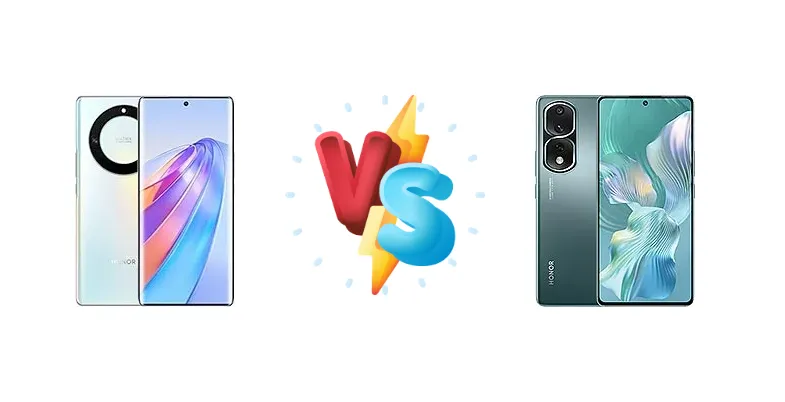
Honor presents a compelling duo with the X40 and 80 Pro Flat, catering to different segments of the smartphone market. The X40 focuses on accessibility, while the 80 Pro Flat aims for a near-flagship experience. This comparison dissects the core differences – primarily the chipset – to determine which device delivers the best value for your needs.
🏆 Quick Verdict
For the average user prioritizing smooth daily performance and faster charging, the Honor 80 Pro Flat is the clear winner. Its Snapdragon 8+ Gen 1 offers a substantial performance leap over the X40’s Snapdragon 695, justifying the price difference. However, the X40 remains a viable option for budget-conscious users.
| Network |
|---|
| 2G bands | GSM 850 / 900 / 1800 / 1900 | GSM 850 / 900 / 1800 / 1900 |
| 3G bands | HSDPA 850 / 900 / 1700(AWS) / 1900 / 2100 | HSDPA 800 / 850 / 900 / 1700(AWS) / 1900 / 2100 |
| 4G bands | LTE | LTE |
| 5G bands | SA/NSA | SA/NSA |
| Speed | HSPA, LTE, 5G | HSPA, LTE, 5G |
| Technology | GSM / CDMA / HSPA / CDMA2000 / LTE / 5G | GSM / CDMA / HSPA / CDMA2000 / LTE / 5G |
| | CDMA2000 1x | CDMA2000 1x |
| Launch |
|---|
| Announced | 2022, September 15 | 2023, January 06 |
| Status | Available. Released 2022, September 15 | Available. Released 2023, January 06 |
| Body |
|---|
| Dimensions | 161.6 x 73.9 x 7.9 mm (6.36 x 2.91 x 0.31 in) | 162.3 x 75.3 x 7.9 mm (6.39 x 2.96 x 0.31 in) |
| SIM | Nano-SIM + Nano-SIM | Nano-SIM + Nano-SIM |
| Weight | 172 g (6.07 oz) | 186 g or 193 g (6.56 oz) |
| Display |
|---|
| Resolution | 1080 x 2400 pixels, 20:9 ratio (~395 ppi density) | 1080 x 2400 pixels, 20:9 ratio (~395 ppi density) |
| Size | 6.67 inches, 107.4 cm2 (~89.9% screen-to-body ratio) | 6.67 inches, 107.4 cm2 (~87.9% screen-to-body ratio) |
| Type | AMOLED, 1B colors, 120Hz, 800 nits (HBM) | OLED, 1B colors, 120Hz, HDR, 1000 nits (peak) |
| Platform |
|---|
| CPU | Octa-core (2x2.2 GHz Kryo 660 Gold & 6x1.7 GHz Kryo 660 Silver) | Octa-core (1x3.0 GHz Cortex-X2 & 3x2.5 GHz Cortex-A710 & 4x1.80 GHz Cortex-A510) |
| Chipset | Qualcomm SM6375 Snapdragon 695 5G (6 nm) | Qualcomm SM8475 Snapdragon 8+ Gen 1 (4 nm) |
| GPU | Adreno 619 | Adreno 730 |
| OS | Android 12, Magic UI 6.1 | Android 12, MagicOS 7 |
| Memory |
|---|
| Card slot | No | No |
| Internal | 128GB 6GB RAM, 128GB 8GB RAM, 256GB 8GB RAM, 256GB 12GB RAM | 256GB 12GB RAM |
| Main Camera |
|---|
| Dual | 50 MP, f/1.8, (wide), PDAF
2 MP (macro) | - |
| Features | LED flash, panorama, HDR | LED flash, HDR, panorama |
| Single | 8 MP, f/2.0, (wide) | 32 MP, f/2.4, (wide) |
| Triple | - | 160 MP, f/1.8, (wide), 1/1.56", 0.75µm, PDAF
8 MP, f/2.2, (ultrawide)
Auxiliary lens |
| Video | 1080p@30fps | 4K@30fps, 1080p@30/60fps, gyro-EIS |
| Selfie camera |
|---|
| Features | - | HDR |
| Single | 8 MP, f/2.0, (wide) | 32 MP, f/2.4, (wide) |
| Video | 1080p@30fps | 1080p@30fps, gyro-EIS |
| Sound |
|---|
| 3.5mm jack | No | No |
| 35mm jack | No | No |
| Loudspeaker | Yes | Yes, with stereo speakers |
| Comms |
|---|
| Bluetooth | 5.1, A2DP, LE, aptX HD | 5.2, A2DP, LE, aptX HD |
| Infrared port | Yes | - |
| NFC | No | Yes |
| Positioning | GPS, GLONASS, BDS | GPS, GALILEO, GLONASS, BDS, QZSS |
| Radio | No | No |
| USB | USB Type-C 2.0, OTG | USB Type-C 2.0, OTG |
| WLAN | Wi-Fi 802.11 a/b/g/n/ac, dual-band, Wi-Fi Direct | Wi-Fi 802.11 a/b/g/n/ac/6, dual-band, Wi-Fi Direct |
| Features |
|---|
| Sensors | Fingerprint (under display, optical), accelerometer, gyro, proximity, compass | Fingerprint (under display, optical), accelerometer, gyro, compass |
| | 24-bit/192kHz audio | Virtual proximity sensing |
| Battery |
|---|
| Charging | 40W wired | 66W wired, 3-50% in 15 min
5W reverse wired |
| Type | Li-Po 5100 mAh | Li-Po 4800 mAh |
| Misc |
|---|
| Colors | Black, Green, Silver | Black, Green, Pink |
| Models | RMO-AN00 | - |
| Price | About 210 EUR | About 450 EUR |
Honor X40
- More affordable price point
- Decent performance for everyday tasks
- Sufficient for basic gaming
- Significantly slower processor
- Slower charging speeds
- Limited multitasking capabilities
Honor 80 Pro Flat
- Flagship-level performance with Snapdragon 8+ Gen 1
- Much faster 66W charging
- Superior gaming experience
- Higher price tag
- Potentially more heat generation under heavy load (though mitigated by 4nm process)
- May be overkill for basic users
Display Comparison
While both devices likely feature OLED panels (based on Honor’s typical offerings), specific details like peak brightness and refresh rates are missing. However, the core difference lies in the processing power needed to drive a high-refresh-rate display smoothly. The Snapdragon 8+ Gen 1 in the 80 Pro Flat is far better equipped to handle a 120Hz or higher panel without compromising battery life. The X40’s Snapdragon 695 might struggle to maintain consistent performance with a high refresh rate, potentially leading to stuttering.
Camera Comparison
Without specific camera sensor details, it’s difficult to make a definitive comparison. However, the processing power of the Snapdragon 8+ Gen 1 in the 80 Pro Flat will enable more sophisticated image processing algorithms, potentially resulting in better dynamic range, noise reduction, and overall image quality. The 80 Pro Flat is also more likely to support advanced features like 8K video recording. While the X40 will likely produce acceptable photos in good lighting conditions, it will struggle in low-light scenarios compared to the 80 Pro Flat.
Performance
The performance gap is the most significant differentiator. The Honor 80 Pro Flat’s Snapdragon 8+ Gen 1 (4nm) is a flagship-tier chipset, featuring a Cortex-X2 prime core clocked at 3.0 GHz, alongside Cortex-A710 and A510 cores. This architecture delivers substantially higher CPU and GPU performance compared to the Honor X40’s Snapdragon 695 (6nm). The 695, while capable for everyday tasks, will show its limitations in demanding games and multitasking. The 4nm process of the 8+ Gen 1 also translates to improved thermal efficiency, reducing throttling during sustained workloads. The 80 Pro Flat will offer a noticeably smoother and more responsive experience.
Battery Life
The Honor 80 Pro Flat’s 66W wired charging is a significant advantage, capable of charging from 30-50% in just 15 minutes. The X40’s 40W charging is considerably slower. While battery capacity isn’t specified, the more efficient Snapdragon 8+ Gen 1 in the 80 Pro Flat will likely offset any potential capacity difference, delivering comparable or even better real-world battery life despite the faster charging speeds. The 5W reverse wired charging on the 80 Pro Flat is a useful addition for topping up accessories.
Buying Guide
Buy the Honor X40 if you need a reliable daily driver for basic tasks, social media, and light gaming, and prioritize affordability. It’s ideal for users who don’t demand the highest performance. Buy the Honor 80 Pro Flat if you prefer a significantly faster processor for demanding apps, gaming, and multitasking, and value quicker charging speeds. This is the choice for power users and mobile gamers.
Frequently Asked Questions
❓ Will the Snapdragon 695 in the Honor X40 struggle with graphically intensive games like Genshin Impact?
Yes, the Snapdragon 695 is not designed for demanding titles like Genshin Impact. You'll likely need to lower graphics settings significantly to achieve playable frame rates, and even then, expect occasional stuttering. The Honor 80 Pro Flat’s Snapdragon 8+ Gen 1 will provide a much smoother and more enjoyable gaming experience.
❓ How much faster is the 66W charging on the Honor 80 Pro Flat compared to the 40W charging on the Honor X40 in real-world use?
The 66W charging on the 80 Pro Flat will significantly reduce charging times. Honor claims 30-50% charge in 15 minutes. The X40’s 40W charging will take considerably longer to reach the same charge level – likely closer to 30-45 minutes for a similar percentage increase.
❓ Is the performance difference between the two phones noticeable for everyday tasks like browsing and social media?
While both phones will handle basic tasks adequately, the 80 Pro Flat will feel noticeably snappier and more responsive. App launch times will be faster, scrolling will be smoother, and multitasking will be less prone to lag. The difference is subtle for casual users, but becomes apparent with frequent use.