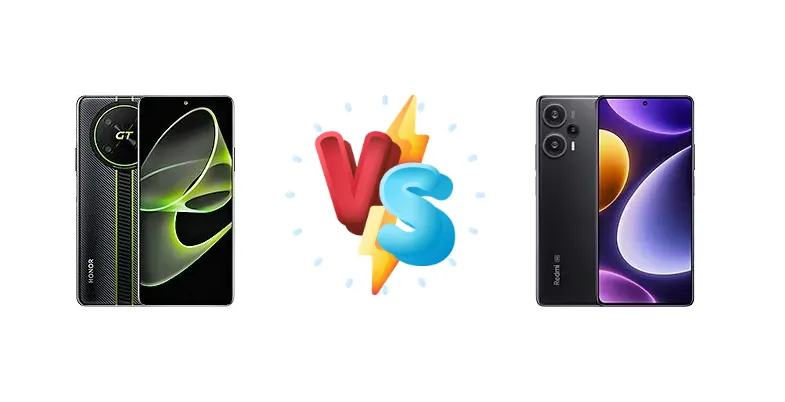
The Honor X40 GT and Xiaomi Redmi Note 12 Turbo represent compelling options in the increasingly competitive mid-range smartphone market. The X40 GT leverages the older, but still potent, Snapdragon 888, while the Redmi Note 12 Turbo champions the newer, more efficient Snapdragon 7+ Gen 2. This comparison dissects the key differences to determine which device delivers the best overall experience.
🏆 Quick Verdict
For most users, the Xiaomi Redmi Note 12 Turbo emerges as the superior choice. Its Snapdragon 7+ Gen 2 offers a better balance of performance and efficiency, translating to smoother sustained performance and improved battery life compared to the Snapdragon 888 in the Honor X40 GT. While the X40 GT offers a slightly faster charging speed, the Turbo’s overall package is more compelling.
| Network |
|---|
| 2G bands | GSM 850 / 900 / 1800 / 1900 | GSM 850 / 900 / 1800 / 1900 |
| 3G bands | HSDPA 850 / 900 / 1700(AWS) / 1900 / 2100 | HSDPA 800 / 850 / 900 / 2100 |
| 4G bands | LTE | 1, 3, 5, 8, 19, 34, 38, 39, 40, 41, 42 |
| 5G bands | SA/NSA | 1, 3, 5, 8, 28, 38, 41, 77, 78 SA/NSA |
| Speed | HSPA, LTE, 5G | HSPA, LTE, 5G |
| Technology | GSM / CDMA / HSPA / EVDO / LTE / 5G | GSM / HSPA / CDMA2000 / LTE / 5G |
| | CDMA2000 1xEV-DO | CDMA2000 1x |
| Launch |
|---|
| Announced | 2022, October 13 | 2023, March 28 |
| Status | Available. Released 2022, October 18 | Available. Released 2023, March 28 |
| Body |
|---|
| Build | - | Glass front, plastic frame, plastic back |
| Dimensions | 166.1 x 75.8 x 8.5 mm (6.54 x 2.98 x 0.33 in) | 161.1 x 75 x 7.9 mm (6.34 x 2.95 x 0.31 in) |
| SIM | Nano-SIM + Nano-SIM | Nano-SIM + Nano-SIM |
| Weight | 199.5 g (7.05 oz) | 181 g (6.38 oz) |
| Display |
|---|
| Resolution | 1080 x 2388 pixels (~385 ppi density) | 1080 x 2400 pixels, 20:9 ratio (~395 ppi density) |
| Size | 6.81 inches, 112.3 cm2 (~89.2% screen-to-body ratio) | 6.67 inches, 107.4 cm2 (~88.9% screen-to-body ratio) |
| Type | IPS LCD, 144Hz | OLED, 68B colors, 120Hz, Dolby Vision, HDR10+, 1000 nits (HBM) |
| Platform |
|---|
| CPU | Octa-core (1x2.84 GHz Cortex-X1 & 3x2.42 GHz Cortex-A78 & 4x1.80 GHz Cortex-A55) | Octa-core (1x2.91 GHz Cortex-X2 & 3x2.49 GHz Cortex-A710 & 4x1.8 GHz Cortex-A510) |
| Chipset | Qualcomm SM8350 Snapdragon 888 5G (5 nm) | Qualcomm SM7475-AB Snapdragon 7+ Gen 2 (4 nm) |
| GPU | Adreno 660 | Adreno 725 |
| OS | Android 12, Magic UI 6.1 | Android 13, MIUI 14 |
| Memory |
|---|
| Card slot | No | No |
| Internal | 256GB 8GB RAM, 256GB 12GB RAM | 256GB 8GB RAM, 256GB 12GB RAM, 256GB 16GB RAM, 512GB 12GB RAM, 1TB 16GB RAM |
| | UFS 3.1 | UFS 3.1 |
| Main Camera |
|---|
| Features | LED flash, panorama, HDR | LED flash, HDR, panorama |
| Single | 16 MP, f/2.5 | - |
| Triple | 50 MP, f/1.8, (wide), PDAF
2 MP (macro)
Auxiliary lens | 64 MP, f/1.8, (wide), 1/2.0", 0.7µm, PDAF, OIS
8 MP, f/2.2, 120˚ (ultrawide), 1/4.0", 1.12µm
2 MP (macro) |
| Video | 4K@30fps, 1080p@30fps; gyro-EIS | 4K@30fps, 1080p@30/60/120/240fps |
| Selfie camera |
|---|
| Single | 16 MP, f/2.5 | 16 MP, f/2.5, (wide) |
| Video | 1080p@30fps | 1080p@30/60fps |
| Sound |
|---|
| 3.5mm jack | No | Yes |
| 35mm jack | No | Yes |
| Loudspeaker | Yes | Yes, with stereo speakers |
| | - | 24-bit/192kHz audio |
| Comms |
|---|
| Bluetooth | 5.2, A2DP, LE, aptX HD | 5.3, A2DP, LE |
| Infrared port | - | Yes |
| NFC | Yes | Yes |
| Positioning | GPS, GLONASS, GALILEO, BDS | GPS (L1), GLONASS (G1), BDS (B1I+B1c), GALILEO (E1), QZSS (L1) |
| Radio | No | No |
| USB | USB Type-C 2.0, OTG | USB Type-C 2.0, OTG |
| WLAN | Wi-Fi 802.11 a/b/g/n/ac/6, dual-band, Wi-Fi Direct | Wi-Fi 802.11 a/b/g/n/ac/6e, dual-band |
| Features |
|---|
| Sensors | Fingerprint (side-mounted), accelerometer, gyro, compass | Fingerprint (side-mounted), accelerometer, gyro, proximity, compass |
| | Virtual proximity sensing | - |
| Battery |
|---|
| Charging | 66W wired, 90% in 30 min
5W reverse wired | 67W wired, PD3.0, QC4 |
| Type | Li-Po 4800 mAh | Li-Po 5000 mAh |
| Misc |
|---|
| Colors | Racing Black, Black, Silver | Black, Blue, White, Harry Potter Edition |
| Models | ADT-AN00 | 23049RAD8C |
| Price | About 300 EUR | About 270 EUR |
Honor X40 GT
- Potentially higher peak CPU performance in short bursts.
- Slightly faster advertised charging speed.
- May be available at a lower price point.
- Snapdragon 888 is less thermally efficient.
- Higher potential for throttling under sustained load.
- Older chipset architecture.
Xiaomi Redmi Note 12 Turbo
- More efficient Snapdragon 7+ Gen 2 chipset.
- Better sustained performance and thermal management.
- PD3.0 and QC4 charging compatibility.
- Likely improved image processing.
- Potentially slightly slower peak CPU performance.
- May be priced slightly higher.
Display Comparison
Neither device’s display specifications are provided, so a direct comparison is limited. However, given the price points, both likely utilize AMOLED panels. The Redmi Note 12 Turbo, being a newer release, may benefit from improvements in color calibration and peak brightness. The absence of LTPO technology on either device suggests standard refresh rate management, potentially impacting battery life during dynamic content viewing. Bezels are likely comparable, focusing on maximizing screen real estate within their respective form factors.
Camera Comparison
Without detailed camera specifications, analysis is limited. Both phones likely feature multi-camera setups, but the quality will depend heavily on sensor size and image processing. The Redmi Note 12 Turbo, being newer, may benefit from improved algorithms. The presence of Optical Image Stabilization (OIS) would be a significant advantage for either device, but is not confirmed. We can assume both will include standard wide, ultrawide, and potentially macro lenses, but the primary sensor’s megapixel count and aperture will be the key differentiators.
Performance
The core of this comparison lies in the chipsets. The Xiaomi Redmi Note 12 Turbo’s Snapdragon 7+ Gen 2 (4nm) is architecturally superior to the Honor X40 GT’s Snapdragon 888 (5nm). While the 888 boasts a Cortex-X1 prime core clocked at 2.84 GHz, the 7+ Gen 2 counters with a Cortex-X2 core at 2.91 GHz and a more modern CPU architecture (A710 vs A78). The 4nm process node of the 7+ Gen 2 provides significantly better thermal efficiency, reducing the likelihood of throttling during extended gaming or demanding tasks. The Redmi Note 12 Turbo will maintain higher sustained performance. The 888, while powerful, is known to generate more heat, potentially leading to performance dips. RAM speed (likely LPDDR5 for both) isn't specified, but the chipset's efficiency will be the dominant factor.
Battery Life
The Honor X40 GT offers 66W wired charging, claiming 90% charge in 30 minutes. The Xiaomi Redmi Note 12 Turbo matches this with 67W charging and adds support for PD3.0 and QC4 standards, offering broader compatibility. While the X40 GT’s charging is marginally faster, the 7+ Gen 2’s superior efficiency in the Turbo will likely result in comparable real-world charging times, even with a potentially smaller battery capacity. The Snapdragon 888’s higher power draw will necessitate more frequent charging cycles.
Buying Guide
Buy the Honor X40 GT if you prioritize raw, burst performance for short gaming sessions and can tolerate potentially warmer temperatures and slightly shorter battery life. It’s a good option for users who frequently switch phones and want a taste of flagship-level power on a budget. Buy the Xiaomi Redmi Note 12 Turbo if you value sustained performance, efficient power consumption, and a more balanced user experience. This phone is ideal for gamers who enjoy longer sessions and users who want a reliable daily driver with excellent battery life.
Frequently Asked Questions
❓ Will the Snapdragon 888 in the Honor X40 GT overheat during prolonged gaming sessions?
The Snapdragon 888 is known to generate significant heat under sustained load. While the Honor X40 GT may have some thermal management features, it's likely to experience throttling – a reduction in performance to prevent overheating – during extended gaming sessions. The Redmi Note 12 Turbo’s Snapdragon 7+ Gen 2 is significantly more efficient and less prone to throttling.
❓ Does the Redmi Note 12 Turbo support high refresh rate gaming, and can it maintain stable frame rates in demanding titles like PUBG?
While the refresh rate isn't specified, the Snapdragon 7+ Gen 2 is capable of driving high refresh rate displays. More importantly, its thermal efficiency allows it to maintain stable frame rates in demanding games like PUBG for longer periods compared to the Honor X40 GT. The 7+ Gen 2’s architecture is optimized for gaming performance and sustained output.
❓ Is the 66W charging on the Honor X40 GT significantly faster than the 67W charging on the Redmi Note 12 Turbo in real-world use?
The difference in charging wattage is minimal. The Redmi Note 12 Turbo’s support for PD3.0 and QC4 offers broader charger compatibility. The 7+ Gen 2’s efficiency means the Turbo may not require as much charging overall, potentially negating the slight wattage advantage of the X40 GT.