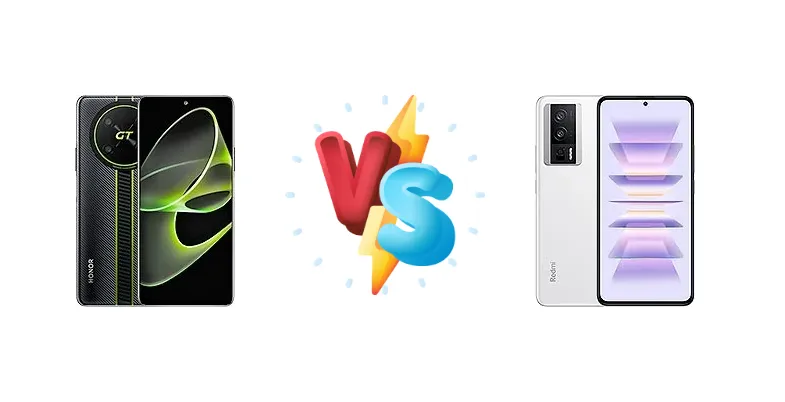
The Honor X40 GT and Xiaomi Redmi K60 Pro represent distinct approaches to the mid-to-high range smartphone market. The X40 GT leverages the still-capable Snapdragon 888 to deliver strong performance at a competitive price, while the K60 Pro jumps forward with the latest Snapdragon 8 Gen 2, promising a significant boost in power and efficiency. This comparison dissects the key differences to determine which device offers the best value for your money.
🏆 Quick Verdict
For most users, the Xiaomi Redmi K60 Pro is the superior choice. Its Snapdragon 8 Gen 2 chipset delivers substantially improved performance and efficiency compared to the Honor X40 GT’s Snapdragon 888, alongside significantly faster 120W charging. While the X40 GT offers a compelling price point, the K60 Pro’s advancements justify the price premium.
| Network |
|---|
| 2G bands | GSM 850 / 900 / 1800 / 1900 | GSM 850 / 900 / 1800 / 1900 |
| 3G bands | HSDPA 850 / 900 / 1700(AWS) / 1900 / 2100 | HSDPA 800 / 850 / 900 / 1700(AWS) / 2100 |
| 4G bands | LTE | 1, 3, 4, 5, 8, 18, 19, 26, 34, 38, 39, 40, 41, 42 |
| 5G bands | SA/NSA | 1, 3, 5, 8, 28, 38, 41, 77, 78 SA/NSA |
| Speed | HSPA, LTE, 5G | HSPA, LTE, 5G |
| Technology | GSM / CDMA / HSPA / EVDO / LTE / 5G | GSM / CDMA / HSPA / CDMA2000 / LTE / 5G |
| | CDMA2000 1xEV-DO | CDMA2000 1x |
| Launch |
|---|
| Announced | 2022, October 13 | 2022, December 27 |
| Status | Available. Released 2022, October 18 | Available. Released 2023, January 01 |
| Body |
|---|
| Dimensions | 166.1 x 75.8 x 8.5 mm (6.54 x 2.98 x 0.33 in) | 162.8 x 75.4 x 8.6 mm or 8.9 mm |
| SIM | Nano-SIM + Nano-SIM | Nano-SIM + Nano-SIM |
| Weight | 199.5 g (7.05 oz) | 201 g or 205 g (7.09 oz) |
| Display |
|---|
| Resolution | 1080 x 2388 pixels (~385 ppi density) | 1440 x 3200 pixels, 20:9 ratio (~526 ppi density) |
| Size | 6.81 inches, 112.3 cm2 (~89.2% screen-to-body ratio) | 6.67 inches, 107.4 cm2 (~87.5% screen-to-body ratio) |
| Type | IPS LCD, 144Hz | OLED, 68B colors, 120Hz, Dolby Vision, HDR10+, 1400 nits (peak) |
| Platform |
|---|
| CPU | Octa-core (1x2.84 GHz Cortex-X1 & 3x2.42 GHz Cortex-A78 & 4x1.80 GHz Cortex-A55) | Octa-core (1x3.2 GHz Cortex-X3 & 2x2.8 GHz Cortex-A715 & 2x2.8 GHz Cortex-A710 & 3x2.0 GHz Cortex-A510) |
| Chipset | Qualcomm SM8350 Snapdragon 888 5G (5 nm) | Qualcomm SM8550-AB Snapdragon 8 Gen 2 (4 nm) |
| GPU | Adreno 660 | Adreno 740 |
| OS | Android 12, Magic UI 6.1 | Android 13, MIUI 14 |
| Memory |
|---|
| Card slot | No | No |
| Internal | 256GB 8GB RAM, 256GB 12GB RAM | 128GB 8GB RAM, 256GB 8GB RAM, 256GB 12GB RAM, 512GB 12GB RAM, 512GB 16GB RAM |
| | UFS 3.1 | UFS 4.0
UFS 3.1 - 128GB only |
| Main Camera |
|---|
| Features | LED flash, panorama, HDR | Color spectrum sensor, Dual-LED dual-tone flash, HDR, panorama |
| Single | 16 MP, f/2.5 | - |
| Triple | 50 MP, f/1.8, (wide), PDAF
2 MP (macro)
Auxiliary lens | 54 MP, f/1.9, (wide), 1/1.49", 1.0µm, PDAF, OIS
8 MP, 118˚ (ultrawide), 1/4.0", 1.12µm
2 MP (macro) |
| Video | 4K@30fps, 1080p@30fps; gyro-EIS | 8K@24fps, 4K@30/60fps, 1080p@30/60/120/240/960fps, 720p@1920fps, gyro-EIS |
| Selfie camera |
|---|
| Features | - | HDR |
| Single | 16 MP, f/2.5 | 16 MP, (wide), 1/3.06", 1.0µm |
| Video | 1080p@30fps | 1080p@30/60/120fps |
| Sound |
|---|
| 3.5mm jack | No | No |
| 35mm jack | No | No |
| Loudspeaker | Yes | Yes, with stereo speakers |
| | - | 24-bit/192kHz audio |
| Comms |
|---|
| Bluetooth | 5.2, A2DP, LE, aptX HD | 5.3, A2DP, LE |
| Infrared port | - | Yes |
| NFC | Yes | Yes |
| Positioning | GPS, GLONASS, GALILEO, BDS | GPS (L1+L5), GLONASS (G1), BDS (B1I+B2a+Bc), GALILEO (E1+E5a), QZSS (L1+L5), NavIC |
| Radio | No | Unspecified |
| USB | USB Type-C 2.0, OTG | USB Type-C 2.0, OTG |
| WLAN | Wi-Fi 802.11 a/b/g/n/ac/6, dual-band, Wi-Fi Direct | Wi-Fi 802.11 a/b/g/n/ac/6e, dual-band, Wi-Fi Direct |
| Features |
|---|
| Sensors | Fingerprint (side-mounted), accelerometer, gyro, compass | Fingerprint (under display, optical), accelerometer, gyro, proximity, compass |
| | Virtual proximity sensing | - |
| Battery |
|---|
| Charging | 66W wired, 90% in 30 min
5W reverse wired | 120W wired, PD3.0, QC3+, 100% in 19 min
30W wireless |
| Type | Li-Po 4800 mAh | Li-Po 5000 mAh |
| Misc |
|---|
| Colors | Racing Black, Black, Silver | Black, White, Mint, Champion Black |
| Models | ADT-AN00 | 22127RK46C |
| Price | About 300 EUR | About 460 EUR |
Honor X40 GT
- More affordable price point
- Still capable Snapdragon 888 performance
- 66W fast charging is respectable
- Snapdragon 888 is less efficient and prone to throttling
- Slower charging compared to the K60 Pro
- Older chipset limits future software support
Xiaomi Redmi K60 Pro
- Significantly faster Snapdragon 8 Gen 2 performance
- Ultra-fast 120W wired charging
- 30W wireless charging support
- More efficient chipset for longer battery life
- Higher price tag
- May be overkill for basic users
Display Comparison
While display specifications aren't provided, both phones likely feature high refresh rate AMOLED panels common in this segment. However, the K60 Pro benefits from the more advanced image signal processor (ISP) within the Snapdragon 8 Gen 2, potentially leading to better color accuracy and dynamic range. The X40 GT, using the older chipset, may exhibit slightly less refined image processing. Bezels are likely comparable, but the K60 Pro’s newer architecture allows for potentially more efficient panel control.
Camera Comparison
Without specific camera sensor details, it’s difficult to make a definitive statement. However, the Snapdragon 8 Gen 2’s superior ISP in the K60 Pro provides a significant advantage in image processing, offering better noise reduction, dynamic range, and overall image quality. The K60 Pro is likely to support more advanced features like 8K video recording and improved low-light performance. The X40 GT’s camera system will be competent, but limited by the older chipset’s processing capabilities. We can assume both phones will have a multi-camera setup, but the K60 Pro will likely have a larger main sensor and more sophisticated image stabilization.
Performance
The core difference lies in the chipsets. The Xiaomi Redmi K60 Pro’s Snapdragon 8 Gen 2 (4nm) is a significant upgrade over the Honor X40 GT’s Snapdragon 888 (5nm). The Gen 2 utilizes the newer Cortex-X3 prime core clocked at 3.2GHz, alongside improved Cortex-A715 and A710 performance cores, resulting in a substantial performance uplift in both CPU and GPU tasks. The 4nm process node of the Gen 2 also translates to better thermal efficiency, minimizing throttling during sustained workloads like gaming. The X40 GT’s Snapdragon 888, while still powerful, will likely exhibit more thermal throttling under heavy load. The K60 Pro’s LPDDR5x RAM further enhances performance compared to the likely LPDDR5 found in the X40 GT.
Battery Life
The Redmi K60 Pro’s 120W wired charging is a game-changer, promising a full charge in just 19 minutes. This is a massive advantage over the Honor X40 GT’s 66W charging, which takes 30 minutes to reach 90%. While battery capacity isn’t specified, the K60 Pro’s more efficient Snapdragon 8 Gen 2 chipset will likely deliver comparable or better battery life despite potentially having a similar capacity to the X40 GT. The K60 Pro also adds 30W wireless charging, a feature absent on the X40 GT.
Buying Guide
Buy the Honor X40 GT if you prioritize affordability and still need a capable gaming experience, understanding you'll be making compromises on raw power and long-term efficiency. Buy the Xiaomi Redmi K60 Pro if you demand the best possible performance, fastest charging speeds, and a more future-proofed device, even if it means spending more upfront.
Frequently Asked Questions
❓ Will the Snapdragon 888 in the Honor X40 GT overheat during prolonged gaming sessions?
The Snapdragon 888 is known to generate significant heat under sustained load. While Honor likely implemented thermal management solutions, expect some degree of throttling during extended gaming, potentially leading to reduced frame rates. The Redmi K60 Pro’s Snapdragon 8 Gen 2 is significantly more efficient and will handle prolonged gaming with less thermal throttling.
❓ Is the 120W charging on the Redmi K60 Pro safe for the battery's long-term health?
Xiaomi employs multiple safety mechanisms to mitigate the potential impact of fast charging on battery health. While fast charging *can* contribute to slightly faster battery degradation over several years, the convenience and speed offered by 120W charging are often considered worth the trade-off. The K60 Pro’s charging system is designed to optimize charging speed while protecting the battery.
❓ Does the Redmi K60 Pro support high frame rate gaming (90fps or 120fps) in popular titles like PUBG Mobile?
The Snapdragon 8 Gen 2 in the Redmi K60 Pro is more than capable of delivering high frame rates in PUBG Mobile and other demanding games. Expect to achieve stable 90fps or even 120fps performance on high graphics settings, depending on the game’s optimization. The Honor X40 GT may struggle to maintain consistently high frame rates at the same settings.