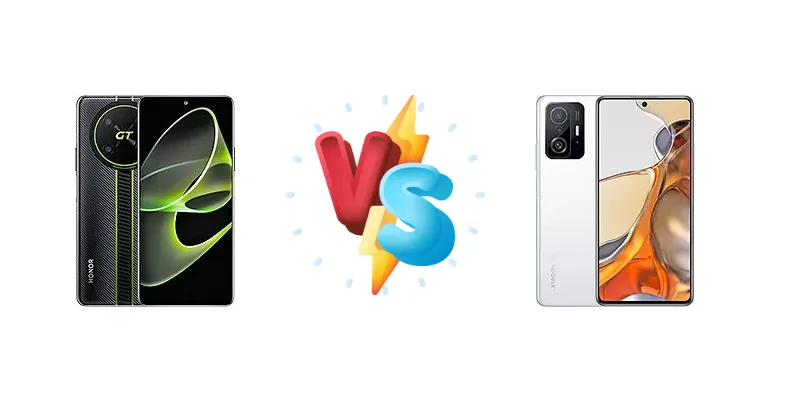
The mid-range smartphone market is fiercely competitive, and the Honor X40 GT and Xiaomi 11T Pro are two strong contenders. Both pack the Snapdragon 888 chipset, promising excellent performance, but they differ significantly in other areas. Let's dive into a comprehensive comparison to help you decide which one is right for you.
🏆 Quick Verdict
The Xiaomi 11T Pro takes the crown thanks to its significantly faster 120W charging, brighter display, and potentially superior camera system. While the Honor X40 GT offers good value, the 11T Pro's overall package is more compelling, especially for those prioritizing speed and display quality.
| Network |
|---|
| 2G bands | GSM 850 / 900 / 1800 / 1900 | GSM 850 / 900 / 1800 / 1900 |
| 3G bands | HSDPA 850 / 900 / 1700(AWS) / 1900 / 2100 | HSDPA 850 / 900 / 1700(AWS) / 1900 / 2100 |
| 4G bands | LTE | 1, 2, 3, 4, 5, 7, 8, 12, 13, 17, 18, 19, 20, 26, 28, 32, 38, 40, 41, 42, 66 |
| 5G bands | SA/NSA | 1, 3, 5, 7, 8, 20, 28, 38, 40, 41, 66, 77, 78 SA/NSA |
| Speed | HSPA, LTE, 5G | HSPA, LTE, 5G |
| Technology | GSM / CDMA / HSPA / EVDO / LTE / 5G | GSM / HSPA / LTE / 5G |
| | CDMA2000 1xEV-DO | - |
| Launch |
|---|
| Announced | 2022, October 13 | 2021, September 15 |
| Status | Available. Released 2022, October 18 | Available. Released 2021, October 05 |
| Body |
|---|
| Build | - | Glass front (Gorilla Glass Victus), aluminum frame, glass back |
| Dimensions | 166.1 x 75.8 x 8.5 mm (6.54 x 2.98 x 0.33 in) | 164.1 x 76.9 x 8.8 mm (6.46 x 3.03 x 0.35 in) |
| SIM | Nano-SIM + Nano-SIM | Nano-SIM + Nano-SIM |
| Weight | 199.5 g (7.05 oz) | 204 g (7.20 oz) |
| | - | IP53, dust and splash resistant |
| Display |
|---|
| Protection | - | Corning Gorilla Glass Victus |
| Resolution | 1080 x 2388 pixels (~385 ppi density) | 1080 x 2400 pixels, 20:9 ratio (~395 ppi density) |
| Size | 6.81 inches, 112.3 cm2 (~89.2% screen-to-body ratio) | 6.67 inches, 107.4 cm2 (~85.1% screen-to-body ratio) |
| Type | IPS LCD, 144Hz | AMOLED, Dolby Vision, 1B colors, 120Hz, HDR10+, 800 nits (typ), 1000 nits (peak) |
| Platform |
|---|
| CPU | Octa-core (1x2.84 GHz Cortex-X1 & 3x2.42 GHz Cortex-A78 & 4x1.80 GHz Cortex-A55) | Octa-core (1x2.84 GHz Cortex-X1 & 3x2.42 GHz Cortex-A78 & 4x1.80 GHz Cortex-A55) |
| Chipset | Qualcomm SM8350 Snapdragon 888 5G (5 nm) | Qualcomm SM8350 Snapdragon 888 5G (5 nm) |
| GPU | Adreno 660 | Adreno 660 |
| OS | Android 12, Magic UI 6.1 | Android 11, upgradable to Android 13, MIUI 14 |
| Memory |
|---|
| Card slot | No | No |
| Internal | 256GB 8GB RAM, 256GB 12GB RAM | 128GB 8GB RAM, 256GB 8GB RAM, 256GB 12GB RAM |
| | UFS 3.1 | UFS 3.1 |
| Main Camera |
|---|
| Features | LED flash, panorama, HDR | Dual-LED dual-tone flash, HDR, panorama |
| Single | 16 MP, f/2.5 | 16 MP, f/2.5, (wide), 1/3.06", 1.0µm |
| Triple | 50 MP, f/1.8, (wide), PDAF
2 MP (macro)
Auxiliary lens | 108 MP, f/1.8, 26mm (wide), 1/1.52", 0.7µm, PDAF
8 MP, f/2.2, 120˚ (ultrawide), 1/4.0", 1.12µm
5 MP, f/2.4, 50mm (telephoto macro), 1/5.0", 1.12µm, AF |
| Video | 4K@30fps, 1080p@30fps; gyro-EIS | 8K@30fps, 4K@30/60fps, 1080p@30/60/120/240/960, HDR10+, gyro-EIS |
| Selfie camera |
|---|
| Single | 16 MP, f/2.5 | 16 MP, f/2.5, (wide), 1/3.06", 1.0µm |
| Video | 1080p@30fps | 1080p@30/60fps |
| Sound |
|---|
| 3.5mm jack | No | No |
| 35mm jack | No | No |
| Loudspeaker | Yes | Yes, with stereo speakers |
| | - | Tuned by Harman Kardon
24-bit/192kHz audio |
| Comms |
|---|
| Bluetooth | 5.2, A2DP, LE, aptX HD | 5.2, A2DP, LE, aptX HD, aptX Adaptive |
| Infrared port | - | Yes |
| NFC | Yes | Yes |
| Positioning | GPS, GLONASS, GALILEO, BDS | GPS (L1+L5), GLONASS (G1), BDS (B1), GALILEO (E1+E5a), QZSS (L1+L5), NavIC |
| Radio | No | No |
| USB | USB Type-C 2.0, OTG | USB Type-C 2.0, OTG |
| WLAN | Wi-Fi 802.11 a/b/g/n/ac/6, dual-band, Wi-Fi Direct | Wi-Fi 802.11 a/b/g/n/ac/6, dual-band, Wi-Fi Direct |
| Features |
|---|
| Sensors | Fingerprint (side-mounted), accelerometer, gyro, compass | Fingerprint (side-mounted), accelerometer, gyro, compass, barometer |
| | Virtual proximity sensing | - |
| Battery |
|---|
| Charging | 66W wired, 90% in 30 min
5W reverse wired | 120W wired, PD3.0, QC3, 72% in 10 min, 100% in 17 min |
| Type | Li-Po 4800 mAh | Li-Po 5000 mAh |
| Misc |
|---|
| Colors | Racing Black, Black, Silver | Meteorite Gray, Moonlight White, Celestial Blue |
| Models | ADT-AN00 | 2107113SG, 2107113SI, 2107113SR |
| Price | About 300 EUR | € 139.00 / $ 185.21 / £ 189.99 / ₹ 39,999 |
| SAR | - | 0.78 W/kg (head) 0.49 W/kg (body) |
| Tests |
|---|
| Battery life | - |
Endurance rating 92h
|
| Camera | - |
Photo / Video |
| Display | - |
Contrast ratio: Infinite (nominal) |
| Loudspeaker | - |
-26.3 LUFS (Good)
|
Honor X40 GT
- Powerful Snapdragon 888 chipset
- Good value for money
- Decent gaming performance
- Reverse wired charging
- Less bright display
- Slower charging speed
- Potentially less advanced camera
Xiaomi 11T Pro
- Extremely fast 120W charging
- Brighter and higher contrast display
- Potentially superior camera system
- Excellent battery life
- Higher price
- Older model (potential software update concerns)
Display Comparison
The Xiaomi 11T Pro boasts a measured peak brightness of 837 nits, significantly brighter than the Honor X40 GT. While the X40 GT's display is likely good, the 11T Pro's higher brightness offers better visibility in sunlight and a more immersive viewing experience. The 11T Pro also advertises an 'infinite' contrast ratio, suggesting excellent blacks and vibrant colors.
Camera Comparison
While both phones are listed as having 'Photo / Video' capabilities, the Xiaomi 11T Pro is generally considered to have a more advanced camera system. It likely features better image processing and potentially higher-resolution sensors. The X40 GT's camera is likely adequate, but not a standout feature.
Performance
Both phones share the same Snapdragon 888 chipset, ensuring comparable performance in most tasks. Gaming performance should be similar, although the X40 GT might have slightly better thermal management due to its design. However, day-to-day usage will feel very similar on both devices.
Battery Life
The Xiaomi 11T Pro's endurance rating of 92h is impressive, suggesting excellent battery life. The Honor X40 GT's battery life is likely good, but not as exceptional as the 11T Pro. More importantly, the Xiaomi 11T Pro's 120W charging is a game-changer, allowing for incredibly fast charging times compared to the X40 GT's 66W.
Buying Guide
The Honor X40 GT is a great choice for budget-conscious buyers who want a powerful processor and decent gaming performance. The Xiaomi 11T Pro is ideal for users who demand fast charging, a vibrant display, and a more refined camera experience, even if it comes at a slightly higher price.
Frequently Asked Questions
❓ Is the Snapdragon 888 still a good chipset?
Yes, the Snapdragon 888 is still a very capable chipset, offering excellent performance for most tasks and games. While newer chipsets are available, the 888 remains a strong performer in this price range.
❓ Which phone has better software support?
Xiaomi generally offers good software support, but as the 11T Pro is an older model, future updates may be limited. Honor's software support can vary, so it's best to check their current update policies.