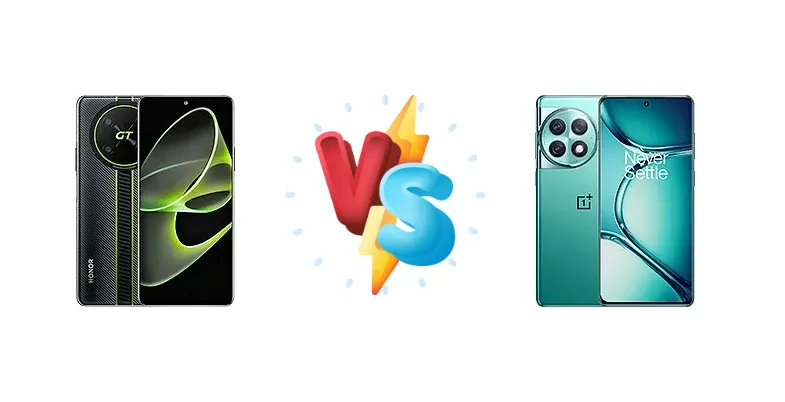
The Honor X40 GT and OnePlus Ace 2 Pro represent distinct points in the Android flagship timeline. The X40 GT, powered by the Snapdragon 888, offers a compelling value proposition, while the Ace 2 Pro leverages the significantly more advanced Snapdragon 8 Gen 2. This comparison dissects the core differences, helping you determine which device best suits your needs and budget.
🏆 Quick Verdict
For most users, the OnePlus Ace 2 Pro is the clear winner. The Snapdragon 8 Gen 2 delivers substantially improved performance and efficiency, coupled with blazing-fast 150W charging. While the Honor X40 GT provides excellent value, the generational leap in processing power and charging speed justifies the Ace 2 Pro's higher price.
| Network |
|---|
| 2G bands | GSM 850 / 900 / 1800 / 1900 | GSM 850 / 900 / 1800 / 1900 |
| 3G bands | HSDPA 850 / 900 / 1700(AWS) / 1900 / 2100 | HSDPA 850 / 900 / 1700(AWS) / 2100 |
| 4G bands | LTE | 1, 3, 4, 5, 7, 8, 18, 19, 26, 28, 34, 38, 39, 40, 41 |
| 5G bands | SA/NSA | 1, 3, 5, 8, 28, 41, 77, 78 SA/NSA |
| Speed | HSPA, LTE, 5G | HSPA, LTE, 5G |
| Technology | GSM / CDMA / HSPA / EVDO / LTE / 5G | GSM / CDMA / HSPA / LTE / 5G |
| | CDMA2000 1xEV-DO | - |
| Launch |
|---|
| Announced | 2022, October 13 | 2023, August 16 |
| Status | Available. Released 2022, October 18 | Available. Released 2023, August 23 |
| Body |
|---|
| Build | - | Glass front (Asahi Glass), plastic frame, glass back (Gorilla Glass 5) |
| Dimensions | 166.1 x 75.8 x 8.5 mm (6.54 x 2.98 x 0.33 in) | 163.1 x 74.2 x 9 mm (6.42 x 2.92 x 0.35 in) |
| SIM | Nano-SIM + Nano-SIM | Nano-SIM + Nano-SIM |
| Weight | 199.5 g (7.05 oz) | 210 g (7.41 oz) |
| Display |
|---|
| Protection | - | Asahi Glass |
| Resolution | 1080 x 2388 pixels (~385 ppi density) | 1240 x 2772 pixels, 20:9 ratio (~451 ppi density) |
| Size | 6.81 inches, 112.3 cm2 (~89.2% screen-to-body ratio) | 6.74 inches, 109.2 cm2 (~90.3% screen-to-body ratio) |
| Type | IPS LCD, 144Hz | AMOLED, 1B colors, 120Hz, HDR10+, 550 nits (typ), 1200 nits (HBM), 1600 nits (peak) |
| Platform |
|---|
| CPU | Octa-core (1x2.84 GHz Cortex-X1 & 3x2.42 GHz Cortex-A78 & 4x1.80 GHz Cortex-A55) | Octa-core (1x3.2 GHz Cortex-X3 & 2x2.8 GHz Cortex-A715 & 2x2.8 GHz Cortex-A710 & 3x2.0 GHz Cortex-A510) |
| Chipset | Qualcomm SM8350 Snapdragon 888 5G (5 nm) | Qualcomm SM8550-AB Snapdragon 8 Gen 2 (4 nm) |
| GPU | Adreno 660 | Adreno 740 |
| OS | Android 12, Magic UI 6.1 | Android 13, ColorOS 13.1 |
| Memory |
|---|
| Card slot | No | No |
| Internal | 256GB 8GB RAM, 256GB 12GB RAM | 256GB 12GB RAM, 512GB 16GB RAM, 1TB 24GB RAM |
| | UFS 3.1 | - |
| Main Camera |
|---|
| Features | LED flash, panorama, HDR | Color spectrum sensor, LED flash, HDR, panorama |
| Single | 16 MP, f/2.5 | - |
| Triple | 50 MP, f/1.8, (wide), PDAF
2 MP (macro)
Auxiliary lens | 50 MP, f/1.8, 24mm (wide), 1/1.56", 1.0µm, PDAF, OIS
8 MP, f/2.2, 16mm, 112˚ (ultrawide), 1/4.0", 1.12µm
2 MP (macro) |
| Video | 4K@30fps, 1080p@30fps; gyro-EIS | 4K@30/60fps, 1080p@30/60/120/240fps, gyro-EIS, OIS |
| Selfie camera |
|---|
| Features | - | HDR |
| Single | 16 MP, f/2.5 | 16 MP, f/2.4, 26mm (wide), 1/3.09", 1.0µm |
| Video | 1080p@30fps | 1080p@30fps |
| Sound |
|---|
| 3.5mm jack | No | - |
| 35mm jack | No | No |
| Loudspeaker | Yes | Yes, with stereo speakers |
| Comms |
|---|
| Bluetooth | 5.2, A2DP, LE, aptX HD | 5.3, A2DP, LE, aptX HD |
| Infrared port | - | Yes |
| NFC | Yes | Yes |
| Positioning | GPS, GLONASS, GALILEO, BDS | GPS (L1+L5), GLONASS (G1), BDS (B1I+B1c+B2a), GALILEO (E1+E5a), QZSS (L1+L5) |
| Radio | No | No |
| USB | USB Type-C 2.0, OTG | USB Type-C 2.0 |
| WLAN | Wi-Fi 802.11 a/b/g/n/ac/6, dual-band, Wi-Fi Direct | Wi-Fi 802.11 a/b/g/n/ac/6/7, dual-band |
| Features |
|---|
| Sensors | Fingerprint (side-mounted), accelerometer, gyro, compass | Fingerprint (under display, optical), accelerometer, gyro, proximity, compass |
| | Virtual proximity sensing | - |
| Battery |
|---|
| Charging | 66W wired, 90% in 30 min
5W reverse wired | 150W wired |
| Type | Li-Po 4800 mAh | Li-Po 5000 mAh |
| Misc |
|---|
| Colors | Racing Black, Black, Silver | Aurora Green, Titanium Gray |
| Models | ADT-AN00 | PJA110 |
| Price | About 300 EUR | About 380 EUR |
Honor X40 GT
- Significantly more affordable
- Still offers capable performance for most tasks
- Decent 66W fast charging
- Older Snapdragon 888 chipset
- Less efficient and prone to throttling
- Likely inferior camera performance
OnePlus Ace 2 Pro
- Cutting-edge Snapdragon 8 Gen 2 performance
- Blazing-fast 150W charging
- Superior thermal efficiency and sustained performance
- Higher price point
- May be overkill for basic users
- Potentially larger physical size
Display Comparison
While display specifications aren't provided, both phones likely feature high refresh rate AMOLED panels, common in their respective price brackets. However, the Ace 2 Pro, being a newer device, likely benefits from advancements in panel technology, potentially offering higher peak brightness and improved color accuracy. The Snapdragon 8 Gen 2’s ISP also supports more advanced display processing, potentially leading to a more vibrant and refined visual experience. Bezels are expected to be minimal on both, but the Ace 2 Pro may have a slight edge in screen-to-body ratio.
Camera Comparison
Without specific camera specs, it’s difficult to make a definitive comparison. However, the Ace 2 Pro, as a newer flagship, likely incorporates a more advanced camera system. The Snapdragon 8 Gen 2’s ISP (Image Signal Processor) is significantly more capable than the 888’s, enabling better image processing, noise reduction, and dynamic range. Expect the Ace 2 Pro to excel in low-light photography and video recording. The X40 GT will likely offer a respectable camera experience, but will fall short of the Ace 2 Pro’s capabilities. We can assume both phones will have a primary wide-angle lens, but the Ace 2 Pro likely has a larger sensor and more sophisticated stabilization.
Performance
The core difference lies in the chipsets. The OnePlus Ace 2 Pro’s Snapdragon 8 Gen 2 (4nm) is a significant upgrade over the Honor X40 GT’s Snapdragon 888 (5nm). The 8 Gen 2 features a newer CPU architecture – Cortex-X3, A715, and A710 – offering substantial gains in both single-core and multi-core performance. The 4nm process node also contributes to improved thermal efficiency, meaning the Ace 2 Pro will likely sustain peak performance for longer periods without throttling. The X40 GT’s Snapdragon 888, while still capable, will struggle to match the Ace 2 Pro in demanding tasks. The Ace 2 Pro also benefits from faster LPDDR5x RAM, further enhancing responsiveness.
Battery Life
The Honor X40 GT offers 66W wired charging, capable of reaching 90% charge in 30 minutes. The OnePlus Ace 2 Pro, however, boasts a staggering 150W wired charging, dramatically reducing charging times. While battery capacity isn’t specified, the Ace 2 Pro’s faster charging effectively mitigates any potential disadvantage from a smaller battery. Users who frequently need to top up their phone will greatly benefit from the Ace 2 Pro’s charging speed. The 5W reverse wired charging on the X40 GT is a useful, but niche, feature.
Buying Guide
Buy the Honor X40 GT if you prioritize affordability and still need strong performance for everyday tasks and moderate gaming. It’s ideal for users who don’t demand the absolute latest and greatest, and are comfortable with a slightly older chipset. Buy the OnePlus Ace 2 Pro if you demand top-tier performance for demanding games, content creation, or heavy multitasking, and value the convenience of incredibly fast charging. This is the phone for power users who want a no-compromise experience.
Frequently Asked Questions
❓ Will the Snapdragon 888 in the Honor X40 GT struggle with graphically intensive games like Genshin Impact?
The Snapdragon 888 is capable of running Genshin Impact, but you'll likely need to lower graphics settings to maintain a stable frame rate. It's also more prone to thermal throttling during extended gaming sessions, potentially leading to performance drops. The Ace 2 Pro’s Snapdragon 8 Gen 2 will deliver a significantly smoother and more consistent gaming experience at higher settings.
❓ How much faster is the 150W charging on the OnePlus Ace 2 Pro compared to the 66W charging on the Honor X40 GT in real-world use?
The 150W charging on the Ace 2 Pro can fully charge the phone in around 30 minutes, while the X40 GT takes considerably longer. This means you can quickly top up your Ace 2 Pro during short breaks, making it ideal for users who are always on the go. The X40 GT’s 66W charging is still fast, but it doesn’t offer the same level of convenience.
❓ Is the difference in performance between the Snapdragon 888 and 8 Gen 2 noticeable for everyday tasks like browsing and social media?
For basic tasks, the difference may not be immediately apparent. However, the Snapdragon 8 Gen 2 offers a smoother and more responsive experience overall, especially when multitasking or switching between apps. The Ace 2 Pro will feel noticeably faster and more fluid in everyday use.