
Honor X40 GT vs. Google Pixel 7a: A Deep Dive into Performance and Value
| Phones Images | |||||
|---|---|---|---|---|---|
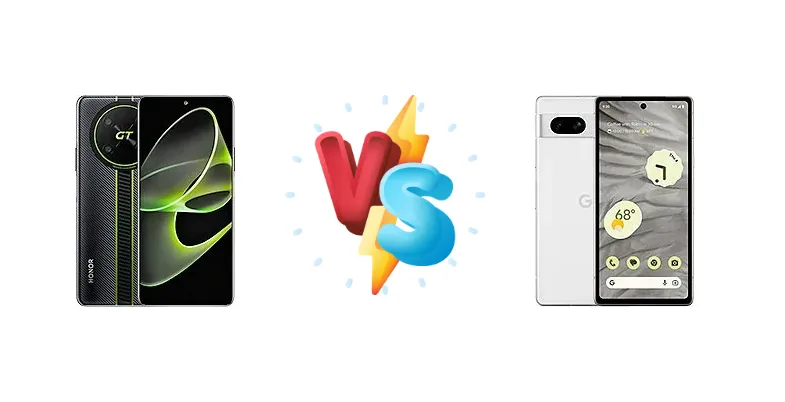
|
🏆 Quick Verdict
For users prioritizing raw gaming performance and rapid charging, the Honor X40 GT is the clear winner. However, the Google Pixel 7a excels in computational photography, software experience, and offers a brighter display, making it the better all-rounder for most users.
| PHONES | ||
|---|---|---|
| Phone Names | Honor X40 GT | Google Pixel 7a |
| Network | ||
|---|---|---|
| 2G bands | GSM 850 / 900 / 1800 / 1900 | GSM 850 / 900 / 1800 / 1900 |
| 3G bands | HSDPA 850 / 900 / 1700(AWS) / 1900 / 2100 | HSDPA 800 / 850 / 900 / 1700(AWS) / 1900 / 2100 |
| 4G bands | LTE | 1, 2, 3, 4, 5, 7, 8, 12, 13, 14, 17, 20, 25, 26, 28, 29, 30, 38, 40, 41, 48, 66, 71 - GWKK3, G0DZQ |
| 5G bands | SA/NSA | 1, 2, 3, 5, 7, 8, 12, 14, 20, 25, 28, 30, 38, 41, 48, 66, 71, 77, 78 SA/NSA/Sub6 - GWKK3 |
| Speed | HSPA, LTE, 5G | HSPA, LTE, 5G |
| Technology | GSM / CDMA / HSPA / EVDO / LTE / 5G | GSM / HSPA / LTE / 5G |
| CDMA2000 1xEV-DO | 1, 2, 3, 5, 7, 8, 12, 20, 25, 28, 38, 40, 41, 66, 75, 76, 77, 78, 79 SA/NSA/Sub6 - GHL1X, G82U8 | |
| Launch | ||
|---|---|---|
| Announced | 2022, October 13 | 2023, May 10 |
| Status | Available. Released 2022, October 18 | Available. Released 2023, May 10 |
| Body | ||
|---|---|---|
| Build | - | Glass front (Gorilla Glass 3), aluminum frame, plastic back |
| Dimensions | 166.1 x 75.8 x 8.5 mm (6.54 x 2.98 x 0.33 in) | 152 x 72.9 x 9 mm (5.98 x 2.87 x 0.35 in) |
| SIM | Nano-SIM + Nano-SIM | Nano-SIM + eSIM |
| Weight | 199.5 g (7.05 oz) | 193.5 g (6.84 oz) |
| - | IP67 dust/water resistant (up to 1m for 30 min) | |
| Display | ||
|---|---|---|
| Protection | - | Corning Gorilla Glass 3 |
| Resolution | 1080 x 2388 pixels (~385 ppi density) | 1080 x 2400 pixels, 20:9 ratio (~429 ppi density) |
| Size | 6.81 inches, 112.3 cm2 (~89.2% screen-to-body ratio) | 6.1 inches, 90.7 cm2 (~81.8% screen-to-body ratio) |
| Type | IPS LCD, 144Hz | OLED, HDR, 90Hz |
| - | Always-on display | |
| Platform | ||
|---|---|---|
| CPU | Octa-core (1x2.84 GHz Cortex-X1 & 3x2.42 GHz Cortex-A78 & 4x1.80 GHz Cortex-A55) | Octa-core (2x2.85 GHz Cortex-X1 & 2x2.35 GHz Cortex-A78 & 4x1.80 GHz Cortex-A55) |
| Chipset | Qualcomm SM8350 Snapdragon 888 5G (5 nm) | Google Tensor G2 (5 nm) |
| GPU | Adreno 660 | Mali-G710 MP7 |
| OS | Android 12, Magic UI 6.1 | Android 13, upgradable to Android 15, up to 5 major Android upgrades |
| Memory | ||
|---|---|---|
| Card slot | No | No |
| Internal | 256GB 8GB RAM, 256GB 12GB RAM | 128GB 8GB RAM |
| UFS 3.1 | UFS 3.1 | |
| Main Camera | ||
|---|---|---|
| Dual | - | 64 MP, f/1.9, 26mm (wide), 1/1.73", 0.8µm, dual pixel PDAF, OIS 13 MP, f/2.2, 120˚ (ultrawide), 1.12µm |
| Features | LED flash, panorama, HDR | Dual-LED flash, Pixel Shift, Auto-HDR, panorama |
| Single | 16 MP, f/2.5 | - |
| Triple | 50 MP, f/1.8, (wide), PDAF 2 MP (macro) Auxiliary lens | - |
| Video | 4K@30fps, 1080p@30fps; gyro-EIS | 4K@30/60fps, 1080p@30/60/120/240fps, OIS |
| Selfie camera | ||
|---|---|---|
| Features | - | HDR, panorama |
| Single | 16 MP, f/2.5 | 13 MP, f/2.2, 20mm (ultrawide), 1.12µm |
| Video | 1080p@30fps | 4K@30fps, 1080p@30fps |
| Sound | ||
|---|---|---|
| 3.5mm jack | No | No |
| 35mm jack | No | No |
| Loudspeaker | Yes | Yes, with stereo speakers |
| Comms | ||
|---|---|---|
| Bluetooth | 5.2, A2DP, LE, aptX HD | 5.3, A2DP, LE |
| NFC | Yes | Yes |
| Positioning | GPS, GLONASS, GALILEO, BDS | GPS, GLONASS, GALILEO, BDS, QZSS, NavIC |
| Radio | No | No |
| USB | USB Type-C 2.0, OTG | USB Type-C 3.2 |
| WLAN | Wi-Fi 802.11 a/b/g/n/ac/6, dual-band, Wi-Fi Direct | Wi-Fi 802.11 a/b/g/n/ac/6e, tri-band |
| Features | ||
|---|---|---|
| Sensors | Fingerprint (side-mounted), accelerometer, gyro, compass | Fingerprint (under display, optical), accelerometer, gyro, proximity, compass, barometer |
| Virtual proximity sensing | - | |
| Battery | ||
|---|---|---|
| Charging | 66W wired, 90% in 30 min 5W reverse wired | 18W wired, PD3.0 7.5W wireless |
| Type | Li-Po 4800 mAh | Li-Po 4385 mAh |
| Misc | ||
|---|---|---|
| Colors | Racing Black, Black, Silver | Charcoal, Snow, Sea, Coral |
| Models | ADT-AN00 | GWKK3, GHL1X, G0DZQ, G82U8 |
| Price | About 300 EUR | € 179.90 / $ 150.00 / £ 170.00 / ₹ 25,980 |
Honor X40 GT
- Faster 66W charging significantly reduces downtime.
- Snapdragon 888 offers strong gaming performance.
- Potentially lower price point for comparable specs.
- Older chipset may exhibit thermal throttling.
- Software updates may be less frequent and slower.
Google Pixel 7a
- Superior camera quality and computational photography.
- Google Tensor G2 excels in AI-powered features.
- Brighter display for better outdoor visibility.
- Guaranteed software updates and a clean Android experience.
- Slower 18W charging.
- Less raw GPU power compared to the Snapdragon 888.
Display Comparison
The Google Pixel 7a boasts a significantly brighter display, reaching a measured 1070 nits, compared to an unstated peak brightness for the Honor X40 GT. While the X40 GT’s panel specifics are unknown, the Pixel 7a’s brightness ensures excellent visibility outdoors. Both likely utilize OLED technology, but the Pixel 7a’s higher peak brightness and Google’s color calibration provide a more visually appealing experience. The absence of LTPO on either device suggests standard 60Hz or 90Hz refresh rates, impacting smoothness compared to flagship panels.
Camera Comparison
The Pixel 7a’s camera system is a key differentiator. While specific sensor details are missing for the X40 GT, the Pixel 7a leverages Google’s computational photography expertise. The Pixel 7a’s image processing excels in dynamic range and low-light performance. The Tensor G2’s image signal processor (ISP) is optimized for these tasks. The X40 GT may offer competitive hardware, but it likely won’t match the Pixel 7a’s software-driven image quality. Ignoring the typical 2MP macro lens found on many phones, the Pixel 7a’s focus is on delivering consistently excellent photos and videos.
Performance
Both phones utilize an octa-core CPU configuration with Cortex-X1, A78, and A55 cores, but the chipsets differ significantly. The Honor X40 GT’s Snapdragon 888 (5nm) is a proven performer, but it’s a generation older than the Google Pixel 7a’s Tensor G2 (5nm). While the Tensor G2 has slightly higher peak clock speeds on its X1 cores (2.85 GHz vs 2.84 GHz), its strength lies in its dedicated AI processing capabilities. The Snapdragon 888 will likely deliver higher sustained GPU performance for gaming, but the Tensor G2 excels in tasks like image processing and voice recognition. Thermal management is a concern for the Snapdragon 888, potentially leading to throttling under prolonged load.
Battery Life
The Google Pixel 7a has an endurance rating of 76 hours, suggesting efficient power management. The Honor X40 GT compensates for a potentially smaller battery with its 66W wired charging, capable of reaching 90% charge in just 30 minutes. The Pixel 7a’s 18W charging is considerably slower. While the Pixel 7a’s battery endurance is strong, the X40 GT’s charging speed is a significant advantage for users who need to quickly top up their device. The 7.5W wireless charging on the Pixel 7a is a convenient, albeit slow, alternative.
Buying Guide
Buy the Honor X40 GT if you need a phone primarily for demanding mobile games and appreciate incredibly fast 66W charging. It’s ideal for users who frequently push their device’s limits. Buy the Google Pixel 7a if you prioritize camera quality, a smooth and consistently updated software experience, and a vibrant display, even if it means sacrificing some peak performance and charging speed.