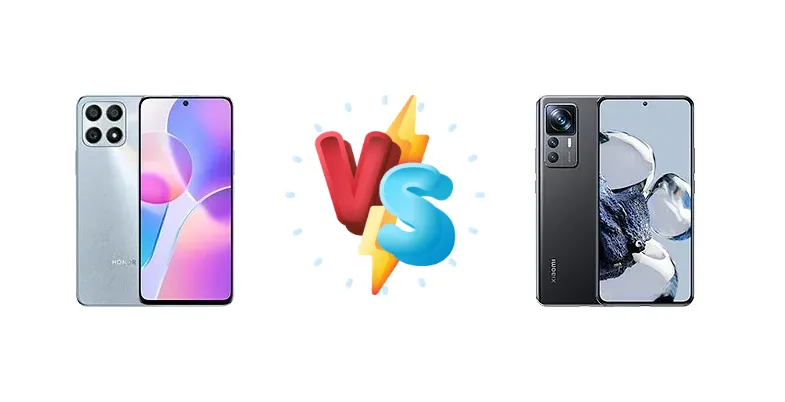
The smartphone market is overflowing with options, making it tough to choose. Today, we're pitting the budget-friendly Honor X30i against the powerhouse Xiaomi 12T Pro. This comparison will help you decide which device best suits your needs and budget.
🏆 Quick Verdict
The Xiaomi 12T Pro is the clear winner, boasting a significantly faster processor, superior camera system, and blazing-fast 120W charging. While the Honor X30i offers decent value, the 12T Pro's performance and features justify its higher price point.
| Network |
|---|
| 2G bands | GSM 850 / 900 / 1800 / 1900 | GSM 850 / 900 / 1800 / 1900 |
| 3G bands | HSDPA 850 / 900 / 1700(AWS) / 1900 / 2100 | HSDPA 800 / 850 / 900 / 1700(AWS) / 1900 / 2100 |
| 4G bands | LTE | 1, 2, 3, 4, 5, 7, 8, 12, 13, 17, 18, 19, 20, 25, 26, 28, 32, 38, 39, 40, 41, 42, 48, 66 |
| 5G bands | SA/NSA | 1, 3, 5, 7, 8, 20, 28, 38, 40, 41, 66, 77, 78, 75 SA/NSA |
| Speed | HSPA, LTE, 5G | HSPA, LTE, 5G |
| Technology | GSM / CDMA / HSPA / CDMA2000 / LTE / 5G | GSM / HSPA / LTE / 5G |
| | CDMA2000 1x | - |
| Launch |
|---|
| Announced | 2021, October 28 | 2022, October 04 |
| Status | Available. Released 2021, November 02 | Available. Released 2022, October 06 |
| Body |
|---|
| Build | Glass front, plastic frame, plastic back | - |
| Dimensions | 163.4 x 74.7 x 7.5 mm (6.43 x 2.94 x 0.30 in) | 163.1 x 75.9 x 8.6 mm (6.42 x 2.99 x 0.34 in) |
| SIM | Nano-SIM + Nano-SIM | · Nano-SIM + eSIM· Nano-SIM + Nano-SIM |
| Weight | 175 g (6.17 oz) | 205 g (7.23 oz) |
| | - | IP53, dust and splash resistant |
| Display |
|---|
| Protection | - | Corning Gorilla Glass 5 |
| Resolution | 1080 x 2388 pixels (~391 ppi density) | 1220 x 2712 pixels, 20:9 ratio (~446 ppi density) |
| Size | 6.7 inches, 108.7 cm2 (~89.1% screen-to-body ratio) | 6.67 inches, 107.4 cm2 (~86.7% screen-to-body ratio) |
| Type | IPS LCD, 90Hz | AMOLED, 68B colors, 120Hz, Dolby Vision, HDR10+, 500 nits (typ), 900 nits (peak) |
| Platform |
|---|
| CPU | Octa-core (2x2.4 GHz Cortex-A76 & 6x2.0 GHz Cortex-A55) | Octa-core (1x3.19 GHz Cortex-X2 & 3x2.75 GHz Cortex-A710 & 4x2.0 GHz Cortex-A510) |
| Chipset | Mediatek Dimensity 810 (6 nm) | Qualcomm SM8475 Snapdragon 8+ Gen 1 (4 nm) |
| GPU | Mali-G57 MC2 | Adreno 730 |
| OS | Android 11, Magic UI 5.0 | Android 12, upgradable to Android 14, HyperOS |
| Memory |
|---|
| Card slot | No | No |
| Internal | 128GB 6GB RAM, 128GB 8GB RAM, 256GB 8GB RAM | 128GB 8GB RAM, 256GB 8GB RAM, 256GB 12GB RAM |
| | - | UFS 3.1 |
| Main Camera |
|---|
| Features | LED flash, panorama, HDR | Color spectrum sensor, Dual-LED dual-tone flash, HDR, panorama |
| Single | 8 MP, f/2.0 | - |
| Triple | 48 MP, f/1.8, 26mm (wide), PDAF
2 MP (macro)
Auxiliary lens | 200 MP, f/1.7, (wide), 1/1.22", 0.64µm, PDAF, OIS
8 MP, f/2.2, 120˚ (ultrawide), 1/4.0", 1.12µm
2 MP (macro) |
| Video | 1080p@30fps | 8K@24fps, 4K@30/60fps, 1080p@30/60/120/240fps, HDR10+ |
| Selfie camera |
|---|
| Features | - | HDR, panorama |
| Single | 8 MP, f/2.0 | 20 MP, f/2.2, (wide), 1/3.47", 0.8µm |
| Video | 1080p@30fps | 1080p@30/60fps, HDR |
| Sound |
|---|
| 3.5mm jack | Yes | No |
| 35mm jack | Yes | No |
| Loudspeaker | Yes, with dual speakers | Yes, with stereo speakers |
| | - | Tuned by Harman Kardon
24-bit/192kHz audio |
| Comms |
|---|
| Bluetooth | 5.1, A2DP, LE | 5.2, A2DP, LE, aptX HD |
| Infrared port | - | Yes |
| NFC | No | Yes (market/region dependent) |
| Positioning | GPS, GLONASS, BDS | GPS (L1+L5), GLONASS (L1), BDS (B1I+B1c+B2a), GALILEO (E1+E5a), QZSS (L1+L5), NavIC (L5) |
| Radio | No | No |
| USB | USB Type-C 2.0, OTG | USB Type-C 2.0, OTG |
| WLAN | Wi-Fi 802.11 a/b/g/n/ac, dual-band, Wi-Fi Direct | Wi-Fi 802.11 a/b/g/n/ac/6, dual-band, Wi-Fi Direct |
| Features |
|---|
| Sensors | Fingerprint (side-mounted), accelerometer, compass | Fingerprint (under display, optical), accelerometer, gyro, proximity, compass |
| Battery |
|---|
| Charging | 22.5W wired | 120W wired, 100% in 19 min |
| Type | Li-Po 4000 mAh | Li-Po 5000 mAh |
| Misc |
|---|
| Colors | Black, Blue, Silver, Rose Gold | Black, Silver, Blue |
| Models | TFY-AN00 | 22081212UG, 22081212G |
| Price | About 190 EUR | $ 208.76 / € 167.62 |
| SAR | - | 1.08 W/kg (head) 1.07 W/kg (body) |
| SAR EU | - | 1.00 W/kg (head) 1.00 W/kg (body) |
| Tests |
|---|
| Battery life | - | Endurance rating 91h |
| Camera | - | Photo / Video |
| Display | - | Contrast ratio: Infinite (nominal) |
| Loudspeaker | - | -24.1 LUFS (Very good) |
| Performance | - | AnTuTu: 1032185 (v9)
GeekBench: 4081 (v5.1)
GFXBench: 65fps (ES 3.1 onscreen) |
Honor X30i
- Affordable price
- Large display
- Decent battery life
- Good value for money
- Lower performance
- Less impressive camera
- Slower charging
- Plastic build
Xiaomi 12T Pro
- Flagship performance
- Excellent camera
- Blazing-fast charging
- Bright and vibrant display
- Premium design
- Higher price
- Potential for overheating under heavy load
- Software bloat (potential)
Display Comparison
The Xiaomi 12T Pro's display shines with a measured peak brightness of 913 nits and an infinite contrast ratio, offering vibrant colors and excellent visibility even in direct sunlight. The Honor X30i likely has a decent display, but it won't match the 12T Pro's quality and brightness. Expect a more standard LCD experience on the X30i.
Camera Comparison
The Xiaomi 12T Pro's camera system is expected to be significantly better, offering higher resolution images, improved low-light performance, and more advanced features. While the Honor X30i's camera is adequate for casual snapshots, it won't compete with the 12T Pro's capabilities. Expect better dynamic range and detail on the Xiaomi.
Performance
Here's where the Xiaomi 12T Pro truly dominates. The Snapdragon 8+ Gen 1 chipset is a flagship-level processor, providing exceptional speed and responsiveness for gaming, multitasking, and demanding applications. The Dimensity 810 in the Honor X30i is capable, but it's in a different league, suitable for everyday use but struggling with intensive tasks.
Battery Life
Both phones boast impressive endurance ratings (91h). However, the Xiaomi 12T Pro's 120W charging is a game-changer, allowing it to recharge from 0% to 100% in just 19 minutes. The Honor X30i's 22.5W charging is considerably slower.
Buying Guide
The Honor X30i is ideal for budget-conscious users who prioritize a large display and decent battery life for everyday tasks. The Xiaomi 12T Pro is for users who demand top-tier performance, a high-quality camera, and incredibly fast charging, and are willing to pay a premium.
Frequently Asked Questions
❓ Is the Honor X30i good for gaming?
The Honor X30i can handle casual games, but it may struggle with demanding titles at high settings due to its less powerful processor.
❓ How much faster is the Xiaomi 12T Pro's charging?
The Xiaomi 12T Pro's 120W charging is significantly faster than the Honor X30i's 22.5W charging, allowing for a full charge in around 19 minutes compared to over an hour.