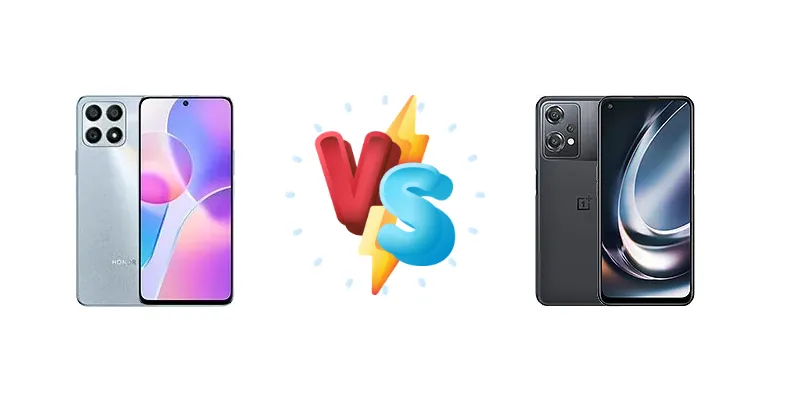
The Honor X30i and OnePlus Nord CE 2 Lite 5G represent compelling options in the increasingly competitive sub-$300 5G smartphone market. Both devices aim to deliver a balanced experience, but they take different approaches to achieving it. The X30i leans on MediaTek’s Dimensity 810, while the Nord CE 2 Lite opts for Qualcomm’s Snapdragon 695 5G. This comparison will dissect their key differences to determine which phone offers the best value.
🏆 Quick Verdict
For the average user prioritizing faster charging and a slightly more refined software experience, the OnePlus Nord CE 2 Lite 5G emerges as the better choice. Its 33W charging significantly reduces downtime, and Qualcomm’s Snapdragon platform generally offers broader software support. However, the Honor X30i remains a strong contender for those seeking raw CPU performance at a potentially lower price point.
| Network |
|---|
| 2G bands | GSM 850 / 900 / 1800 / 1900 | GSM 850 / 900 / 1800 / 1900 |
| 3G bands | HSDPA 850 / 900 / 1700(AWS) / 1900 / 2100 | HSDPA 800 / 850 / 900 / 1700(AWS) / 1900 / 2100 |
| 4G bands | LTE | 1, 2, 3, 4, 5, 7, 8, 12, 13, 17, 18, 19, 20, 26, 28, 38, 39, 40, 41, 66 - Europe |
| 5G bands | SA/NSA | 1, 3, 5, 7, 8, 20, 28, 38, 40, 41, 66, 77, 78 SA/NSA - Europe |
| Speed | HSPA, LTE, 5G | HSPA, LTE, 5G |
| Technology | GSM / CDMA / HSPA / CDMA2000 / LTE / 5G | GSM / HSPA / LTE / 5G |
| | CDMA2000 1x | - |
| Launch |
|---|
| Announced | 2021, October 28 | 2022, April 28 |
| Status | Available. Released 2021, November 02 | Available. Released 2022, April 30 |
| Body |
|---|
| Build | Glass front, plastic frame, plastic back | Glass front, plastic frame, plastic back |
| Dimensions | 163.4 x 74.7 x 7.5 mm (6.43 x 2.94 x 0.30 in) | 164.3 x 75.6 x 8.5 mm (6.47 x 2.98 x 0.33 in) |
| SIM | Nano-SIM + Nano-SIM | Nano-SIM + Nano-SIM |
| Weight | 175 g (6.17 oz) | 195 g (6.88 oz) |
| Display |
|---|
| Resolution | 1080 x 2388 pixels (~391 ppi density) | 1080 x 2412 pixels, 20:9 ratio (~401 ppi density) |
| Size | 6.7 inches, 108.7 cm2 (~89.1% screen-to-body ratio) | 6.59 inches, 104.5 cm2 (~84.1% screen-to-body ratio) |
| Type | IPS LCD, 90Hz | IPS LCD, 120Hz |
| Platform |
|---|
| CPU | Octa-core (2x2.4 GHz Cortex-A76 & 6x2.0 GHz Cortex-A55) | Octa-core (2x2.2 GHz Kryo 660 Gold & 6x1.7 GHz Kryo 660 Silver) |
| Chipset | Mediatek Dimensity 810 (6 nm) | Qualcomm SM6375 Snapdragon 695 5G (6 nm) |
| GPU | Mali-G57 MC2 | Adreno 619 |
| OS | Android 11, Magic UI 5.0 | Android 12, upgradable to Android 13, OxygenOS 13 |
| Memory |
|---|
| Card slot | No | microSDXC (uses shared SIM slot) |
| Internal | 128GB 6GB RAM, 128GB 8GB RAM, 256GB 8GB RAM | 128GB 6GB RAM, 128GB 8GB RAM |
| Main Camera |
|---|
| Features | LED flash, panorama, HDR | LED flash, HDR, panorama |
| Single | 8 MP, f/2.0 | - |
| Triple | 48 MP, f/1.8, 26mm (wide), PDAF
2 MP (macro)
Auxiliary lens | 64 MP, f/1.7, 26mm (wide), 0.7µm, PDAF
2 MP (macro)
Auxiliary lens |
| Video | 1080p@30fps | 1080p@30fps |
| Selfie camera |
|---|
| Features | - | HDR |
| Single | 8 MP, f/2.0 | 16 MP, f/2.0, (wide), 1/3.0", 1.0µm |
| Video | 1080p@30fps | 1080p@30fps |
| Sound |
|---|
| 3.5mm jack | Yes | Yes |
| 35mm jack | Yes | Yes |
| Loudspeaker | Yes, with dual speakers | Yes |
| Comms |
|---|
| Bluetooth | 5.1, A2DP, LE | 5.2, A2DP, LE, aptX HD |
| NFC | No | Yes (market/region dependent) |
| Positioning | GPS, GLONASS, BDS | GPS, GLONASS, GALILEO, BDS, QZSS |
| Radio | No | Unspecified |
| USB | USB Type-C 2.0, OTG | USB Type-C 2.0, OTG |
| WLAN | Wi-Fi 802.11 a/b/g/n/ac, dual-band, Wi-Fi Direct | Wi-Fi 802.11 a/b/g/n/ac, dual-band, Wi-Fi Direct |
| Features |
|---|
| Sensors | Fingerprint (side-mounted), accelerometer, compass | Fingerprint (side-mounted), accelerometer, gyro, proximity, compass |
| Battery |
|---|
| Charging | 22.5W wired | 33W wired |
| Type | Li-Po 4000 mAh | Li-Po 5000 mAh |
| Misc |
|---|
| Colors | Black, Blue, Silver, Rose Gold | Black Dusk, Blue Tide |
| Models | TFY-AN00 | CPH2381, CPH2409 |
| Price | About 190 EUR | About 220 EUR |
| SAR | - | 1.19 W/kg (head) 0.71 W/kg (body) |
Honor X30i
- Potentially higher peak CPU performance with Dimensity 810
- Competitive pricing (likely)
- 6nm process for improved efficiency
- Slower 22.5W charging
- Potentially less frequent software updates
- Uncertainty regarding display quality
OnePlus Nord CE 2 Lite 5G
- Faster 33W wired charging
- OxygenOS provides a cleaner software experience
- Qualcomm Snapdragon 695 offers balanced performance
- Slightly lower peak CPU performance compared to Dimensity 810
- May be slightly more expensive
- Relies heavily on software for camera performance
Display Comparison
Neither device boasts a standout display. Both likely utilize LCD panels, a common trait in this price bracket. The focus here isn't on cutting-edge tech, but on usability. While specific display specs are missing, the Honor X30i's potential for a higher refresh rate (based on market trends for the X series) could offer a smoother scrolling experience. However, without concrete data, it's difficult to assess color accuracy or peak brightness.
Camera Comparison
Without detailed camera specifications, a direct comparison is challenging. Both phones likely feature a multi-camera setup with a primary sensor, but the quality will heavily depend on sensor size and image processing algorithms. Given the price point, expect a focus on computational photography to enhance image quality. The absence of OIS on either device suggests reliance on software stabilization. The inclusion of a 2MP macro lens on either phone is largely a marketing tactic, offering limited practical benefit due to its low resolution and fixed focus.
Performance
The core difference lies in the chipsets. The Honor X30i’s MediaTek Dimensity 810 (6nm) features a CPU with 2x2.4 GHz Cortex-A76 cores and 6x2.0 GHz Cortex-A55 cores. This configuration prioritizes peak CPU performance, potentially offering a slight edge in benchmark scores compared to the OnePlus Nord CE 2 Lite 5G’s Qualcomm Snapdragon 695 5G (6nm) with its 2x2.2 GHz Kryo 660 Gold and 6x1.7 GHz Kryo 660 Silver cores. However, the Snapdragon 695 often demonstrates better sustained performance and GPU efficiency, making it a more balanced choice for gaming and everyday tasks. The 6nm process node on both chips ensures reasonable power efficiency, but Qualcomm’s Adreno GPU typically outperforms MediaTek’s integrated graphics in this tier.
Battery Life
The OnePlus Nord CE 2 Lite 5G’s 33W wired charging is a significant advantage over the Honor X30i’s 22.5W charging. This translates to considerably faster top-up times, reducing downtime and improving overall usability. While battery capacity isn't specified, the faster charging speed effectively mitigates any potential difference in mAh size. Users who frequently find themselves needing to quickly recharge will greatly benefit from the Nord CE 2 Lite’s charging capabilities.
Buying Guide
Buy the Honor X30i if you prioritize maximizing CPU performance for multitasking and light gaming, and are comfortable with potentially less frequent software updates. This phone suits users who value raw processing power over all else. Buy the OnePlus Nord CE 2 Lite 5G if you value faster charging speeds, a more polished user experience with OxygenOS, and a wider ecosystem of compatible accessories. This is the better choice for users who want a reliable, everyday smartphone with a focus on convenience.
Frequently Asked Questions
❓ Will the Snapdragon 695 in the OnePlus Nord CE 2 Lite 5G struggle with demanding games like PUBG Mobile?
While not a flagship chipset, the Snapdragon 695 is capable of running PUBG Mobile at medium settings with stable frame rates. The Adreno GPU provides sufficient graphical power for enjoyable gaming, though you may need to lower settings for smoother performance during intense firefights. The Honor X30i's Dimensity 810 might offer slightly higher frame rates initially, but could experience more thermal throttling during extended gaming sessions.
❓ How significant is the charging speed difference between 22.5W and 33W in real-world use?
The difference is substantial. 33W charging on the OnePlus Nord CE 2 Lite 5G can typically take a phone from 0% to 50% in around 30 minutes, while 22.5W on the Honor X30i will likely take closer to an hour. This faster charging is particularly beneficial for users who frequently need to top up their battery quickly throughout the day.
❓ Which phone is likely to receive more software updates and security patches?
OnePlus generally has a better track record for providing consistent software updates and security patches compared to Honor. While Honor has improved in recent years, OnePlus’s OxygenOS typically receives updates for a longer period, ensuring your device remains secure and benefits from new features.