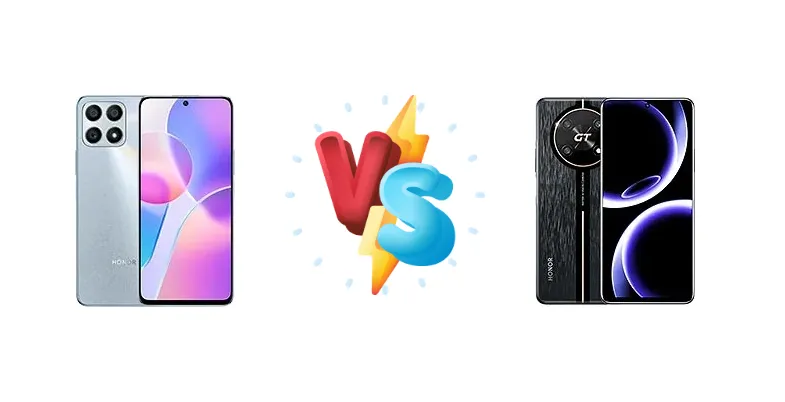
Honor's X series consistently delivers compelling value, but the X40 GT Racing and X30i represent distinct approaches. The X30i, powered by the Mediatek Dimensity 810, focuses on a balanced experience, while the X40 GT Racing prioritizes faster charging and potentially improved performance, though details on its CPU are limited. This comparison dissects the key differences to help you choose the right device.
🏆 Quick Verdict
For the average user prioritizing rapid replenishment, the Honor X40 GT Racing is the clear winner thanks to its 66W charging, capable of reaching 90% in just 30 minutes. However, those seeking a proven chipset and a more established performance profile may find the X30i a safer bet.
| Network |
|---|
| 2G bands | GSM 850 / 900 / 1800 / 1900 | GSM 850 / 900 / 1800 / 1900 |
| 3G bands | HSDPA 850 / 900 / 1700(AWS) / 1900 / 2100 | HSDPA 850 / 900 / 1700(AWS) / 1900 / 2100 |
| 4G bands | LTE | LTE |
| 5G bands | SA/NSA | SA/NSA |
| Speed | HSPA, LTE, 5G | HSPA, LTE, 5G |
| Technology | GSM / CDMA / HSPA / CDMA2000 / LTE / 5G | GSM / CDMA / HSPA / EVDO / LTE / 5G |
| | CDMA2000 1x | - |
| Launch |
|---|
| Announced | 2021, October 28 | 2023, September 19 |
| Status | Available. Released 2021, November 02 | Available. Released 2023, September 22 |
| Body |
|---|
| Build | Glass front, plastic frame, plastic back | - |
| Dimensions | 163.4 x 74.7 x 7.5 mm (6.43 x 2.94 x 0.30 in) | 166.1 x 75.8 x 8.5 mm (6.54 x 2.98 x 0.33 in) |
| SIM | Nano-SIM + Nano-SIM | Nano-SIM + Nano-SIM |
| Weight | 175 g (6.17 oz) | 199.5 g (7.05 oz) |
| Display |
|---|
| Resolution | 1080 x 2388 pixels (~391 ppi density) | 1080 x 2388 pixels (~385 ppi density) |
| Size | 6.7 inches, 108.7 cm2 (~89.1% screen-to-body ratio) | 6.81 inches, 112.3 cm2 (~89.2% screen-to-body ratio) |
| Type | IPS LCD, 90Hz | IPS LCD, 144Hz |
| Platform |
|---|
| CPU | Octa-core (2x2.4 GHz Cortex-A76 & 6x2.0 GHz Cortex-A55) | Octa-core |
| Chipset | Mediatek Dimensity 810 (6 nm) | - |
| GPU | Mali-G57 MC2 | - |
| OS | Android 11, Magic UI 5.0 | Android 13, Magic OS 7.1 |
| Memory |
|---|
| Card slot | No | No |
| Internal | 128GB 6GB RAM, 128GB 8GB RAM, 256GB 8GB RAM | 256GB 12GB RAM, 512GB 12GB RAM |
| Main Camera |
|---|
| Features | LED flash, panorama, HDR | LED flash, panorama, HDR |
| Single | 8 MP, f/2.0 | - |
| Triple | 48 MP, f/1.8, 26mm (wide), PDAF
2 MP (macro)
Auxiliary lens | 50 MP, f/1.8, (wide), PDAF
2 MP (macro)
Auxiliary lens |
| Video | 1080p@30fps | 4K@30fps, 1080p@30fps; gyro-EIS |
| Selfie camera |
|---|
| Single | 8 MP, f/2.0 | 16 MP, f/2.5 |
| Video | 1080p@30fps | 1080p@30fps |
| Sound |
|---|
| 3.5mm jack | Yes | - |
| 35mm jack | Yes | No |
| Loudspeaker | Yes, with dual speakers | Yes |
| Comms |
|---|
| Bluetooth | 5.1, A2DP, LE | 5.2, A2DP, LE, aptX HD |
| NFC | No | Yes |
| Positioning | GPS, GLONASS, BDS | GPS, GLONASS, GALILEO, BDS |
| Radio | No | No |
| USB | USB Type-C 2.0, OTG | USB Type-C 2.0, OTG |
| WLAN | Wi-Fi 802.11 a/b/g/n/ac, dual-band, Wi-Fi Direct | Wi-Fi 802.11 a/b/g/n/ac/6, dual-band, Wi-Fi Direct |
| Features |
|---|
| Sensors | Fingerprint (side-mounted), accelerometer, compass | Fingerprint (side-mounted), accelerometer, gyro, compass |
| Battery |
|---|
| Charging | 22.5W wired | 66W wired, 90% in 30 min
5W reverse wired |
| Type | Li-Po 4000 mAh | Li-Po 4800 mAh |
| Misc |
|---|
| Colors | Black, Blue, Silver, Rose Gold | Black, Silver |
| Models | TFY-AN00 | - |
| Price | About 190 EUR | About 300 EUR |
Honor X30i
- Proven Mediatek Dimensity 810 chipset
- Balanced performance for everyday tasks
- Reliable and well-documented performance
- Slower 22.5W charging
- Lacks reverse charging capability
Honor X40 GT Racing
- Ultra-fast 66W charging (90% in 30 min)
- 5W reverse wired charging
- Potentially improved CPU performance
- CPU specifications are unknown
- Performance is unverified
Display Comparison
Display specifications are currently unavailable for both devices. However, given the X series positioning, we can anticipate both phones will utilize LCD panels. The X40 GT Racing's 'Racing' moniker suggests a focus on visual experience, potentially indicating a higher refresh rate or improved color calibration compared to the X30i. Without specific data, it's difficult to assess which device offers superior image quality.
Camera Comparison
Camera details are absent for both devices. Given the price bracket, we can expect both phones to feature multi-camera setups, likely with a primary sensor and supporting lenses. The X40 GT Racing's 'GT' branding hints at a possible emphasis on photography or videography, potentially featuring a larger sensor or more advanced image processing algorithms. However, without concrete specifications, it's impossible to determine which device will deliver superior image quality.
Performance
The Honor X30i's Mediatek Dimensity 810 (6nm) provides a known performance baseline with its octa-core configuration (2x2.4 GHz Cortex-A76 & 6x2.0 GHz Cortex-A55). This chipset is well-suited for everyday tasks and moderate gaming. The X40 GT Racing, while also featuring an octa-core CPU, lacks specific chipset details. The absence of this information makes a direct performance comparison challenging. The 6nm Dimensity 810 offers a good balance of power and efficiency, while the X40 GT Racing's CPU could potentially offer improvements, but without knowing the fabrication process (e.g., 4nm, 5nm) or core architecture, it's impossible to quantify.
Battery Life
The most significant difference lies in charging speed. The Honor X30i supports 22.5W wired charging, a standard rate for its class. In contrast, the X40 GT Racing boasts 66W wired charging, capable of reaching 90% charge in just 30 minutes. This dramatically reduces charging time, a major benefit for users who frequently need to top up their phones. The X40 GT Racing also includes 5W reverse wired charging, allowing it to charge other devices, a feature absent on the X30i. While battery capacity isn't specified for either device, the faster charging of the X40 GT Racing effectively mitigates the impact of a potentially smaller battery.
Buying Guide
Buy the Honor X30i if you need a reliable, well-documented chipset (Dimensity 810) for consistent performance in everyday tasks and light gaming, and aren't overly concerned with the fastest possible charging. Buy the Honor X40 GT Racing if you prioritize minimizing downtime with its significantly faster 66W charging and potentially benefit from a newer, though less-detailed, CPU configuration, making it ideal for users who frequently top up their phones throughout the day.
Frequently Asked Questions
❓ How much faster is the 66W charging on the Honor X40 GT Racing compared to the 22.5W charging on the X30i in real-world use?
The 66W charging on the X40 GT Racing can realistically charge the phone from 0% to 90% in approximately 30 minutes, while the X30i's 22.5W charging will likely take over 1.5 to 2 hours for a full charge. This difference is substantial for users who need a quick power boost.
❓ Since the Honor X40 GT Racing's CPU details are missing, is it a gamble to purchase it over the X30i with the known Dimensity 810?
It does introduce an element of risk. The X30i's Dimensity 810 is a proven performer. The X40 GT Racing *could* offer better performance, but without knowing the chipset and its fabrication process, it's impossible to guarantee. If consistent, predictable performance is crucial, the X30i is the safer choice.
❓ Does the Honor X40 GT Racing's faster charging generate more heat during the charging process?
Faster charging *can* generate more heat, but Honor likely incorporates thermal management technologies to mitigate this. The 66W charging includes safeguards to prevent overheating, and the phone's design likely includes heat dissipation features. However, it's reasonable to expect the X40 GT Racing to get slightly warmer during charging than the X30i.