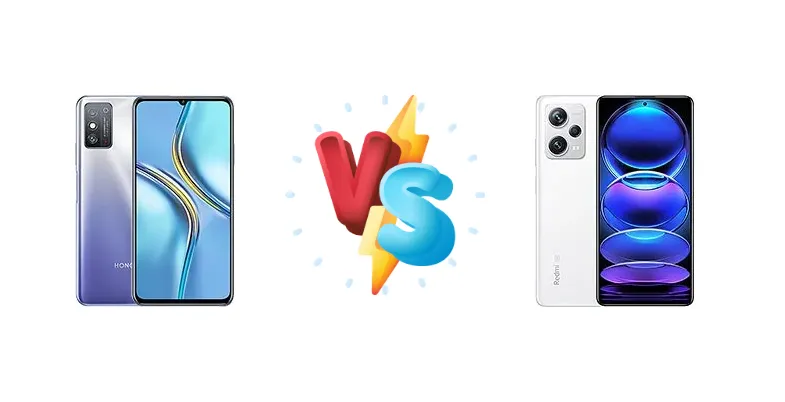
The mid-range smartphone market is fiercely competitive, and the Honor X30 Max and Xiaomi Redmi Note 12 Pro+ represent compelling options. While both aim to deliver a premium experience without the flagship price tag, they take distinctly different approaches – the X30 Max prioritizing size and a more conservative feature set, while the Redmi Note 12 Pro+ aggressively pushes charging speed and camera capabilities. This comparison will dissect their key differences to help you determine which device best suits your needs.
🏆 Quick Verdict
For most users, the Xiaomi Redmi Note 12 Pro+ is the stronger choice. Its significantly faster 120W charging, coupled with a respectable 88-hour endurance rating, dramatically improves usability. While the Honor X30 Max offers a larger display, the Redmi Note 12 Pro+'s overall package provides a more modern and convenient experience.
| Network |
|---|
| 2G bands | GSM 850 / 900 / 1800 / 1900 | GSM 850 / 900 / 1800 / 1900 - SIM 1 & SIM 2 |
| 3G bands | HSDPA 800 / 850 / 900 / 1700(AWS) / 1900 / 2100 | HSDPA 800 / 850 / 900 / 1900 / 2100 |
| 4G bands | LTE | 1, 3, 5, 8, 19, 34, 38, 39, 40, 41 - International, China |
| 5G bands | SA/NSA | 1, 3, 5, 8, 28, 38, 40, 41, 77, 78 SA/NSA - International |
| Speed | HSPA, LTE, 5G | HSPA, LTE-A (CA), 5G |
| Technology | GSM / CDMA / HSPA / CDMA2000 / LTE / 5G | GSM / CDMA / HSPA / EVDO / LTE / 5G |
| | CDMA2000 1x | 1, 3, 5, 8, 28, 38, 41, 77, 78 SA/NSA - China |
| Launch |
|---|
| Announced | 2021, October 28 | 2022, October 27 |
| Status | Available. Released 2021, November 02 | Available. Released 2022, November 01 |
| Body |
|---|
| Build | Glass front, plastic frame, plastic back | Glass front (Gorilla Glass 5), glass back |
| Dimensions | 174.4 x 84.9 x 8.3 mm (6.87 x 3.34 x 0.33 in) | 162.9 x 76 x 8.9 mm (6.41 x 2.99 x 0.35 in) |
| SIM | Nano-SIM + Nano-SIM | Dual SIM (Nano-SIM, dual stand-by) |
| Weight | 228 g (8.04 oz) | 208.4 g (7.34 oz) |
| | - | IP53, dust and splash resistant |
| Display |
|---|
| Protection | - | Corning Gorilla Glass 5 |
| Resolution | 1080 x 2280 pixels, 19:9 ratio (~356 ppi density) | 1080 x 2400 pixels, 20:9 ratio (~395 ppi density) |
| Size | 7.09 inches, 125.5 cm2 (~84.7% screen-to-body ratio) | 6.67 inches, 107.4 cm2 (~86.8% screen-to-body ratio) |
| Type | IPS LCD, HDR10 | OLED, 1B colors, 120Hz, Dolby Vision, HDR10+, 500 nits (typ), 900 nits (HBM) |
| Platform |
|---|
| CPU | Octa-core (2x2.4 GHz Cortex-A78 & 6x2.0 GHz Cortex-A55) | Octa-core (2x2.6 GHz Cortex-A78 & 6x2.0 GHz Cortex-A55) |
| Chipset | Mediatek Dimensity 900 (6 nm) | Mediatek MT6877V Dimensity 1080 (6 nm) |
| GPU | Mali-G68 MC4 | Mali-G68 MC4 |
| OS | Android 11, Magic UI 5.0 | Android 12, MIUI 13 |
| Memory |
|---|
| Card slot | No | No |
| Internal | 128GB 8GB RAM, 256GB 8GB RAM | 256GB 8GB RAM, 256GB 12GB RAM |
| | - | UFS 2.2 |
| Main Camera |
|---|
| Dual | 64 MP, f/1.8, 26mm (wide), PDAF
Auxiliary lens | - |
| Features | LED flash, panorama, HDR | Dual-LED dual-tone flash, HDR, panorama |
| Single | 8 MP, f/2.0 | - |
| Triple | - | 200 MP, f/1.7, 24mm (wide), 1/1.4", 0.56µm, PDAF, OIS
8 MP, f/2.2, 120˚ (ultrawide), 1/4", 1.12µm
2 MP, f/2.4, (macro) |
| Video | 4K@30fps, 1080p@30fps, gyro-EIS | 4K@30fps, 1080p@30/60/120fps, 720p@960fps |
| Selfie camera |
|---|
| Features | HDR | HDR |
| Single | 8 MP, f/2.0 | 16 MP, f/2.5, (wide), 1/3.06", 1.0µm |
| Video | 1080p@30fps | 1080p@30/60fps |
| Sound |
|---|
| 3.5mm jack | Yes | Yes |
| 35mm jack | Yes | - |
| Loudspeaker | Yes, with dual speakers | Yes, with stereo speakers |
| | - | 24-bit/192kHz audio |
| Comms |
|---|
| Bluetooth | 5.1, A2DP, LE | 5.2, A2DP, LE |
| Infrared port | - | Yes |
| NFC | Yes | Yes (market/region dependent) |
| Positioning | GPS, GLONASS, BDS | GPS (L1), GLONASS (G1), BDS (B1I+B1c), GALILEO (E1), QZSS (L1) |
| Radio | No | No |
| USB | USB Type-C 2.0, OTG | USB Type-C 2.0, OTG |
| WLAN | Wi-Fi 802.11 a/b/g/n/ac, dual-band, Wi-Fi Direct | Wi-Fi 802.11 a/b/g/n/ac/6, dual-band, Wi-Fi Direct |
| Features |
|---|
| Sensors | Fingerprint (side-mounted), accelerometer, gyro, proximity, compass | Fingerprint (side-mounted), accelerometer, proximity, gyro, compass |
| Battery |
|---|
| Charging | 22.5W wired | 120W wired, PD3.0, 100% in 19 min (advertised) |
| Type | Li-Po 5000 mAh | Li-Po 5000 mAh, non-removable |
| Misc |
|---|
| Colors | Black, Blue, Silver/Violet | Arctic White, Iceberg Blue, Obsidian Black, Trend edition |
| Models | KKG-AN70 | 22101316UCP, 22101316UG |
| Price | About 320 EUR | $ 348.00 / £ 439.00 / € 399.00 / ₹ 29,949 |
| Tests |
|---|
| Battery life | - |
Endurance rating 88h
|
| Camera | - |
Photo / Video |
| Display | - |
Contrast ratio: Infinite (nominal) |
| Loudspeaker | - |
-26.7 LUFS (Good)
|
| Performance | - |
AnTuTu: 498710 (v9)
GeekBench: 2208 (v5.1), 2372 (v6)
GFXBench: 22fps (ES 3.1 onscreen) |
Honor X30 Max
- Potentially larger display size (unconfirmed)
- More affordable price point (likely)
- Simple and straightforward user experience
- Slow 22.5W charging
- Unspecified display technology (likely LCD)
- Less powerful chipset
Xiaomi Redmi Note 12 Pro+
- Ultra-fast 120W charging
- Likely superior AMOLED display
- More powerful Dimensity 1080 chipset
- Potentially better camera system
- May be more expensive
- Faster charging can generate more heat
- Software bloatware (typical of Xiaomi)
Display Comparison
The Honor X30 Max doesn't specify display specs beyond its size, leaving key details like peak brightness and panel type unknown. The Redmi Note 12 Pro+, however, boasts an 'Infinite' (nominal) contrast ratio, suggesting a strong AMOLED panel. While the X30 Max likely uses an LCD, the Redmi Note 12 Pro+'s AMOLED will deliver superior color vibrancy and deeper blacks. The lack of detailed display information for the X30 Max makes a direct comparison difficult, but the Redmi Note 12 Pro+ is expected to offer a significantly more visually appealing experience.
Camera Comparison
The Redmi Note 12 Pro+’s camera system is the clear standout. While details are limited, the presence of a high-resolution sensor (likely 200MP, based on the model name) suggests a significant advantage in image detail and low-light performance. The Honor X30 Max’s camera specs are not provided, making a direct comparison impossible. However, given its positioning, it’s unlikely to match the Redmi Note 12 Pro+'s capabilities. The Redmi Note 12 Pro+’s inclusion of Optical Image Stabilization (OIS) further enhances image quality, particularly in videos and low-light scenarios.
Performance
Both phones utilize Mediatek Dimensity chipsets fabricated on a 6nm process, but the Redmi Note 12 Pro+ features the more advanced Dimensity 1080. This translates to a slightly higher CPU clock speed – 2.6 GHz Cortex-A78 cores versus the X30 Max’s 2.4 GHz. While both have the same Cortex-A55 efficiency cores, the 1080’s improved architecture and potentially faster RAM (likely LPDDR4X or LPDDR5 vs the X30 Max’s unspecified RAM) will result in snappier app loading and smoother multitasking. The Redmi Note 12 Pro+ will likely exhibit better sustained performance under load due to the chipset’s enhancements.
Battery Life
The Redmi Note 12 Pro+’s 120W wired charging is a game-changer, advertised to reach 100% in just 19 minutes. This is a massive advantage over the Honor X30 Max’s comparatively slow 22.5W charging. While the Redmi Note 12 Pro+’s battery capacity isn’t specified, its 88-hour endurance rating suggests efficient power management. The Honor X30 Max will likely require significantly longer to fully charge, making the Redmi Note 12 Pro+ the clear winner for users who prioritize convenience and minimal downtime.
Buying Guide
Buy the Honor X30 Max if you prioritize a very large screen for media consumption and are less concerned with rapid charging or cutting-edge camera features. It's a solid option for those on a tighter budget who value screen real estate above all else. Buy the Xiaomi Redmi Note 12 Pro+ if you value fast charging, a more versatile camera system, and a generally more responsive user experience. It’s ideal for users who are always on the go and need to quickly top up their battery.
Frequently Asked Questions
❓ How much faster is the 120W charging on the Redmi Note 12 Pro+ compared to the 22.5W charging on the Honor X30 Max?
The Redmi Note 12 Pro+'s 120W charging is dramatically faster. While the X30 Max will take well over an hour to fully charge, the Redmi Note 12 Pro+ is advertised to reach 100% in just 19 minutes. This difference is substantial and significantly impacts usability for users who need to quickly top up their battery.
❓ Does the Dimensity 1080 in the Redmi Note 12 Pro+ offer a noticeable performance improvement over the Dimensity 900 in the Honor X30 Max for gaming?
Yes, the Dimensity 1080 provides a noticeable performance boost for gaming. Its higher clock speeds and architectural improvements result in smoother frame rates and better sustained performance, especially in demanding titles. While both chipsets are capable, the Redmi Note 12 Pro+ will offer a more enjoyable gaming experience.
❓ Is the camera on the Redmi Note 12 Pro+ significantly better than what we can expect from the Honor X30 Max, given the lack of camera specs for the latter?
Almost certainly. The Redmi Note 12 Pro+ is expected to feature a high-resolution sensor (potentially 200MP) and OIS, features not typically found in phones positioned like the Honor X30 Max. This translates to better image detail, improved low-light performance, and more stable videos.