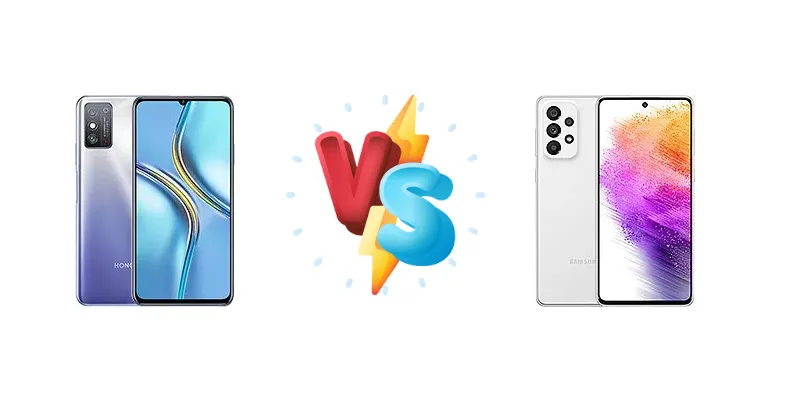
The Honor X30 Max and Samsung Galaxy A73 5G represent compelling options in the increasingly competitive mid-range 5G smartphone market. While both aim to deliver a balanced experience, they take different approaches to achieving it, primarily through chipset choice and overall design philosophy. This comparison dissects those differences to determine which device offers the best value for your money.
🏆 Quick Verdict
For the average user prioritizing consistent performance and a more refined software experience, the Samsung Galaxy A73 5G emerges as the better choice. Its Snapdragon 778G chipset offers a slight edge in sustained performance, and Samsung’s software support is generally more robust. However, the Honor X30 Max presents a strong value proposition for those on a tighter budget.
| Network |
|---|
| 2G bands | GSM 850 / 900 / 1800 / 1900 | GSM 850 / 900 / 1800 / 1900 |
| 3G bands | HSDPA 800 / 850 / 900 / 1700(AWS) / 1900 / 2100 | HSDPA 850 / 900 / 1700(AWS) / 1900 / 2100 |
| 4G bands | LTE | 1, 2, 3, 4, 5, 7, 8, 12, 13, 17, 20, 26, 28, 32, 38, 40, 41, 66 |
| 5G bands | SA/NSA | 1, 3, 5, 7, 28, 40, 41, 66, 78 SA/NSA/Sub6 |
| Speed | HSPA, LTE, 5G | HSPA, LTE, 5G |
| Technology | GSM / CDMA / HSPA / CDMA2000 / LTE / 5G | GSM / HSPA / LTE / 5G |
| | CDMA2000 1x | - |
| Launch |
|---|
| Announced | 2021, October 28 | 2022, March 17 |
| Status | Available. Released 2021, November 02 | Available. Released 2022, April 22 |
| Body |
|---|
| Build | Glass front, plastic frame, plastic back | - |
| Dimensions | 174.4 x 84.9 x 8.3 mm (6.87 x 3.34 x 0.33 in) | 163.7 x 76.1 x 7.6 mm (6.44 x 3.00 x 0.30 in) |
| SIM | Nano-SIM + Nano-SIM | · Nano-SIM· Nano-SIM + Nano-SIM |
| Weight | 228 g (8.04 oz) | 181 g (6.38 oz) |
| | - | IP67 dust/water resistant (up to 1m for 30 min) |
| Display |
|---|
| Protection | - | Corning Gorilla Glass 5 |
| Resolution | 1080 x 2280 pixels, 19:9 ratio (~356 ppi density) | 1080 x 2400 pixels, 20:9 ratio (~393 ppi density) |
| Size | 7.09 inches, 125.5 cm2 (~84.7% screen-to-body ratio) | 6.7 inches, 108.4 cm2 (~87.0% screen-to-body ratio) |
| Type | IPS LCD, HDR10 | Super AMOLED Plus, 120Hz, 800 nits (HBM) |
| Platform |
|---|
| CPU | Octa-core (2x2.4 GHz Cortex-A78 & 6x2.0 GHz Cortex-A55) | Octa-core (1x2.4 GHz Cortex-A78 & 3x2.2 GHz Cortex-A78 & 4x1.9 GHz Cortex-A55) |
| Chipset | Mediatek Dimensity 900 (6 nm) | Qualcomm SM7325 Snapdragon 778G 5G (6 nm) |
| GPU | Mali-G68 MC4 | Adreno 642L |
| OS | Android 11, Magic UI 5.0 | Android 12, up to 4 major Android upgrades, One UI 6.1 |
| Memory |
|---|
| Card slot | No | microSDXC (uses shared SIM slot) |
| Internal | 128GB 8GB RAM, 256GB 8GB RAM | 128GB 6GB RAM, 128GB 8GB RAM, 256GB 8GB RAM |
| Main Camera |
|---|
| Dual | 64 MP, f/1.8, 26mm (wide), PDAF
Auxiliary lens | - |
| Features | LED flash, panorama, HDR | LED flash, panorama, HDR |
| Quad | - | 108 MP, f/1.8, (wide), PDAF, OIS
12 MP, f/2.2, (ultrawide)
5 MP (macro)
Auxiliary lens |
| Single | 8 MP, f/2.0 | 32 MP, f/2.2, 26mm (wide), 1/2.8", 0.8µm |
| Video | 4K@30fps, 1080p@30fps, gyro-EIS | 4K@30fps, 1080p@30/60fps; gyro-EIS |
| Selfie camera |
|---|
| Features | HDR | HDR |
| Single | 8 MP, f/2.0 | 32 MP, f/2.2, 26mm (wide), 1/2.8", 0.8µm |
| Video | 1080p@30fps | 4K@30fps, 1080p@30fps |
| Sound |
|---|
| 3.5mm jack | Yes | No |
| 35mm jack | Yes | No |
| Loudspeaker | Yes, with dual speakers | Yes, with stereo speakers |
| Comms |
|---|
| Bluetooth | 5.1, A2DP, LE | 5.0, A2DP, LE |
| NFC | Yes | Yes (market/region dependent) |
| Positioning | GPS, GLONASS, BDS | GPS, GLONASS, GALILEO, BDS, QZSS |
| Radio | No | Unspecified |
| USB | USB Type-C 2.0, OTG | USB Type-C 2.0, OTG |
| WLAN | Wi-Fi 802.11 a/b/g/n/ac, dual-band, Wi-Fi Direct | Wi-Fi 802.11 a/b/g/n/ac/6, dual-band, Wi-Fi Direct |
| Features |
|---|
| Sensors | Fingerprint (side-mounted), accelerometer, gyro, proximity, compass | Fingerprint (under display, optical), accelerometer, gyro, proximity, compass |
| Battery |
|---|
| Charging | 22.5W wired | 25W wired |
| Type | Li-Po 5000 mAh | Li-Po 5000 mAh |
| Misc |
|---|
| Colors | Black, Blue, Silver/Violet | Gray, Mint, White |
| Models | KKG-AN70 | SM-A736B, SM-A736B/DS |
| Price | About 320 EUR | About 600 EUR |
| SAR | - | 1.14 W/kg (head) |
| SAR EU | - | 1.28 W/kg (head) 1.42 W/kg (body) |
Honor X30 Max
- Potentially larger display for immersive media consumption.
- Competitive pricing offers excellent value.
- Decent performance for everyday tasks.
- Dimensity 900 may struggle with demanding games.
- Software support and updates may be less frequent.
Samsung Galaxy A73 5G
- Snapdragon 778G provides smoother performance and better gaming.
- Samsung’s software is more polished and feature-rich.
- Likely better camera performance with advanced image processing.
- May be more expensive than the Honor X30 Max.
- Charging speed is only marginally faster.
Display Comparison
Both devices utilize 6nm chipsets, suggesting a focus on efficiency. However, display specifications are not provided, so a direct comparison is limited. Given Samsung’s history, the A73 likely benefits from a higher peak brightness and potentially better color accuracy. Honor often prioritizes value, so the X30 Max may use a slightly less advanced panel. The larger screen size of the X30 Max (implied by the 'Max' branding) will appeal to media consumers, but without knowing the A73’s screen size, a definitive statement is impossible.
Camera Comparison
Without detailed camera specs, analysis is limited. However, Samsung typically invests heavily in camera technology, and the A73 likely benefits from more advanced image processing algorithms and potentially larger sensor sizes. The presence of OIS (Optical Image Stabilization) on the A73 would be a significant advantage for low-light photography and video recording. The X30 Max may rely more on software enhancements to compensate for potentially less capable hardware. The inclusion of a 2MP macro camera on either device is largely a marketing tactic and unlikely to deliver significant image quality improvements.
Performance
The core difference lies in the chipsets: the Honor X30 Max features the Mediatek Dimensity 900, while the Samsung Galaxy A73 5G uses the Qualcomm Snapdragon 778G 5G. Both are 6nm chips, but the Snapdragon 778G boasts a more sophisticated CPU configuration – a 1x2.4 GHz Cortex-A78 core alongside 3x2.2 GHz Cortex-A78 cores, versus the Dimensity 900’s 2x2.4 GHz Cortex-A78 and 6x2.0 GHz Cortex-A55. This suggests the Snapdragon 778G will offer better multi-core performance and sustained speeds, particularly in demanding applications. The A73’s GPU is also likely to outperform the Dimensity 900’s, leading to a smoother gaming experience. While both use 6nm fabrication, Qualcomm’s architecture generally provides better thermal management.
Battery Life
Battery capacity isn’t specified, but the A73’s 25W charging slightly edges out the X30 Max’s 22.5W. While the difference isn’t massive, it translates to a faster 0-100% charge time. The actual battery life will depend on the capacity of each device and the efficiency of their respective chipsets and software. The Snapdragon 778G’s efficiency could offset a potentially smaller battery capacity in the A73, resulting in comparable real-world usage.
Buying Guide
Buy the Honor X30 Max if you need a large-screen phone with decent performance for everyday tasks and media consumption, and are comfortable with a less polished software experience. It’s ideal for users who prioritize screen size and value over top-tier performance. Buy the Samsung Galaxy A73 5G if you prefer a more balanced experience with a slightly more powerful chipset, a more refined user interface, and a longer commitment to software updates. This phone suits users who want a reliable all-rounder with a focus on camera quality and long-term usability.
Frequently Asked Questions
❓ Will the Snapdragon 778G in the Galaxy A73 5G overheat during prolonged gaming sessions?
The Snapdragon 778G is known for its relatively efficient thermal management. While some heat generation is inevitable during intensive gaming, the 6nm process and Qualcomm’s optimizations should prevent significant throttling, providing a consistently smooth experience for extended periods.
❓ Is the 22.5W charging on the Honor X30 Max slow compared to other phones?
22.5W is considered relatively slow by today’s standards, with many phones offering 33W or even 65W charging. Expect a full charge to take around 1.5 to 2 hours. However, it’s sufficient for overnight charging and won’t significantly impact daily usability.
❓ Does the Dimensity 900 support advanced 5G features like carrier aggregation?
Yes, the Mediatek Dimensity 900 supports 5G carrier aggregation, allowing it to combine multiple 5G channels for faster and more reliable data speeds, provided your carrier supports it. This ensures a better 5G experience in areas with strong network coverage.
❓ How does Samsung’s software update policy compare to Honor’s for the A73 and X30 Max?
Samsung generally provides longer and more frequent software updates than Honor. The Galaxy A73 5G is likely to receive at least three major Android OS updates and four years of security patches, while the Honor X30 Max may receive fewer updates, potentially limiting its long-term usability.