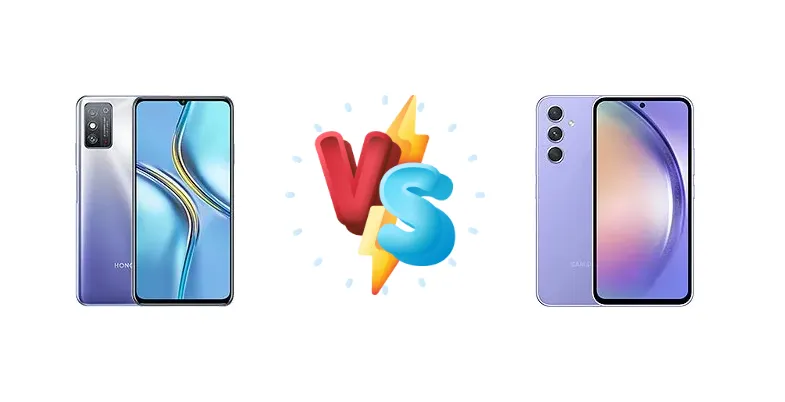
The Honor X30 Max and Samsung Galaxy A54 represent compelling options in the increasingly competitive mid-range smartphone market. The X30 Max focuses on delivering a large display and solid performance at an aggressive price point, while the Galaxy A54 aims for a more balanced experience with a refined design and Samsung’s established software ecosystem. This comparison dives deep into the specifications to determine which device best suits your needs.
🏆 Quick Verdict
For the average user prioritizing a consistently polished experience and long-term software support, the Samsung Galaxy A54 is the better choice. While the Honor X30 Max offers a larger screen and competitive performance, the A54’s superior display brightness and refined software outweigh these advantages.
| Network |
|---|
| 2G bands | GSM 850 / 900 / 1800 / 1900 | GSM 850 / 900 / 1800 / 1900 |
| 3G bands | HSDPA 800 / 850 / 900 / 1700(AWS) / 1900 / 2100 | HSDPA 850 / 900 / 1700(AWS) / 1900 / 2100 |
| 4G bands | LTE | 1, 2, 3, 4, 5, 7, 8, 12, 17, 20, 26, 28, 32, 38, 40, 41, 66 - International |
| 5G bands | SA/NSA | 1, 3, 7, 8, 20, 28, 38, 40, 41, 77, 78 SA/NSA/Sub6 - International |
| Speed | HSPA, LTE, 5G | HSPA, LTE, 5G |
| Technology | GSM / CDMA / HSPA / CDMA2000 / LTE / 5G | GSM / HSPA / LTE / 5G |
| | CDMA2000 1x | 25, 41, 66, 71 SA/NSA/Sub6/mmWave - USA |
| Launch |
|---|
| Announced | 2021, October 28 | 2023, March 15 |
| Status | Available. Released 2021, November 02 | Available. Released 2023, March 24 |
| Body |
|---|
| Build | Glass front, plastic frame, plastic back | Glass front (Gorilla Glass 5), glass back (Gorilla Glass 5), plastic frame |
| Dimensions | 174.4 x 84.9 x 8.3 mm (6.87 x 3.34 x 0.33 in) | 158.2 x 76.7 x 8.2 mm (6.23 x 3.02 x 0.32 in) |
| SIM | Nano-SIM + Nano-SIM | · Nano-SIM + eSIM· Nano-SIM + Nano-SIM |
| Weight | 228 g (8.04 oz) | 202 g (7.13 oz) |
| | - | IP67 dust/water resistant (up to 1m for 30 min) |
| Display |
|---|
| Protection | - | Corning Gorilla Glass 5 |
| Resolution | 1080 x 2280 pixels, 19:9 ratio (~356 ppi density) | 1080 x 2340 pixels, 19.5:9 ratio (~403 ppi density) |
| Size | 7.09 inches, 125.5 cm2 (~84.7% screen-to-body ratio) | 6.4 inches, 100.5 cm2 (~82.9% screen-to-body ratio) |
| Type | IPS LCD, HDR10 | Super AMOLED, 120Hz, HDR10+, 1000 nits (HBM) |
| Platform |
|---|
| CPU | Octa-core (2x2.4 GHz Cortex-A78 & 6x2.0 GHz Cortex-A55) | Octa-core (4x2.4 GHz Cortex-A78 & 4x2.0 GHz Cortex-A55) |
| Chipset | Mediatek Dimensity 900 (6 nm) | Exynos 1380 (5 nm) |
| GPU | Mali-G68 MC4 | Mali-G68 MP5 |
| OS | Android 11, Magic UI 5.0 | Android 13, up to 4 major Android upgrades, One UI 7 |
| Memory |
|---|
| Card slot | No | microSDXC (uses shared SIM slot) |
| Internal | 128GB 8GB RAM, 256GB 8GB RAM | 128GB 4GB RAM, 128GB 6GB RAM, 128GB 8GB RAM, 256GB 6GB RAM, 256GB 8GB RAM |
| Main Camera |
|---|
| Dual | 64 MP, f/1.8, 26mm (wide), PDAF
Auxiliary lens | - |
| Features | LED flash, panorama, HDR | LED flash, panorama, HDR |
| Single | 8 MP, f/2.0 | 32 MP, f/2.2, 26mm (wide), 1/2.8", 0.8µm |
| Triple | - | 50 MP, f/1.8, 23mm (wide), 1/1.56", 1.0µm, PDAF, OIS
12 MP, f/2.2, 13mm, 123˚ (ultrawide), 1/3.X", 1.12µm
5 MP (macro) |
| Video | 4K@30fps, 1080p@30fps, gyro-EIS | 4K@30fps, 1080p@30/60fps, 720p@480fps, gyro-EIS |
| Selfie camera |
|---|
| Features | HDR | - |
| Single | 8 MP, f/2.0 | 32 MP, f/2.2, 26mm (wide), 1/2.8", 0.8µm |
| Video | 1080p@30fps | 4K@30fps, 1080p@30/60fps |
| Sound |
|---|
| 3.5mm jack | Yes | No |
| 35mm jack | Yes | No |
| Loudspeaker | Yes, with dual speakers | Yes, with stereo speakers |
| Comms |
|---|
| Bluetooth | 5.1, A2DP, LE | 5.3, A2DP, LE |
| NFC | Yes | Yes (market/region dependent) |
| Positioning | GPS, GLONASS, BDS | GPS, GLONASS, GALILEO, BDS |
| Radio | No | No |
| USB | USB Type-C 2.0, OTG | USB Type-C 2.0, OTG |
| WLAN | Wi-Fi 802.11 a/b/g/n/ac, dual-band, Wi-Fi Direct | Wi-Fi 802.11 a/b/g/n/ac/6, dual-band, Wi-Fi Direct |
| Features |
|---|
| Sensors | Fingerprint (side-mounted), accelerometer, gyro, proximity, compass | Fingerprint (under display, optical), accelerometer, gyro, compass, barometer (USA only) |
| | - | Virtual proximity sensing |
| Battery |
|---|
| Charging | 22.5W wired | 25W wired |
| Type | Li-Po 5000 mAh | 5000 mAh |
| Misc |
|---|
| Colors | Black, Blue, Silver/Violet | Lime, Graphite, Violet, White |
| Models | KKG-AN70 | SM-A546V, SM-A546U, SM-A546U1, SM-A546B, SM-A546B/DS, SM-A546E, SM-A546E/DS, SM-A5460, SM-A546M, SM-A546M/DS, SM-A546W |
| Price | About 320 EUR | € 210.00 / $ 119.11 / £ 169.95 / ₹ 28,999 |
| SAR | - | 0.81 W/kg (head) 0.67 W/kg (body) |
| SAR EU | - | 0.69 W/kg (head) 1.34 W/kg (body) |
| Tests |
|---|
| Battery life | - |
Endurance rating 119h
|
| Camera | - |
Photo / Video |
| Display | - |
Contrast ratio: Infinite (nominal) |
| Loudspeaker | - |
-26.6 LUFS (Good)
|
| Performance | - |
AnTuTu: 506678 (v9)
GeekBench: 2703 (v5.1), 2797 (v6)
GFXBench: 25fps (ES 3.1 onscreen) |
Honor X30 Max
- Potentially larger display size for immersive media consumption.
- Competitive performance for the price.
- Aggressive pricing may offer significant savings.
- Less refined software experience compared to Samsung.
- Uncertainty regarding display quality and camera performance.
- Slower charging speed (22.5W).
Samsung Galaxy A54
- Brighter and more vibrant display for better outdoor visibility.
- More efficient Exynos 1380 chipset for improved battery life.
- Samsung’s One UI offers a polished and feature-rich software experience.
- Potentially higher price point.
- May not offer the same raw performance-per-dollar as the X30 Max.
- Smaller display size compared to the X30 Max.
Display Comparison
The Samsung Galaxy A54 boasts a significantly brighter display, reaching a measured 980 nits, compared to the Honor X30 Max’s unspecified peak brightness. This difference is crucial for outdoor visibility. While both likely utilize OLED panels, the A54’s ‘Infinite’ contrast ratio suggests a superior implementation. The X30 Max’s larger screen size is a benefit for media consumption, but the A54’s higher brightness and potentially better color accuracy provide a more enjoyable viewing experience overall. The lack of refresh rate information for the X30 Max is a notable omission, potentially giving the A54 an edge if it supports a higher refresh rate.
Camera Comparison
Both devices are listed as having Photo/Video capabilities, but detailed camera specifications are absent for the Honor X30 Max. The Samsung Galaxy A54 likely benefits from Samsung’s established image processing pipeline and potentially superior sensor technology. Without knowing the main sensor resolution or aperture of the X30 Max, it’s difficult to make a direct comparison. The A54’s camera system is expected to deliver more consistent results across various lighting conditions, and its video recording capabilities are likely more advanced. The presence of OIS (Optical Image Stabilization) on the A54, if present, would further enhance image and video quality.
Performance
Both the Honor X30 Max and Samsung Galaxy A54 employ octa-core CPUs with a similar core configuration: 2x2.4 GHz Cortex-A78 and 6x2.0 GHz Cortex-A55 (X30 Max) versus 4x2.4 GHz Cortex-A78 and 4x2.0 GHz Cortex-A55 (A54). However, the Samsung Galaxy A54’s Exynos 1380 is fabricated on a 5nm process, while the Honor X30 Max uses a 6nm Dimensity 900. This smaller node generally translates to improved power efficiency and potentially better sustained performance under load, reducing thermal throttling. While both chipsets are capable, the Exynos 1380 likely holds a slight edge in GPU performance, benefiting gaming and graphically intensive tasks.
Battery Life
The Samsung Galaxy A54 achieves an impressive 11:15h active use score and an endurance rating of 119 hours, indicating excellent battery life. The Honor X30 Max’s battery capacity is unknown, but its 22.5W charging speed is slightly slower than the A54’s 25W charging. While faster charging is convenient, the A54’s superior endurance rating suggests it may not require charging as frequently. The 5nm process of the Exynos 1380 also contributes to better power efficiency, further extending the A54’s battery life.
Buying Guide
Buy the Honor X30 Max if you prioritize a large screen for media consumption and value raw performance-per-dollar. It’s ideal for users who frequently watch videos or play less demanding games and aren’t heavily invested in the Samsung ecosystem. Buy the Samsung Galaxy A54 if you prefer a brighter, more vibrant display, a more refined user experience with Samsung’s One UI, and guaranteed software updates for years to come. It’s the better option for users who value camera quality, long-term reliability, and a seamless software experience.
Frequently Asked Questions
❓ Does the Exynos 1380 in the Galaxy A54 tend to overheat during prolonged gaming sessions?
The Exynos 1380, fabricated on a 5nm process, is generally efficient and well-managed in the Galaxy A54. While some heat generation is inevitable during intensive gaming, the A54’s thermal design is typically sufficient to prevent significant throttling, allowing for sustained performance. However, prolonged gaming at maximum settings may still result in some temperature increase.
❓ Is the 2MP macro camera on the Samsung Galaxy A54 actually useful for taking detailed close-up photos?
The 2MP macro camera on the Galaxy A54, like many phones in this price range, is a mixed bag. While it allows for close-up shots, the low resolution often results in images lacking detail and sharpness. It’s usable for casual snapshots, but don’t expect professional-quality macro photography. Good lighting conditions are essential for acceptable results.
❓ What kind of gaming performance can I expect from the Honor X30 Max with the Dimensity 900?
The Dimensity 900 in the Honor X30 Max is capable of handling most popular mobile games at medium to high settings. However, demanding titles may require some graphical compromises to maintain a smooth frame rate. The 6nm process helps with efficiency, but it may not match the sustained performance of the A54’s 5nm Exynos 1380 in extended gaming sessions.
❓ How long will Samsung provide software updates for the Galaxy A54?
Samsung typically provides four years of major Android OS updates and five years of security updates for its A-series devices, including the Galaxy A54. This commitment to long-term software support is a significant advantage, ensuring your phone remains secure and up-to-date with the latest features for years to come.