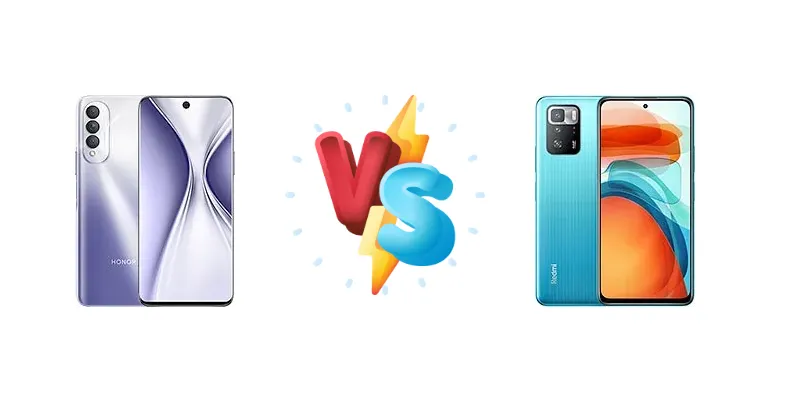
Both the Honor X20 SE and the Xiaomi Redmi Note 10 Pro (China) target the competitive mid-range smartphone market, relying on Mediatek's Dimensity series to deliver performance. However, a significant gap exists between the Dimensity 700 powering the Honor and the more potent Dimensity 1100 in the Redmi Note 10 Pro. This comparison dissects these differences, focusing on real-world impact for users.
🏆 Quick Verdict
For the average user prioritizing responsiveness and future-proofing, the Xiaomi Redmi Note 10 Pro (China) is the clear winner. Its Dimensity 1100 chipset offers a substantial performance uplift, coupled with significantly faster 67W charging. The Honor X20 SE remains a viable option for budget-conscious users, but compromises on processing power are unavoidable.
| Network |
|---|
| 2G bands | GSM 850 / 900 / 1800 / 1900 | GSM 850 / 900 / 1800 / 1900 |
| 3G bands | HSDPA 850 / 900 / 1700(AWS) / 1900 / 2100 | HSDPA 850 / 900 / 1700(AWS) / 1900 / 2100 |
| 4G bands | LTE | 1, 2, 3, 4, 5, 7, 8, 18, 19, 26, 34, 38, 39, 40, 41, 42 |
| 5G bands | SA/NSA | 1, 3, 28, 41, 77, 78 SA/NSA/Sub6 |
| Speed | HSPA, LTE, 5G | HSPA, LTE, 5G |
| Technology | GSM / CDMA / HSPA / LTE / 5G | GSM / CDMA / HSPA / EVDO / LTE / 5G |
| | CDMA 800 | CDMA2000 1xEV-DO |
| Launch |
|---|
| Announced | 2021, June 30 | 2021, May 26 |
| Status | Available. Released 2021, July 09 | Available. Released 2021, June 02 |
| Body |
|---|
| Build | - | Glass front (Gorilla Glass Victus), plastic frame, plastic back |
| Dimensions | 160.7 x 73.3 x 8.4 mm (6.33 x 2.89 x 0.33 in) | 163.3 x 75.9 x 8.9 mm (6.43 x 2.99 x 0.35 in) |
| SIM | Nano-SIM + Nano-SIM | Nano-SIM + Nano-SIM |
| Weight | 179 g (6.31 oz) | 193 g (6.81 oz) |
| | - | IP53, dust and splash resistant |
| Display |
|---|
| Protection | - | Corning Gorilla Glass Victus |
| Resolution | 1080 x 2400 pixels, 20:9 ratio (~399 ppi density) | 1080 x 2400 pixels, 20:9 ratio (~399 ppi density) |
| Size | 6.6 inches, 105.2 cm2 (~89.3% screen-to-body ratio) | 6.6 inches, 105.2 cm2 (~84.9% screen-to-body ratio) |
| Type | IPS LCD | IPS LCD, 120Hz, HDR10, 450 nits (typ) |
| Platform |
|---|
| CPU | Octa-core (2x2.2 GHz Cortex-A76 & 6x2.0 GHz Cortex-A55) | Octa-core (4x2.6 GHz Cortex-A78 & 4x2.0 GHz Cortex-A55) |
| Chipset | Mediatek Dimensity 700 (7 nm) | Mediatek Dimensity 1100 (6 nm) |
| GPU | Mali-G57 MC2 | Mali-G77 MC9 |
| OS | Android 11, Magic UI 4.0 | Android 11, MIUI 12.5 |
| Memory |
|---|
| Card slot | No | No |
| Internal | 128GB 6GB RAM, 128GB 8GB RAM | 128GB 6GB RAM, 128GB 8GB RAM, 256GB 8GB RAM |
| | - | UFS 3.1 |
| Main Camera |
|---|
| Features | LED flash, HDR, panorama | Color spectrum sensor, LED flash, HDR, panorama |
| Single | 16 MP, f/2.0, (wide) | 16 MP, f/2.5, (wide), 1/3.06", 1.0µm |
| Triple | 64 MP, f/1.9, 27mm (wide), PDAF
2 MP (macro)
Auxiliary lens | 64 MP, f/1.8, 26mm (wide), 1/1.97", 0.7µm, PDAF
8 MP, f/2.2, 120˚ (ultrawide), 1/4.0", 1.12µm
2 MP (macro) |
| Video | 1080p@30fps, gyro-EIS | 4K@30fps, 1080p@30/60/120fps, 720p@960fps, HDR |
| Selfie camera |
|---|
| Features | - | Panorama, HDR |
| Single | 16 MP, f/2.0, (wide) | 16 MP, f/2.5, (wide), 1/3.06", 1.0µm |
| Video | 1080p@30fps | 1080p@30fps, 720p@120fps, HDR |
| Sound |
|---|
| 3.5mm jack | Yes | No |
| 35mm jack | Yes | No |
| Loudspeaker | Yes | Yes, with stereo speakers |
| | - | 24-bit/192kHz audio
Tuned by JBL |
| Comms |
|---|
| Bluetooth | 5.1, A2DP, LE | 5.2, A2DP, LE |
| Infrared port | - | Yes |
| NFC | No | Yes |
| Positioning | GPS, GLONASS, GALILEO, BDS | GPS, GLONASS, GALILEO, BDS, QZSS |
| Radio | No | No |
| USB | USB Type-C 2.0, OTG | USB Type-C 2.0 |
| WLAN | Wi-Fi 802.11 a/b/g/n/ac, dual-band, Wi-Fi Direct | Wi-Fi 802.11 a/b/g/n/ac/6, dual-band, Wi-Fi Direct |
| Features |
|---|
| Sensors | Fingerprint (side-mounted), accelerometer, gyro, proximity, compass | Fingerprint (side-mounted), accelerometer, gyro, compass |
| | - | Virtual proximity sensing |
| Battery |
|---|
| Charging | 22.5W wired | 67W wired, PD3.0, 100% in 42 min |
| Type | Li-Po 4000 mAh | Li-Po 5000 mAh |
| Misc |
|---|
| Colors | Black, Green, Rose Gold, Silver | Stargaze Black, Wave Blue, Cloud White |
| Models | CHL-AN00 | - |
| Price | About 240 EUR | About 200 EUR |
Honor X20 SE
- More affordable price point
- Decent performance for basic tasks
- Sufficient for everyday use
- Significantly slower charging
- Less powerful chipset for gaming and multitasking
- Likely lower quality display
Xiaomi Redmi Note 10 Pro (China)
- Much faster 67W charging
- Significantly more powerful Dimensity 1100 chipset
- Likely superior camera performance
- Better overall user experience
- Higher price tag
- May not be readily available in all markets
Display Comparison
Neither device's display specifications are provided, so a direct comparison is limited. However, given the Redmi Note 10 Pro's positioning, it likely features a higher resolution and potentially a higher refresh rate panel than the X20 SE. The Redmi Note 10 Pro's market segment suggests a focus on visual experience, while the X20 SE likely prioritizes cost savings in this area. Expect the Redmi to have better viewing angles and color accuracy.
Camera Comparison
Without specific camera specs, analysis is limited. However, the Redmi Note 10 Pro, positioned as a 'Pro' model, likely features a larger main sensor and more sophisticated image processing algorithms. The Dimensity 1100’s ISP (Image Signal Processor) is also more capable than the Dimensity 700’s, enabling faster image processing and potentially better low-light performance. While both phones likely include standard features like HDR and portrait modes, the Redmi Note 10 Pro is expected to deliver superior image quality and detail.
Performance
The core difference lies in the chipsets. The Xiaomi Redmi Note 10 Pro’s Dimensity 1100, fabricated on a 6nm process, boasts a more advanced CPU configuration – four Cortex-A78 cores clocked at 2.6 GHz versus the Honor X20 SE’s two Cortex-A76 cores at 2.2 GHz. This architectural difference translates to significantly improved single-core and multi-core performance for the Redmi Note 10 Pro, benefiting demanding applications and multitasking. The 6nm node also contributes to better power efficiency, potentially mitigating the performance gap under sustained load. The Honor X20 SE’s Dimensity 700 (7nm) is adequate for everyday tasks, but will struggle with graphically intensive games and complex applications.
Battery Life
The Redmi Note 10 Pro’s 67W charging is a game-changer, capable of fully charging the device in a claimed 42 minutes. This is a massive advantage over the Honor X20 SE’s 22.5W charging, which will take considerably longer to reach 100%. While battery capacity isn't specified, the faster charging of the Redmi Note 10 Pro effectively mitigates any potential disadvantage from a slightly smaller battery size. Users who frequently find themselves needing to top up their phone will greatly benefit from the Redmi’s charging speed.
Buying Guide
Buy the Honor X20 SE if you need a functional, affordable smartphone for basic tasks like calling, texting, and light social media use, and aren't concerned with demanding gaming or heavy multitasking. Buy the Xiaomi Redmi Note 10 Pro (China) if you prioritize a smoother user experience, faster app loading times, and the ability to handle graphically intensive games and applications, and value rapid charging for minimal downtime.
Frequently Asked Questions
❓ Is the Dimensity 1100 in the Redmi Note 10 Pro capable of handling demanding games like Genshin Impact?
Yes, the Dimensity 1100 is a capable chipset for gaming. While it won't deliver flagship-level performance, it can comfortably run Genshin Impact at medium settings with stable frame rates. The improved GPU performance compared to the Dimensity 700 in the Honor X20 SE makes a significant difference in gaming.
❓ How much faster is the 67W charging on the Redmi Note 10 Pro compared to the 22.5W charging on the Honor X20 SE?
The 67W charging on the Redmi Note 10 Pro is substantially faster. Xiaomi claims a full charge in 42 minutes. The Honor X20 SE’s 22.5W charging will likely take well over 1.5 to 2 hours for a full charge, making it less convenient for users who need a quick power boost.
❓ Will I notice a significant difference in app loading times between these two phones?
Yes, you will. The Redmi Note 10 Pro’s Dimensity 1100, with its more powerful CPU cores, will load apps significantly faster than the Honor X20 SE’s Dimensity 700. This difference will be particularly noticeable with larger, more complex applications.