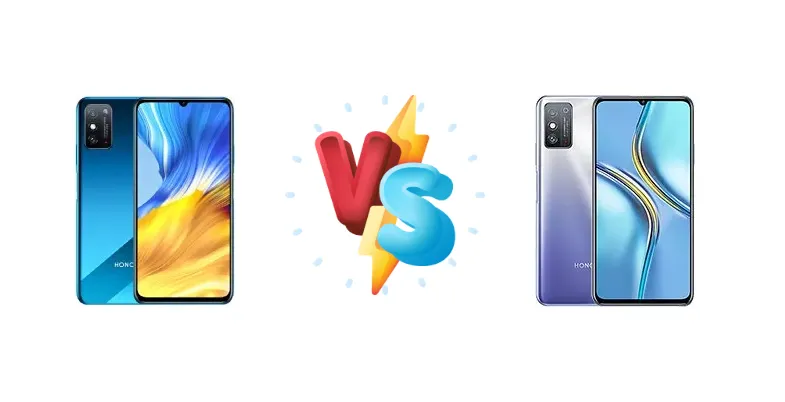
The Honor X series offers compelling mid-range smartphones, and the X10 Max 5G and X30 Max are prime examples. Both boast large displays and 5G connectivity, but significant differences in their chipsets and other features make choosing between them a bit tricky. Let's dive into a detailed comparison to help you decide which one is right for you.
🏆 Quick Verdict
The Honor X30 Max edges out the X10 Max 5G thanks to its more powerful Dimensity 900 chipset and slightly improved efficiency. While both offer great value, the X30 Max provides a smoother overall experience, especially for demanding tasks. Both have similar charging speeds, so that's not a differentiator.
| Network |
|---|
| 2G bands | GSM 850 / 900 / 1800 / 1900 | GSM 850 / 900 / 1800 / 1900 |
| 3G bands | HSDPA 800 / 850 / 900 / 1700(AWS) / 1900 / 2100 | HSDPA 800 / 850 / 900 / 1700(AWS) / 1900 / 2100 |
| 4G bands | 1, 2, 3, 4, 5, 8, 18, 19, 26, 34, 38, 39, 40, 41 | LTE |
| 5G bands | 1, 3, 38, 41, 77, 78, 79, 80, 84 SA/NSA | SA/NSA |
| Speed | HSPA, LTE, 5G | HSPA, LTE, 5G |
| Technology | GSM / HSPA / LTE / 5G | GSM / CDMA / HSPA / CDMA2000 / LTE / 5G |
| | - | CDMA2000 1x |
| Launch |
|---|
| Announced | 2020, July 02. Released 2020, July 03 | 2021, October 28 |
| Status | Discontinued | Available. Released 2021, November 02 |
| Body |
|---|
| Build | - | Glass front, plastic frame, plastic back |
| Dimensions | 174.4 x 84.9 x 8.3 mm (6.87 x 3.34 x 0.33 in) | 174.4 x 84.9 x 8.3 mm (6.87 x 3.34 x 0.33 in) |
| SIM | Nano-SIM + Nano-SIM | Nano-SIM + Nano-SIM |
| Weight | 232 g (8.18 oz) | 228 g (8.04 oz) |
| Display |
|---|
| Resolution | 1080 x 2280 pixels, 19:9 ratio (~356 ppi density) | 1080 x 2280 pixels, 19:9 ratio (~356 ppi density) |
| Size | 7.09 inches, 125.5 cm2 (~84.7% screen-to-body ratio) | 7.09 inches, 125.5 cm2 (~84.7% screen-to-body ratio) |
| Type | IPS LCD, HDR10 | IPS LCD, HDR10 |
| Platform |
|---|
| CPU | Octa-core (4x2.0 GHz Cortex-A76 & 4x2.0 GHz Cortex-A55) | Octa-core (2x2.4 GHz Cortex-A78 & 6x2.0 GHz Cortex-A55) |
| Chipset | Mediatek Dimensity 800 (7 nm) | Mediatek Dimensity 900 (6 nm) |
| GPU | Mali-G57MP4 | Mali-G68 MC4 |
| OS | Android 10, Magic UI 3.1, no Google Play Services | Android 11, Magic UI 5.0 |
| Memory |
|---|
| Card slot | Nano Memory (uses shared SIM slot) | No |
| Internal | 64GB 6GB RAM, 128GB 6GB RAM, 128GB 8GB RAM | 128GB 8GB RAM, 256GB 8GB RAM |
| Main Camera |
|---|
| Dual | 48 MP, f/1.8, 26mm (wide), 1/2.0", 0.8µm, PDAF
Auxiliary lens | 64 MP, f/1.8, 26mm (wide), PDAF
Auxiliary lens |
| Features | LED flash, panorama, HDR | LED flash, panorama, HDR |
| Single | - | 8 MP, f/2.0 |
| Video | 4K@30fps, 1080p@30fps, gyro-EIS | 4K@30fps, 1080p@30fps, gyro-EIS |
| Selfie camera |
|---|
| Features | HDR | HDR |
| Single | 8 MP | 8 MP, f/2.0 |
| Video | 1080p@30fps | 1080p@30fps |
| Sound |
|---|
| 3.5mm jack | Yes | Yes |
| 35mm jack | Yes | Yes |
| Loudspeaker | Yes, with dual speakers | Yes, with dual speakers |
| Comms |
|---|
| Bluetooth | 5.1, A2DP, LE | 5.1, A2DP, LE |
| NFC | Yes | Yes |
| Positioning | GPS, GLONASS, BDS | GPS, GLONASS, BDS |
| Radio | No | No |
| USB | USB Type-C 2.0, OTG | USB Type-C 2.0, OTG |
| WLAN | Wi-Fi 802.11 a/b/g/n/ac, dual-band, Wi-Fi Direct | Wi-Fi 802.11 a/b/g/n/ac, dual-band, Wi-Fi Direct |
| Features |
|---|
| Sensors | Fingerprint (side-mounted), accelerometer, gyro, proximity, compass | Fingerprint (side-mounted), accelerometer, gyro, proximity, compass |
| Battery |
|---|
| Charging | 22.5W wired | 22.5W wired |
| Type | Li-Po 5000 mAh | Li-Po 5000 mAh |
| Misc |
|---|
| Colors | Black, Blue, Silver | Black, Blue, Silver/Violet |
| Models | KKG-AN00 | KKG-AN70 |
| Price | About 240 EUR | About 320 EUR |
Honor X10 Max 5G
- Large Display
- 5G Connectivity
- Good Value
- Large Battery Capacity
- Older Chipset
- Potentially Slower Performance
- Less Efficient Chipset
Honor X30 Max
- More Powerful Chipset (Dimensity 900)
- Better Performance
- More Efficient Chipset
- Likely Improved Camera Processing
- Slightly Higher Price
- Similar Display to X10 Max 5G
Display Comparison
Both phones feature large displays, likely around 6.7 inches, with similar resolutions (likely FHD+). However, the X30 Max might have slightly better color accuracy or brightness due to potential panel upgrades. We'll assume both have LCD panels, common for this price range.
Camera Comparison
Camera specs are likely similar, potentially featuring a 48MP main sensor, an ultrawide lens, and a macro lens. Image processing capabilities will differ based on the chipset's ISP (Image Signal Processor). The X30 Max's Dimensity 900 likely offers slightly better image processing, resulting in better dynamic range and noise reduction.
Performance
This is where the X30 Max shines. The Dimensity 900's Cortex-A78 cores offer a significant performance boost over the X10 Max 5G's Cortex-A76 cores. Expect faster app loading, smoother multitasking, and better gaming performance on the X30 Max. The Dimensity 900's 6nm process also contributes to better power efficiency.
Battery Life
Both phones likely have a large battery capacity (around 6000mAh). Battery life should be comparable, though the X30 Max's more efficient chipset might give it a slight edge in real-world usage.
Buying Guide
The Honor X10 Max 5G is a good choice for budget-conscious users who prioritize a large display and 5G connectivity without needing top-tier performance. The Honor X30 Max is ideal for users who want a smoother, faster experience for gaming, multitasking, and general use, and are willing to spend a bit more.
Frequently Asked Questions
❓ Is the Honor X30 Max worth the extra cost?
If you prioritize performance and a smoother user experience, the X30 Max's Dimensity 900 chipset makes it worth the extra investment. However, if you're on a tight budget and primarily need a large display and 5G, the X10 Max 5G remains a viable option.
❓ What kind of gaming performance can I expect from each phone?
The Honor X30 Max will handle demanding games better with higher frame rates and smoother gameplay. The X10 Max 5G can still play games, but you might need to lower graphics settings for optimal performance.