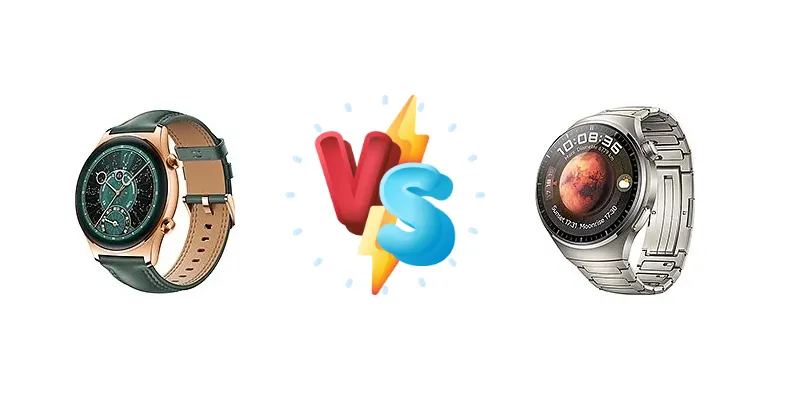
The Honor Watch GS 4 and Huawei Watch 4 Pro represent interesting points in the smartwatch landscape. Honor, having spun off from Huawei, now operates with a degree of independence, while Huawei continues to refine its ecosystem. This comparison isn't just about specs; it's about understanding the implications of choosing a watch deeply integrated into either the Honor or Huawei world.
🏆 Quick Verdict
For the average user prioritizing convenience and a potentially wider app ecosystem, the Huawei Watch 4 Pro emerges as the stronger choice, primarily due to its wireless charging and established health platform. However, the Honor Watch GS 4 may appeal to those seeking a more open experience, though details remain scarce.
| Network |
|---|
| 2G bands | N/A | N/A |
| 3G bands | N/A | HSDPA 850 / 900 / 1800 / 1900 / 2100 / 800 |
| 4G bands | N/A | LTE |
| EDGE | No | - |
| GPRS | No | - |
| Speed | No | HSPA, LTE |
| Technology | No cellular connectivity | HSPA / LTE |
| Launch |
|---|
| Announced | 2024, March 18 | 2023, May 10 |
| Status | Available. Released 2024, March 29 | Available. Released 2023, June 22 |
| Body |
|---|
| Build | Glass front, plastic back, stainless steel frame 316L | Glass front, ceramic back, TC4 titanium frame |
| Dimensions | 45.9 x 45.9 x 10.5 mm (1.81 x 1.81 x 0.41 in) | 47.6 x 47.6 x 12.9 mm (1.87 x 1.87 x 0.51 in) |
| SIM | No | eSIM |
| Weight | 44 g (1.55 oz) | 65 g (2.29 oz) |
| | - | 50m water resistant
5 ATM
Compatible with standard 22mm straps |
| Display |
|---|
| Protection | - | Sapphire crystal glass |
| Resolution | 466 x 466 pixels (~326 ppi density) | 466 x 466 pixels (~310 ppi density) |
| Size | 1.43 inches | 1.5 inches |
| Type | AMOLED | LTPO AMOLED |
| | - | * the display resolution is unconfirmed
Always-on display |
| Platform |
|---|
| OS | Proprietary OS | HarmonyOS 3.0 |
| Memory |
|---|
| Card slot | No | No |
| Internal | 4GB 32MB RAM | 32GB 2GB RAM |
| Sound |
|---|
| 3.5mm jack | - | No |
| 35mm jack | No | No |
| Loudspeaker | Yes | Yes |
| Comms |
|---|
| Bluetooth | 5.0, LE, EDR | 5.2, A2DP, LE |
| NFC | Yes (China only) | Yes |
| Positioning | GPS (L1+L5), BDS (B1I+B2a), GALILEO (E1+E5a), QZSS (L1+L5), GLONASS | GPS (L1+L5), GLONASS, BDS, GALILEO, QZSS |
| Radio | No | No |
| USB | No | No |
| WLAN | No | Wi-Fi 802.11 b/g/n (market/region dependent) |
| Features |
|---|
| Sensors | Accelerometer, gyro, heart rate, barometer, compass, SpO2 | Accelerometer, gyro, heart rate, barometer, compass, SpO2, thermometer (body temperature) |
| Battery |
|---|
| Charging | - | Wireless |
| Type | Li-Po 451 mAh | Li-Ion |
| Misc |
|---|
| Colors | Black, Steel, Gold | Titanium |
| Models | MUS-B19 | MDS-AL00, MDS-AL10 |
| Price | About 120 EUR | About 550 EUR |
Honor Watch GS 4
- Potential for a more open ecosystem
- May offer a more competitive price point
- Honor's design language may appeal to some users
- Lack of detailed specifications hinders a thorough comparison
- Uncertainty regarding app ecosystem support
- Charging method and battery life are unknown
Huawei Watch 4 Pro
- Wireless charging for added convenience
- Mature health and fitness tracking platform
- Established Huawei ecosystem integration
- Potential ecosystem lock-in
- Reliance on Huawei’s app store
- May be more expensive than the Honor GS 4
Display Comparison
Without specific display details for the Honor Watch GS 4, we can infer a focus on standard smartwatch panel technology. The Huawei Watch 4 Pro likely utilizes an AMOLED display, given Huawei’s history with this technology in its wearables. The presence or absence of LTPO (Low-Temperature Polycrystalline Oxide) in the GS 4 is unknown, but its inclusion in the Pro model would significantly impact battery life by dynamically adjusting the refresh rate. Bezels are a key differentiator; a smaller bezel on the Pro model would translate to a more immersive viewing experience. Color accuracy, measured in sRGB or DCI-P3 coverage, will be crucial for photo previews and vibrant watch faces.
Camera Comparison
Neither watch is expected to prioritize camera functionality, but the inclusion of any camera (even a basic one) on the Huawei Watch 4 Pro would be a differentiating factor. Sensor size and lens aperture are key determinants of image quality in low-light conditions. Image processing algorithms play a vital role in noise reduction and color accuracy. The value of any camera feature on a smartwatch is debatable, but it could be used for quick scans or remote control functionality.
Performance
The chipset powering the Honor Watch GS 4 is currently unknown. Huawei’s use of its own Kirin chips in previous models suggests a similar approach for the Watch 4 Pro, potentially optimized for power efficiency. RAM speed (LPDDR4x or LPDDR5) will impact app loading times and multitasking. Thermal management is critical; a poorly optimized chipset can lead to throttling during extended workouts or GPS tracking. The absence of detailed specs for the GS 4 makes a direct performance comparison difficult, but Huawei’s established silicon expertise gives the Watch 4 Pro an initial advantage.
Battery Life
Battery capacity (measured in mAh) is a primary concern for smartwatch users. The Huawei Watch 4 Pro’s wireless charging capability offers convenience, but charging speed (measured in Watts) is equally important. A larger battery capacity doesn’t always translate to longer battery life; software optimization and chipset efficiency play a significant role. Real-world usage scenarios (always-on display, GPS tracking, heart rate monitoring) will heavily influence battery drain. The Honor Watch GS 4’s charging method and battery size are currently unknown, making a direct comparison impossible.
Buying Guide
Buy the Honor Watch GS 4 if you prioritize a potentially more open smartwatch experience, less ecosystem lock-in, and are comfortable with a brand still establishing its independent smartwatch identity. Buy the Huawei Watch 4 Pro if you are already invested in the Huawei ecosystem (phones, earbuds), value the convenience of wireless charging, and prioritize a mature health and fitness tracking platform with established data analysis.
Frequently Asked Questions
❓ How does the Huawei Watch 4 Pro's health tracking compare to other leading smartwatches like the Apple Watch or Samsung Galaxy Watch?
Huawei's health tracking, powered by its TruSeen technology, focuses heavily on heart rate monitoring, SpO2 levels, and sleep analysis. While it offers comparable metrics to Apple and Samsung, the data interpretation and integration with third-party apps may be less extensive. Huawei's strength lies in its detailed sleep tracking and stress monitoring features.
❓ Is the Honor Watch GS 4 compatible with iPhones, or is it primarily designed for Android users?
Given Honor's increasing independence, compatibility with iPhones is plausible, but likely limited. Expect core smartwatch functionality (notifications, time display) to work, but advanced features and app integration may be restricted. The Huawei Watch 4 Pro also faces similar compatibility challenges with iOS.
❓ What kind of app ecosystem can I expect on the Huawei Watch 4 Pro, given the limitations of the Huawei AppGallery?
The Huawei AppGallery for smartwatches is growing, but it remains smaller than the Apple App Store or Google Play Store. Expect essential apps like fitness trackers, music players, and basic utilities. However, the availability of third-party apps may be limited. Huawei is actively working to expand the AppGallery, but it's a key consideration for users heavily reliant on a wide range of apps.