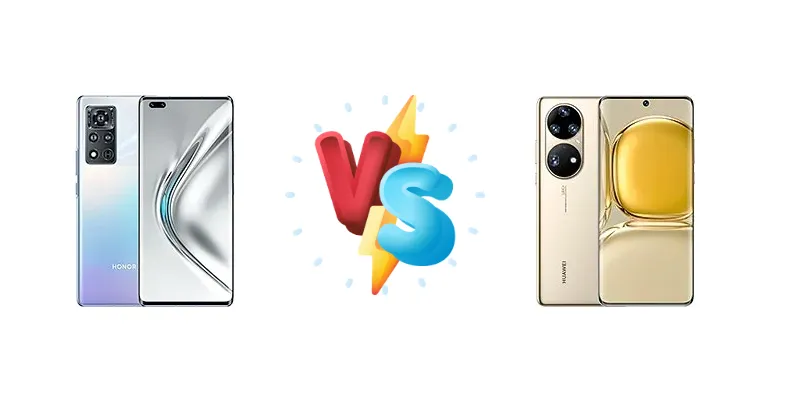
The Honor View40 and Huawei P50 Pro represent interesting points in the evolution of both brands. The View40, released as Honor charted its independence, aimed to deliver flagship specs at a competitive price. The P50 Pro, meanwhile, showcases Huawei’s continued camera innovation despite ongoing geopolitical challenges. This comparison dissects their key differences to determine which phone offers the best value and experience.
🏆 Quick Verdict
For most users, the Huawei P50 Pro emerges as the stronger contender. While both offer 66W wired and 50W wireless charging, the P50 Pro’s Kirin 9000 (or Snapdragon 888 4G variant) provides a more refined and powerful processing experience, coupled with a demonstrably brighter display. However, the View40 remains a compelling option for budget-conscious buyers prioritizing fast charging and a high refresh rate.
| Network |
|---|
| 2G bands | GSM 850 / 900 / 1800 / 1900 | GSM 850 / 900 / 1800 / 1900 |
| 3G bands | HSDPA 800 / 850 / 900 / 1700(AWS) / 1800 / 1900 / 2100 | HSDPA 800 / 850 / 900 / 1700(AWS) / 1900 / 2100 |
| 4G bands | LTE | 1, 2, 3, 4, 5, 6, 7, 8, 9, 12, 17, 18, 19, 20, 26, 28, 34, 38, 39, 40, 41 - China |
| 5G bands | SA/NSA | - |
| Speed | HSPA, LTE, 5G | HSPA, LTE |
| Technology | GSM / HSPA / LTE / 5G | GSM / CDMA / HSPA / CDMA2000 / LTE |
| | - | 1, 2, 3, 4, 5, 7, 8, 12, 17, 18, 19, 20, 26, 28, 32, 34, 38, 39, 40, 41, 66 - International |
| Launch |
|---|
| Announced | 2021, January 22 | 2021, July 29 |
| Status | Cancelled | Available. Released 2021, August 12 |
| Body |
|---|
| Build | - | Glass front, glass back, aluminum frame |
| Dimensions | 163.1 x 74.3 x 8 mm (6.42 x 2.93 x 0.31 in) | 158.8 x 72.8 x 8.5 mm (6.25 x 2.87 x 0.33 in) |
| SIM | Nano-SIM + Nano-SIM | · Nano-SIM· Nano-SIM + Nano-SIM |
| Weight | 189 g (6.67 oz) | 195 g (6.88 oz) |
| | - | IP68 dust/water resistant (up to 1.5m for 30 min) |
| Display |
|---|
| Resolution | 1236 x 2676 pixels, 19.5:9 ratio (~439 ppi density) | 1228 x 2700 pixels (~450 ppi density) |
| Size | 6.72 inches, 110.9 cm2 (~91.5% screen-to-body ratio) | 6.6 inches, 105.4 cm2 (~91.2% screen-to-body ratio) |
| Type | AMOLED, 1B colors, HDR10, 120Hz, 800 nits (peak) | OLED, 1B colors, 120Hz |
| | Always-on display | - |
| Platform |
|---|
| CPU | Octa-core (4x2.6 GHz Cortex-A77 & 4x2.0 GHz Cortex-A55) | Octa-core (1x3.13 GHz Cortex-A77 & 3x2.54 GHz Cortex-A77 & 4x2.05 GHz Cortex-A55)Octa-core (1x2.84 GHz Cortex-X1 & 3x2.42 GHz Cortex-A78 & 4x1.80 GHz Cortex-A55) |
| Chipset | Mediatek Dimensity 1000+ (7 nm) | Kirin 9000 (5 nm)Qualcomm SM8350 Snapdragon 888 4G (5 nm) |
| GPU | Mali-G77 MC9 | Mali-G78 MP24Adreno 660 |
| OS | Android 10, with Google Play Services (unconfirmed) | HarmonyOS 2.0 (China), EMUI 14.2 (Europe), no Google Play Services |
| Memory |
|---|
| Card slot | No | Nano Memory (uses shared SIM slot) |
| Internal | 256GB 8GB RAM | 128GB 8GB RAM, 256GB 8GB RAM, 512GB 8GB RAM, 512GB 12GB RAM |
| | UFS 2.1 | - |
| Main Camera |
|---|
| Features | Laser AF, LED flash, panorama, HDR | Laser AF, color spectrum sensor, Leica optics, dual-LED flash, panorama, HDR |
| Quad | - | 50 MP, f/1.8, 23mm (wide), PDAF, OIS
64 MP, f/3.5, 90mm (periscope telephoto), PDAF, OIS, 3.5x optical zoom, 7x lossless zoom
13 MP, f/2.2, 13mm (ultrawide), AF
40 MP, f/1.6, 23mm (B/W), AF |
| Single | - | 13 MP, f/2.4, (wide), AF |
| Triple | 50 MP, f/1.9, (wide), 1/1.56", 1.0µm, PDAF
8 MP, f/2.4, 120˚, 17mm (ultrawide)
2 MP (macro) | - |
| Video | 4K, 1080p, 720p@1920fps, HDR, gyro-EIS | 4K@30/60fps, 1080p@30/60fps, 1080p@960fps; gyro-EIS |
| Selfie camera |
|---|
| Dual | 16 MP, f/2.0, (wide)
Color spectrum sensor | - |
| Features | HDR | Panorama, HDR |
| Single | - | 13 MP, f/2.4, (wide), AF |
| Video | 1080p@30fps, gyro-EIS | 4K@30fps, 1080p@30/60/240fps |
| Sound |
|---|
| 3.5mm jack | No | No |
| 35mm jack | No | No |
| Loudspeaker | Yes, with stereo speakers | Yes, with stereo speakers |
| Comms |
|---|
| Bluetooth | 5.1, A2DP, LE | 5.2, A2DP, LE |
| Infrared port | Yes | Yes |
| NFC | Yes | Yes |
| Positioning | GPS (L1+L5), GLONASS, BDS, GALILEO, QZSS | GPS (L1+L5), GLONASS (L1), BDS (B1I+B1c+B2a+B2b), GALILEO (E1+E5a+E5b), QZSS (L1+L5), NavIC |
| Radio | No | No |
| USB | USB Type-C, OTG | USB Type-C 3.1, OTG |
| WLAN | Wi-Fi 802.11 a/b/g/n/ac/6, dual-band, Wi-Fi Direct | Wi-Fi 802.11 a/b/g/n/ac/6, dual-band, Wi-Fi Direct |
| Features |
|---|
| Sensors | Fingerprint (under display, optical), accelerometer, gyro, proximity, compass | Fingerprint (under display, optical), accelerometer, gyro, proximity, compass, barometer |
| Battery |
|---|
| Charging | 66W wired, 60% in 15 min, 100% in 35 min
50W wireless, 50% in 35 min
5W reverse wired | 66W wired
50W wireless
Reverse wireless charging |
| Type | Li-Po 4000 mAh | Li-Po 4360 mAh |
| Misc |
|---|
| Colors | Midnight Black, Rose Gold, Titanium Silver | Golden Black, Cocoa Gold, Pearl White, Charm Pink |
| Models | - | JAD-AL50, JAD-LX9, JAD-AL00 |
| Price | - | $ 196.62 / £ 329.00 / € 473.13 |
| Tests |
|---|
| Battery life | - |
Endurance rating 76h
|
| Camera | - |
Photo / Video |
| Display | - |
Contrast ratio: Infinite (nominal) |
| Loudspeaker | - |
-27.3 LUFS (Good)
|
| Performance | - |
AnTuTu: 793876 (v8), 786215 (v9)
GeekBench: 3145 (v5.1)
GFXBench: 44fps (ES 3.1 onscreen) |
Honor View40
- Faster charging speeds (claimed 0-100% in 35 mins)
- Potentially lower price point
- Reverse wired charging
- Older 7nm chipset
- Less powerful CPU
- Likely inferior camera system
Huawei P50 Pro
- More powerful processor (Kirin 9000 or Snapdragon 888 4G)
- Brighter display
- Superior camera capabilities (likely)
- Higher price point
- Snapdragon 888 4G variant lacks 5G
- Charging times not explicitly stated
Display Comparison
The Huawei P50 Pro boasts a significantly brighter display, reaching 754 nits measured, compared to an unspecified peak brightness for the View40. This translates to better visibility under direct sunlight. While both feature excellent contrast ratios (infinite, nominally), the P50 Pro’s brightness advantage is a clear win for outdoor usability. Details regarding the View40’s panel technology (OLED, refresh rate) are crucial, but absent in the provided data. The P50 Pro’s display is geared towards a more visually immersive experience, particularly for HDR content.
Camera Comparison
Both phones are marketed on their camera capabilities, but the P50 Pro likely holds a substantial advantage. While both are described as having 'Photo / Video' capabilities, the P50 Pro’s lineage within Huawei’s camera-focused brand suggests a more sophisticated image processing pipeline and potentially larger sensor sizes. The absence of specific sensor details for both phones makes a precise comparison difficult, but Huawei’s history of camera innovation points towards a more refined photographic experience on the P50 Pro. Ignoring the likely minimal utility of any 2MP macro lenses on either device, the main sensor and image processing are the key differentiators.
Performance
The chipset is where a significant divergence occurs. The Huawei P50 Pro offers two options: the Kirin 9000 (5nm) and the Qualcomm Snapdragon 888 4G (also 5nm). Both represent a step up in process node technology compared to the Honor View40’s Mediatek Dimensity 1000+ (7nm). The smaller 5nm node generally translates to improved power efficiency and thermal performance. The Kirin 9000’s CPU configuration (1x3.13 GHz Cortex-A77, 3x2.54 GHz Cortex-A77, 4x2.05 GHz Cortex-A55) and the Snapdragon 888 4G’s (1x2.84 GHz Cortex-X1, 3x2.42 GHz Cortex-A78, 4x1.80 GHz Cortex-A55) offer more processing power than the View40’s (4x2.6 GHz Cortex-A77 & 4x2.0 GHz Cortex-A55). The Snapdragon 888 4G’s limitation to 4G connectivity is a key consideration for users in areas with robust 5G infrastructure.
Battery Life
Both devices share an endurance rating of 76 hours, suggesting comparable real-world battery life despite potentially different battery capacities (not specified). However, the charging speeds are a key differentiator. Both support 66W wired and 50W wireless charging, with the View40 claiming 60% charge in 15 minutes and 100% in 35 minutes, while the P50 Pro’s times are not specified. The inclusion of 5W reverse wired charging on the View40 and reverse wireless charging on the P50 Pro adds a degree of versatility, though these features are rarely critical for most users.
Buying Guide
Buy the Honor View40 if you need a fast-charging phone with a smooth 120Hz display and are on a tighter budget. It’s ideal for users who prioritize gaming and media consumption without breaking the bank. Buy the Huawei P50 Pro if you prefer a superior camera system, a brighter and more vibrant display, and a more powerful processor, even if it comes at a higher price point. This phone caters to photography enthusiasts and power users.
Frequently Asked Questions
❓ Does the Snapdragon 888 4G in the P50 Pro significantly limit its future-proofing compared to a 5G variant?
The Snapdragon 888 4G’s lack of 5G connectivity is a valid concern. If you live in an area with widespread 5G coverage and anticipate needing it in the coming years, this is a major drawback. However, if 5G availability is limited in your region, or you don’t foresee needing it frequently, the performance benefits of the Snapdragon 888 4G may outweigh the lack of 5G.
❓ How does the Dimensity 1000+ handle graphically demanding games like PUBG or Genshin Impact on the Honor View40?
The Dimensity 1000+ is capable of running demanding games like PUBG and Genshin Impact, but you may need to lower graphics settings to maintain a consistently high frame rate. The 7nm process node and the GPU are less efficient than the 5nm options in the P50 Pro, potentially leading to more noticeable thermal throttling during extended gaming sessions. The View40’s 120Hz display will contribute to a smoother visual experience, but the processor may be a limiting factor.
❓ Is the 50W wireless charging on both phones compatible with all Qi wireless chargers?
While both phones support 50W wireless charging, achieving those speeds requires a compatible charger capable of delivering that wattage. Standard Qi wireless chargers typically output at lower power levels (e.g., 15W), so you won’t experience the full 50W charging speed with those. Using a compatible charger is essential to take advantage of the faster wireless charging capabilities.