
Honor View30 vs. Google Pixel 5a 5G: A Detailed Comparison of Mid-Range Powerhouses
| Phones Images | |||||
|---|---|---|---|---|---|
|
🏆 Quick Verdict
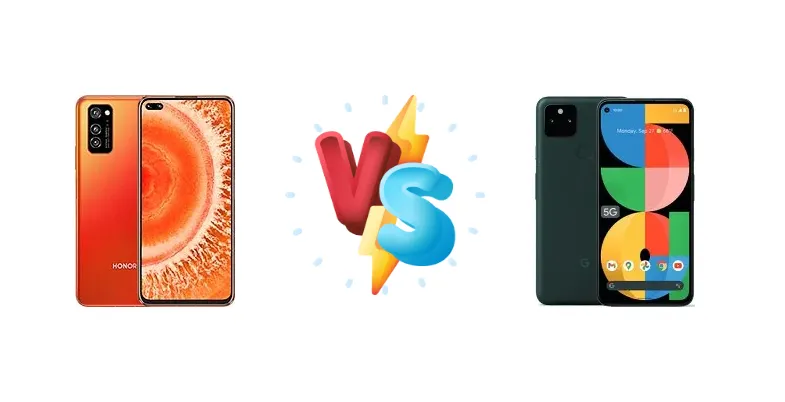
For the average user prioritizing camera quality and software support, the Google Pixel 5a 5G is the better choice. However, the Honor View30 offers significantly faster 40W charging and a potentially higher peak performance ceiling for demanding tasks, making it ideal for power users.
| PHONES | ||
|---|---|---|
| Phone Names | Honor View30 | Google Pixel 5a 5G |
| Network | ||
|---|---|---|
| 2G bands | GSM 850 / 900 / 1800 / 1900 | GSM 850 / 900 / 1800 / 1900 |
| 3G bands | HSDPA 800 / 850 / 900 / 1700(AWS) / 1900 / 2100 | HSDPA 850 / 900 / 1700(AWS) / 1900 / 2100 |
| 4G bands | 1, 2, 3, 4, 5, 7, 8, 12, 17, 18, 19, 26, 34, 38, 39, 40, 41 | 1, 2, 3, 4, 5, 7, 8, 12, 13, 14, 17, 18, 19, 20, 25, 26, 28, 29, 30, 32, 38, 39, 40, 41, 42, 46, 48, 66, 71 |
| 5G bands | 1, 3, 41, 77, 78, 79 SA/NSA | 1, 2, 5, 12, 25, 28, 41, 66, 71, 77, 78 SA/NSA/Sub6 |
| Speed | HSPA, LTE, 5G (2+ Gbps DL) | HSPA, LTE, 5G |
| Technology | GSM / HSPA / LTE / 5G | GSM / HSPA / EVDO / LTE / 5G |
| - | CDMA2000 1xEV-DO | |
| Launch | ||
|---|---|---|
| Announced | 2020, February 24. Released 2020, April 27 | 2021, August 17 |
| Status | Discontinued | Available. Released 2021, August 26 |
| Body | ||
|---|---|---|
| Build | Glass front, glass back, aluminum frame | Glass front (Gorilla Glass 3), aluminum frame, aluminum back |
| Dimensions | 162.7 x 75.8 x 8.9 mm (6.41 x 2.98 x 0.35 in) | 156.2 x 73.2 x 8.8 mm (6.15 x 2.88 x 0.35 in) |
| SIM | Nano-SIM + Nano-SIM | Nano-SIM + eSIM |
| Weight | 213 g (7.51 oz) | 183 g (6.46 oz) |
| - | IP67 dust/water resistant (up to 1m for 30 min) | |
| Display | ||
|---|---|---|
| Protection | Yes | Corning Gorilla Glass 3 |
| Resolution | 1080 x 2400 pixels, 20:9 ratio (~401 ppi density) | 1080 x 2400 pixels, 20:9 ratio (~415 ppi density) |
| Size | 6.57 inches, 104.2 cm2 (~84.5% screen-to-body ratio) | 6.34 inches, 97.0 cm2 (~84.9% screen-to-body ratio) |
| Type | IPS LCD | OLED, HDR |
| - | Always-on display | |
| Platform | ||
|---|---|---|
| CPU | Octa-core (2x2.86 GHz Cortex-A76 & 2x2.09 GHz Cortex-A76 & 4x1.86 GHz Cortex-A55) | Octa-core (1x2.4 GHz Kryo 475 Prime & 1x2.2 GHz Kryo 475 Gold & 6x1.8 GHz Kryo 475 Silver) |
| Chipset | Kirin 990 (7 nm) | Qualcomm SM7250 Snapdragon 765G 5G (7 nm) |
| GPU | Mali-G76 MP16 | Adreno 620 |
| OS | Android 10, Magic UI 3, no Google Play Services | Android 11, upgradable to Android 14 |
| Memory | ||
|---|---|---|
| Card slot | No | No |
| Internal | 128GB 6GB RAM, 128GB 8GB RAM | 128GB 6GB RAM |
| UFS 3.0 | - | |
| Main Camera | ||
|---|---|---|
| Dual | - | 12.2 MP, f/1.7, 27mm, (wide), 1/2.55", 1.4µm, dual pixel PDAF, OIS 16 MP, f/2.2, 119˚ (ultrawide), 1.0µm |
| Features | Laser AF, LED flash, HDR, panorama | LED flash, Pixel Shift, Auto-HDR, panorama |
| Single | - | 8 MP, f/2.0, 24mm (wide), 1.12µm |
| Triple | 40 MP, f/1.8, 27mm (wide), 1/1.7", PDAF 8 MP, f/2.4, 80mm (telephoto), 1/4.0", PDAF, OIS, 3x optical zoom 8 MP, f/2.4, 16mm (ultrawide) | - |
| Video | 4K@30fps, 1080p@30fps, 720p@960fps, (gyro-EIS) | 4K@30/60fps, 1080p@30/60/120/240fps; gyro-EIS |
| Selfie camera | ||
|---|---|---|
| Dual | 32 MP, f/2.0, 26mm (wide), 1/2.8", 0.8µm 8 MP, f/2.2, 17mm (ultrawide) | - |
| Features | HDR | HDR |
| Single | - | 8 MP, f/2.0, 24mm (wide), 1.12µm |
| Video | 1080p@30fps | 1080p@30fps |
| Sound | ||
|---|---|---|
| 3.5mm jack | No | Yes |
| 35mm jack | No | Yes |
| Loudspeaker | Yes | Yes, with stereo speakers |
| Comms | ||
|---|---|---|
| Bluetooth | 5.1, A2DP, LE | 5.0, A2DP, LE, aptX HD |
| NFC | Yes | Yes |
| Positioning | GPS (L1+L5), GLONASS, BDS, GALILEO, QZSS | GPS, GLONASS, GALILEO, QZSS, BDS |
| Radio | No | No |
| USB | USB Type-C 2.0, OTG | USB Type-C 3.1 |
| WLAN | Wi-Fi 802.11 a/b/g/n/ac, dual-band, Wi-Fi Direct | Wi-Fi 802.11 a/b/g/n/ac, dual-band, Wi-Fi Direct |
| Features | ||
|---|---|---|
| Sensors | Fingerprint (side-mounted), accelerometer, gyro, proximity, compass | Fingerprint (rear-mounted), accelerometer, gyro, proximity, compass, barometer |
| Battery | ||
|---|---|---|
| Charging | 40W wired, 70% in 30 min | 18W wired, PD2.0 |
| Type | Li-Po 4200 mAh | Li-Po 4680 mAh |
| Misc | ||
|---|---|---|
| Colors | Ocean Blue, Midnight Black, Icelandic Frost, Sunrise Orange | Mostly Black |
| Models | - | G1F8F, G4S1M |
| Price | - | $ 189.00 / C$ 249.99 |
| Tests | ||
|---|---|---|
| Battery life | - | Endurance rating 122h |
| Display | - | Contrast ratio: Infinite (nominal) |
| Performance | - | AnTuTu: 291303 (v8) GeekBench: 1337 (v5.1) GFXBench: 19fps (ES 3.1 onscreen) |
Honor View30
- Significantly faster 40W charging
- Potentially higher peak CPU and GPU performance
- May offer more RAM options (depending on variant)
- EMUI software may not appeal to all users
- Software update support is less certain
Google Pixel 5a 5G
- Clean Android experience with guaranteed updates
- Exceptional camera performance and image processing
- Brighter display for outdoor visibility
- Slower 18W charging
- Less powerful chipset compared to Kirin 990
Display Comparison
The Pixel 5a 5G boasts a brighter display, reaching a measured 861 nits, compared to the Honor View30’s unspecified peak brightness. This translates to better outdoor visibility for the Pixel. While the Honor View30’s panel technology isn’t detailed, the Pixel 5a 5G’s ‘Infinite’ contrast ratio suggests a typical OLED experience with perfect blacks. Both devices likely utilize similar OLED panels, but the Pixel’s higher brightness gives it a clear advantage in direct sunlight.
Camera Comparison
The Pixel 5a 5G’s strength lies in its computational photography, leveraging Google’s image processing algorithms. While sensor sizes aren’t specified, the Pixel’s reputation for excellent dynamic range and low-light performance suggests a well-tuned camera system. The Honor View30’s camera specs are missing, making a direct comparison difficult. However, the Pixel 5a 5G’s consistent image quality and software features provide a more reliable photographic experience. Ignoring potential 2MP macro lenses on either device, the Pixel’s image processing is the key differentiator.
Performance
The Honor View30’s Kirin 990, built on a 7nm process, features a more complex CPU configuration with two high-performance Cortex-A76 cores clocked at 2.86 GHz, potentially offering higher single-core performance than the Pixel 5a 5G’s Snapdragon 765G. However, the Snapdragon 765G’s Kryo 475 Prime core at 2.4 GHz is optimized for efficiency. The Kirin 990’s GPU is likely more powerful, but the Snapdragon 765G benefits from Qualcomm’s optimized software and thermal management, potentially mitigating throttling during sustained loads. The Honor View30’s performance advantage is likely most noticeable in graphically intensive tasks.
Battery Life
Both the Honor View30 and Google Pixel 5a 5G achieve an endurance rating of 122 hours, indicating similar overall battery life despite potentially different battery capacities. However, the Honor View30’s 40W wired charging significantly outperforms the Pixel 5a 5G’s 18W PD2.0 charging. The Honor View30 can reach 70% charge in just 30 minutes, while the Pixel 5a 5G will take considerably longer. This charging speed difference is a major advantage for the Honor View30, especially for users who need quick top-ups.
Buying Guide
Buy the Honor View30 if you need rapid charging, are comfortable with EMUI (or a custom ROM), and prioritize raw processing power for gaming or video editing. Buy the Google Pixel 5a 5G if you value a clean Android experience, exceptional camera performance, and guaranteed software updates, even if it means sacrificing some charging speed and peak CPU performance.