
Honor View30 Pro vs. Google Pixel 5a 5G: A Detailed Comparison of Mid-Range 5G Powerhouses
| Phones Images | |||||
|---|---|---|---|---|---|
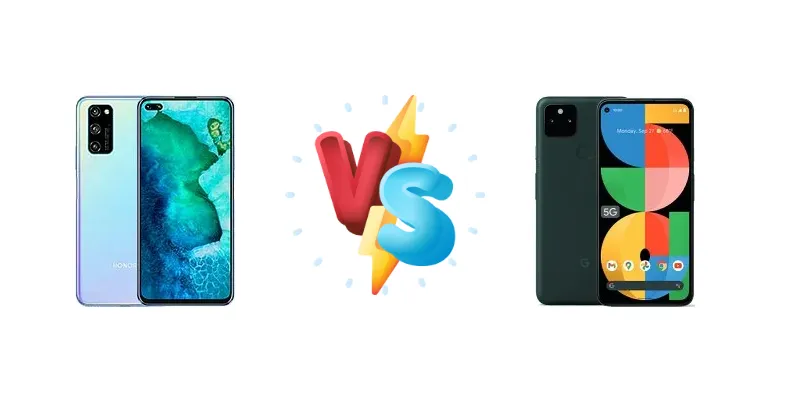
|
🏆 Quick Verdict
For users prioritizing raw performance and faster charging, the Honor View30 Pro is the clear winner. However, the Google Pixel 5a 5G excels in camera consistency, software experience, and battery endurance, making it the better choice for everyday users who value reliability and photographic simplicity.
| PHONES | ||
|---|---|---|
| Phone Names | Honor View30 Pro | Google Pixel 5a 5G |
| Network | ||
|---|---|---|
| 2G bands | GSM 850 / 900 / 1800 / 1900 | GSM 850 / 900 / 1800 / 1900 |
| 3G bands | HSDPA 800 / 850 / 900 / 1700(AWS) / 1900 / 2100 | HSDPA 850 / 900 / 1700(AWS) / 1900 / 2100 |
| 4G bands | 1, 2, 3, 4, 5, 7, 8, 12, 17, 18, 19, 26, 34, 38, 39, 40, 41 | 1, 2, 3, 4, 5, 7, 8, 12, 13, 14, 17, 18, 19, 20, 25, 26, 28, 29, 30, 32, 38, 39, 40, 41, 42, 46, 48, 66, 71 |
| 5G bands | 1, 3, 41, 77, 78, 79 SA/NSA | 1, 2, 5, 12, 25, 28, 41, 66, 71, 77, 78 SA/NSA/Sub6 |
| Speed | HSPA, LTE, 5G (2+ Gbps DL) | HSPA, LTE, 5G |
| Technology | GSM / HSPA / LTE / 5G | GSM / HSPA / EVDO / LTE / 5G |
| - | CDMA2000 1xEV-DO | |
| Launch | ||
|---|---|---|
| Announced | 2020, February 24. Released 2020, April 27 | 2021, August 17 |
| Status | Discontinued | Available. Released 2021, August 26 |
| Body | ||
|---|---|---|
| Build | Glass front, glass back, aluminum frame | Glass front (Gorilla Glass 3), aluminum frame, aluminum back |
| Dimensions | 162.7 x 75.8 x 8.8 mm (6.41 x 2.98 x 0.35 in) | 156.2 x 73.2 x 8.8 mm (6.15 x 2.88 x 0.35 in) |
| SIM | Nano-SIM + Nano-SIM | Nano-SIM + eSIM |
| Weight | 206 g (7.27 oz) | 183 g (6.46 oz) |
| - | IP67 dust/water resistant (up to 1m for 30 min) | |
| Display | ||
|---|---|---|
| Protection | Yes | Corning Gorilla Glass 3 |
| Resolution | 1080 x 2400 pixels, 20:9 ratio (~400 ppi density) | 1080 x 2400 pixels, 20:9 ratio (~415 ppi density) |
| Size | 6.57 inches, 104.7 cm2 (~84.9% screen-to-body ratio) | 6.34 inches, 97.0 cm2 (~84.9% screen-to-body ratio) |
| Type | IPS LCD | OLED, HDR |
| - | Always-on display | |
| Platform | ||
|---|---|---|
| CPU | Octa-core (2x2.86 GHz Cortex-A76 & 2x2.36 GHz Cortex-A76 & 4x1.95 GHz Cortex-A55) | Octa-core (1x2.4 GHz Kryo 475 Prime & 1x2.2 GHz Kryo 475 Gold & 6x1.8 GHz Kryo 475 Silver) |
| Chipset | Kirin 990 5G (7 nm+) | Qualcomm SM7250 Snapdragon 765G 5G (7 nm) |
| GPU | Mali-G76 MP16 | Adreno 620 |
| OS | Android 10, Magic UI 3, no Google Play Services | Android 11, upgradable to Android 14 |
| Memory | ||
|---|---|---|
| Card slot | No | No |
| Internal | 128GB 8GB RAM, 256GB 8GB RAM | 128GB 6GB RAM |
| UFS 3.0 | - | |
| Main Camera | ||
|---|---|---|
| Dual | - | 12.2 MP, f/1.7, 27mm, (wide), 1/2.55", 1.4µm, dual pixel PDAF, OIS 16 MP, f/2.2, 119˚ (ultrawide), 1.0µm |
| Features | Laser AF, LED flash, HDR, panorama | LED flash, Pixel Shift, Auto-HDR, panorama |
| Single | - | 8 MP, f/2.0, 24mm (wide), 1.12µm |
| Triple | 40 MP, f/1.6, 27mm (wide), 1/1.7", PDAF, OIS 8 MP, f/2.4, 80mm (telephoto), 1/4.0", PDAF, OIS, 3x optical zoom 12 MP, f/2.2, 16mm (ultrawide), 1.4µm, AF | - |
| Video | 4K@30fps, 1080p@30fps, 720p@960fps, (gyro-EIS) | 4K@30/60fps, 1080p@30/60/120/240fps; gyro-EIS |
| Selfie camera | ||
|---|---|---|
| Dual | 32 MP, f/2.0, 26mm (wide), 1/2.8", 0.8µm 8 MP, f/2.2, 17mm (ultrawide) | - |
| Features | HDR | HDR |
| Single | - | 8 MP, f/2.0, 24mm (wide), 1.12µm |
| Video | 4K@30fps, 1080p@30fps | 1080p@30fps |
| Sound | ||
|---|---|---|
| 3.5mm jack | No | Yes |
| 35mm jack | No | Yes |
| Loudspeaker | Yes | Yes, with stereo speakers |
| Comms | ||
|---|---|---|
| Bluetooth | 5.1, A2DP, LE | 5.0, A2DP, LE, aptX HD |
| Infrared port | Yes | - |
| NFC | Yes | Yes |
| Positioning | GPS (L1+L5), GLONASS, BDS, GALILEO, QZSS | GPS, GLONASS, GALILEO, QZSS, BDS |
| Radio | No | No |
| USB | USB Type-C 2.0, OTG | USB Type-C 3.1 |
| WLAN | Wi-Fi 802.11 a/b/g/n/ac, dual-band, Wi-Fi Direct | Wi-Fi 802.11 a/b/g/n/ac, dual-band, Wi-Fi Direct |
| Features | ||
|---|---|---|
| Sensors | Fingerprint (side-mounted), accelerometer, gyro, proximity, compass | Fingerprint (rear-mounted), accelerometer, gyro, proximity, compass, barometer |
| Battery | ||
|---|---|---|
| Charging | 40W wired, 70% in 30 min 27W wireless, 52% in 30 min Reverse wireless | 18W wired, PD2.0 |
| Type | Li-Po 4100 mAh | Li-Po 4680 mAh |
| Misc | ||
|---|---|---|
| Colors | Ocean Blue, Midnight Black, Icelandic frost, Sunrise Orange | Mostly Black |
| Models | - | G1F8F, G4S1M |
| Price | - | $ 189.00 / C$ 249.99 |
| Tests | ||
|---|---|---|
| Battery life | - | Endurance rating 122h |
| Display | - | Contrast ratio: Infinite (nominal) |
| Performance | - | AnTuTu: 291303 (v8) GeekBench: 1337 (v5.1) GFXBench: 19fps (ES 3.1 onscreen) |
Honor View30 Pro
- Significantly faster processor for demanding tasks
- Faster wired and wireless charging speeds
- Reverse wireless charging capability
- Software support may be limited compared to Pixel
- Camera performance may be inconsistent without strong software optimization
Google Pixel 5a 5G
- Exceptional camera quality with Google’s computational photography
- Guaranteed software updates and long-term support
- Excellent battery life and efficiency
- Slower charging speeds compared to the View30 Pro
- Less powerful processor for intensive gaming and editing
Display Comparison
The Google Pixel 5a 5G boasts a brighter display, reaching a measured peak of 861 nits, which translates to better visibility outdoors compared to the Honor View30 Pro (brightness data unavailable). Both phones offer an 'infinite' contrast ratio, typical of OLED panels. While the View30 Pro’s panel specifications are unknown, the Pixel 5a’s display prioritizes usability in bright environments. The lack of high refresh rate on either device is a notable omission, focusing instead on power efficiency.
Camera Comparison
The Pixel 5a 5G leverages Google’s renowned computational photography expertise, consistently delivering excellent image quality, particularly in challenging lighting conditions. While specific sensor sizes are not provided, the Pixel’s image processing algorithms excel at dynamic range and noise reduction. The Honor View30 Pro’s camera system, while likely featuring higher megapixel counts, relies more on hardware specifications than software optimization. The Pixel 5a 5G’s focus on consistent, reliable results makes it the more appealing option for casual photographers. The absence of detailed camera specs for the View30 Pro makes a direct sensor comparison difficult, but Google’s software advantage is undeniable.
Performance
The Honor View30 Pro’s Kirin 990 5G (7nm+) demonstrably outperforms the Pixel 5a 5G’s Snapdragon 765G (7nm) in raw processing power. The Kirin 990’s octa-core configuration, with two high-performance Cortex-A76 cores clocked at 2.86 GHz, provides a significant advantage in CPU-intensive tasks. While the Snapdragon 765G’s Kryo 475 Prime core at 2.4 GHz is capable, it cannot match the Kirin’s peak speeds. The Kirin 990 also benefits from a more powerful GPU, making the View30 Pro the superior choice for mobile gaming. However, the Snapdragon 765G’s 7nm process offers good efficiency, and the Pixel 5a 5G’s software optimization helps mitigate the performance gap.
Battery Life
Both the Honor View30 Pro and Google Pixel 5a 5G achieve an endurance rating of 122 hours, indicating comparable overall battery life. However, their charging capabilities differ significantly. The View30 Pro supports 40W wired charging, achieving 70% charge in 30 minutes, and 27W wireless charging, reaching 52% in the same timeframe, alongside reverse wireless charging. The Pixel 5a 5G is limited to 18W wired charging with PD2.0, a slower charging speed. While both phones offer similar battery endurance, the View30 Pro’s faster charging options provide greater convenience for users who frequently need to top up their battery.
Buying Guide
Buy the Honor View30 Pro if you need a phone capable of handling demanding tasks like gaming and video editing, and if fast wired and wireless charging are essential. Buy the Google Pixel 5a 5G if you prefer a streamlined Android experience, exceptional camera performance in various lighting conditions, and a phone that consistently delivers all-day battery life without compromise.