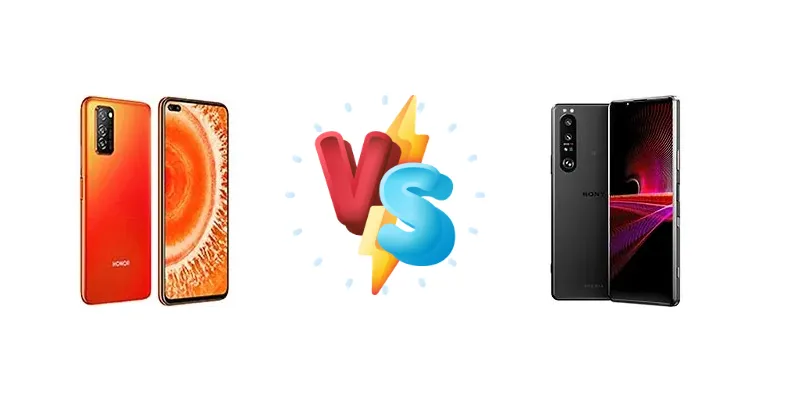
The Honor View, representing a peak in Honor's Kirin-powered era, now faces off against the Sony Xperia 1 III, a professional-grade flagship known for its multimedia capabilities. This comparison examines whether the older Honor View still holds value against Sony’s feature-rich offering, particularly considering the price difference that has emerged over time.
🏆 Quick Verdict
For the average user, the Sony Xperia 1 III emerges as the superior device. While the Honor View offers a compelling price point, the Xperia 1 III’s Snapdragon 888, superior display brightness, and comprehensive feature set – including faster charging and wireless capabilities – justify the investment for those prioritizing performance and a premium experience.
| Network |
|---|
| 2G bands | GSM 850 / 900 / 1800 / 1900 | GSM 850 / 900 / 1800 / 1900 |
| 3G bands | HSDPA 800 / 850 / 900 / 1700(AWS) / 1900 / 2100 | HSDPA 800 / 850 / 900 / 1700(AWS) / 1900 / 2100 |
| 4G bands | LTE | 1, 2, 3, 4, 5, 7, 8, 12, 13, 17, 19, 20, 25, 26, 28, 29, 32, 34, 38, 39, 40, 41, 46, 66 - Europe |
| 5G bands | - | 1, 3, 5, 7, 8, 20, 28, 38, 40, 41, 77, 78 SA/NSA/Sub6 - Europe |
| Speed | HSPA, LTE | HSPA, LTE, 5G |
| Technology | GSM / HSPA / LTE | GSM / HSPA / LTE / 5G |
| | - | SA/NSA/Sub6/mmWave - USA (specific) |
| Launch |
|---|
| Announced | Not announced yet | 2021, April 14 |
| Status | Cancelled | Available. Released 2021, August 25 |
| Body |
|---|
| Build | Glass front, aluminum frame | Glass front (Gorilla Glass Victus), glass back (Gorilla Glass 6), aluminum frame |
| Dimensions | - | 165 x 71 x 8.2 mm (6.50 x 2.80 x 0.32 in) |
| SIM | Nano-SIM + Nano-SIM | Nano-SIM + Nano-SIM |
| Weight | - | 186 g / 187.1 g (mmWave) (6.56 oz) |
| | - | IP65/IP68 dust/water resistant (up to 1.5m for 30 min) |
| Display |
|---|
| Protection | Yes | Corning Gorilla Glass Victus |
| Resolution | 1080 x 2310 pixels (~398 ppi density) | 1644 x 3840 pixels, 21:9 ratio (~643 ppi density) |
| Size | 6.4 inches, 101.4 cm2 | 6.5 inches, 98.6 cm2 (~84.2% screen-to-body ratio) |
| Type | IPS LCD | OLED, 1B colors, 120Hz, HDR BT.2020 |
| | - | Runs at 1096 x 2560 pixels except for select use cases |
| Platform |
|---|
| CPU | Octa-core (2x2.86 GHz Cortex-A76 & 2x2.09 GHz Cortex-A76 & 4x1.86 GHz Cortex-A55) | Octa-core (1x2.84 GHz Cortex-X1 & 3x2.42 GHz Cortex-A78 & 4x1.80 GHz Cortex-A55) |
| Chipset | Kirin 990 5G (7 nm+) | Qualcomm SM8350 Snapdragon 888 5G (5 nm) |
| GPU | Mali-G76 MP16 | Adreno 660 |
| OS | Android 10 | Android 11, upgradable to Android 13 |
| Memory |
|---|
| Card slot | No | microSDXC (uses shared SIM slot) |
| Internal | 128GB 8GB RAM, 256GB 8GB RAM | 256GB 12GB RAM, 512GB 12GB RAM |
| | UFS 3.0 | UFS 3.X |
| Main Camera |
|---|
| Features | Panorama, HDR, LED flash | Zeiss optics, Zeiss T* lens coating, color spectrum sensor, LED flash, panorama, HDR, eye tracking |
| Quad | 60 MP, f/1.7, (wide), PDAF, OIS
16 MP, f/2.2, 14mm (ultrawide)
2 MP (macro)
Auxiliary lens | - |
| Single | - | 8 MP, f/2.0, 24mm (wide), 1/4", 1.12µm |
| Triple | - | 12 MP, f/1.7, 24mm (wide), 1/1.7", 1.8µm, dual pixel PDAF, OIS
12 MP, f/2.3, 70mm (telephoto), f/2.8, 105mm (telephoto), 1/2.9", dual pixel PDAF, 3x/4.4x optical zoom, OIS
12 MP, f/2.2, 124˚, 16mm (ultrawide), 1/2.6", dual pixel PDAF
0.3 MP, TOF 3D, (depth) |
| Video | 4K@30fps, 1080p@30fps, 720p@960fps, (gyro-EIS) | 4K@24/25/30/60/120fps HDR, 1080p@30/60/120fps; 5-axis gyro-EIS, OIS |
| Selfie camera |
|---|
| Features | HDR | HDR |
| Single | 24 MP, f/2.0, 26mm (wide), 1/2.8", 0.9µm
TOF 3D, (depth sensor) | 8 MP, f/2.0, 24mm (wide), 1/4.0", 1.12µm |
| Video | 1080p@30fps | 1080p@30fps, 5-axis gyro-EIS |
| Sound |
|---|
| 3.5mm jack | No | Yes |
| 35mm jack | No | Yes |
| Loudspeaker | Yes | Yes, with stereo speakers |
| | - | 24-bit/192kHz audio
Dynamic vibration system |
| Comms |
|---|
| Bluetooth | 5.0, A2DP, aptX HD, LE | 5.2, A2DP, LE, aptX HD, aptX Adaptive |
| Infrared port | Yes | - |
| NFC | Yes | Yes |
| Positioning | GPS | GPS, GLONASS, BDS, GALILEO, QZSS |
| Radio | No | No |
| USB | USB Type-C 3.1, OTG | USB Type-C 3.1, OTG, video output |
| WLAN | Wi-Fi 802.11 a/b/g/n/ac, dual-band, Wi-Fi Direct | Wi-Fi 802.11 a/b/g/n/ac/6, dual-band, Wi-Fi Direct, DLNA |
| Features |
|---|
| Sensors | Fingerprint (side-mounted), accelerometer, gyro, proximity, compass | Fingerprint (side-mounted), accelerometer, gyro, proximity, barometer, compass |
| | - | Native Sony Alpha camera support |
| Battery |
|---|
| Charging | 22.5W wired | 30W wired, PD, 50% in 30 min
Wireless
Reverse wireless |
| Type | Li-Po 4000 mAh, non-removable | Li-Po 4500 mAh |
| Misc |
|---|
| Colors | Blue, Orange, other colors | Frosted Black, Frosted Gray, Frosted Purple |
| Models | - | XQBC62/V, XQBC52V.UKCX, SO-51B, SOG03, A101SO, XQ-BC62, XQ-BC72, XQ-BC52, XQ-BC01, XQ-BC11, XQ-BC21, XQ-BC72 |
| Price | - | € 505.26 / $ 903.43 |
| Tests |
|---|
| Battery life | - |
Endurance rating 82h
|
| Camera | - |
Photo / Video |
| Display | - |
Contrast ratio: Infinite (nominal) |
| Loudspeaker | - |
-26.5 LUFS (Good)
|
| Performance | - |
AnTuTu: 607423 (v8)
GeekBench: 3515 (v5.1)
GFXBench: 54fps (ES 3.1 onscreen) |
Honor View
- More affordable price point
- Clean and user-friendly software
- Capable 5G connectivity
- Older chipset with less performance
- Slower charging speed
- Less advanced camera system
Sony Xperia 1 III
- Powerful Snapdragon 888 processor
- Brighter and more accurate display
- Faster charging and wireless charging
- Higher price tag
- Potentially more complex software
- Larger size and weight
Display Comparison
The Sony Xperia 1 III boasts a significantly brighter display at 620 nits, offering superior visibility in direct sunlight compared to the Honor View’s unspecified brightness. While both have an 'infinite' contrast ratio (typical for OLED), the Xperia 1 III’s display is geared towards professional content consumption, likely with wider color gamut coverage. The Honor View’s display, while good, lacks the peak brightness and color accuracy expected from a flagship in the same tier as the Xperia 1 III.
Camera Comparison
Both devices feature capable camera systems, but the Xperia 1 III is geared towards professional photography and videography. While both are listed as having Photo/Video capabilities, the Xperia 1 III’s camera system benefits from Sony’s image processing expertise and likely features a larger sensor and more advanced features. The Honor View’s camera, while adequate, is unlikely to match the dynamic range, detail, and low-light performance of the Xperia 1 III. The absence of specific sensor details for the Honor View makes a precise comparison difficult, but the Xperia 1 III’s focus on professional-grade imaging is a clear differentiator.
Performance
The Xperia 1 III’s Qualcomm Snapdragon 888 5G (5nm) represents a substantial leap in performance and efficiency over the Honor View’s Kirin 990 5G (7nm+). The Snapdragon 888’s Cortex-X1 prime core provides a noticeable advantage in single-core tasks, while its Adreno 660 GPU delivers superior graphics performance. The Kirin 990, while capable, is likely to exhibit more thermal throttling under sustained load. The Xperia 1 III also benefits from faster LPDDR5 RAM, contributing to smoother multitasking and app loading times.
Battery Life
Both phones achieve an endurance rating of 82 hours, suggesting comparable battery life despite the Honor View’s unspecified mAh capacity. However, the Xperia 1 III offers significantly faster charging at 30W with PD support and 50% charge in 30 minutes, alongside wireless and reverse wireless charging capabilities. The Honor View is limited to 22.5W wired charging, resulting in a slower charging experience. The Xperia 1 III’s charging versatility provides a more convenient user experience.
Buying Guide
Buy the Honor View if you need a capable 5G phone on a tight budget and prioritize a clean user interface. It’s a solid all-rounder for everyday tasks and casual gaming. Buy the Sony Xperia 1 III if you are a content creator, a photography enthusiast, or demand the best possible performance and a feature-packed experience, including professional video recording and advanced display settings.
Frequently Asked Questions
❓ Does the Kirin 990 5G in the Honor View struggle with demanding games like Genshin Impact?
The Kirin 990 5G is capable of running Genshin Impact, but you may need to lower graphics settings to maintain a stable frame rate. The Snapdragon 888 in the Xperia 1 III offers a smoother experience at higher settings due to its superior GPU and thermal management.
❓ Is the 30W charging on the Xperia 1 III a significant improvement over the Honor View's 22.5W charging?
Yes, the 30W charging on the Xperia 1 III is noticeably faster. It can charge from 0 to 50% in just 30 minutes, while the Honor View will take considerably longer to reach the same level. The addition of wireless charging on the Xperia 1 III further enhances convenience.
❓ How does the camera processing differ between the Honor View and the Sony Xperia 1 III?
Sony’s Xperia 1 III utilizes advanced image processing algorithms developed for their professional camera systems, resulting in more natural colors, wider dynamic range, and better detail retention. The Honor View’s camera processing is likely more geared towards social media sharing with potentially more saturated colors.
❓ Is the lack of wireless charging on the Honor View a dealbreaker?
For users who frequently use wireless charging, the absence of this feature on the Honor View is a significant drawback. The Xperia 1 III offers both wireless and reverse wireless charging, providing greater flexibility and convenience.