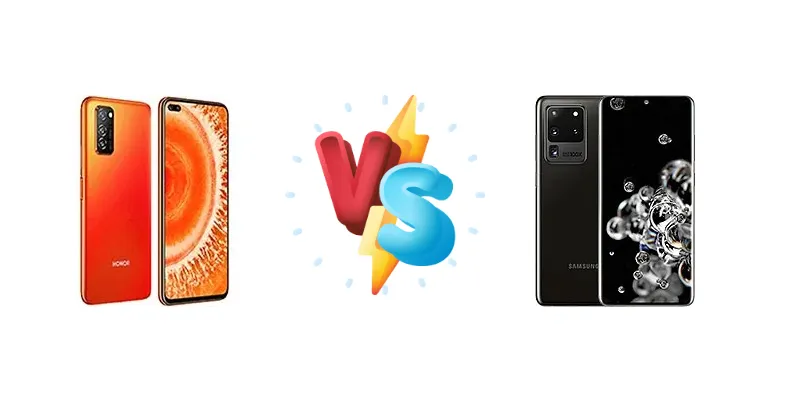
The Honor View and Samsung Galaxy S20 Ultra represent different approaches to the flagship smartphone. The Honor View, released with the Kirin 990 5G, aimed to deliver premium features at a more accessible price point. The S20 Ultra, meanwhile, was Samsung’s no-compromise ultra-premium offering, boasting the latest Snapdragon or Exynos processors and a groundbreaking camera system. This comparison dissects their key differences to determine which phone best suits your needs.
🏆 Quick Verdict
For the average user prioritizing value and a balanced experience, the Honor View offers compelling performance and 5G connectivity at a significantly lower cost. However, the Samsung Galaxy S20 Ultra wins for those demanding the absolute best camera capabilities, faster charging, and wireless charging convenience, despite its higher price and potential thermal concerns.
| Network |
|---|
| 2G bands | GSM 850 / 900 / 1800 / 1900 | GSM 850 / 900 / 1800 / 1900 |
| 3G bands | HSDPA 800 / 850 / 900 / 1700(AWS) / 1900 / 2100 | HSDPA 850 / 900 / 1700(AWS) / 1900 / 2100 |
| 4G bands | LTE | 1, 2, 3, 4, 5, 7, 8, 12, 13, 17, 18, 19, 20, 25, 26, 28, 32, 38, 39, 40, 41, 66 |
| Speed | HSPA, LTE | HSPA 42.2/5.76 Mbps, LTE (7CA) Cat20 2000/200 Mbps |
| Technology | GSM / HSPA / LTE | GSM / CDMA / HSPA / EVDO / LTE |
| | - | CDMA2000 1xEV-DO |
| Launch |
|---|
| Announced | Not announced yet | 2020, February 11 |
| Status | Cancelled | Available. Released 2020, March 15 |
| Body |
|---|
| Build | Glass front, aluminum frame | Glass front (Gorilla Glass 6), glass back (Gorilla Glass 6), aluminum frame |
| Dimensions | - | 166.9 x 76 x 8.8 mm (6.57 x 2.99 x 0.35 in) |
| SIM | Nano-SIM + Nano-SIM | · Nano-SIM + eSIM· Nano-SIM + Nano-SIM |
| Weight | - | 220 g (7.76 oz) |
| | - | IP68 dust/water resistant (up to 1.5m for 30 min) |
| Display |
|---|
| Protection | Yes | Corning Gorilla Glass 6 |
| Resolution | 1080 x 2310 pixels (~398 ppi density) | 1440 x 3200 pixels, 20:9 ratio (~511 ppi density) |
| Size | 6.4 inches, 101.4 cm2 | 6.9 inches, 114.0 cm2 (~89.9% screen-to-body ratio) |
| Type | IPS LCD | Dynamic AMOLED 2X, 120Hz, HDR10+, 1400 nits (peak) |
| | - | Always-on display
120Hz@FHD/60Hz@QHD refresh rate |
| Platform |
|---|
| CPU | Octa-core (2x2.86 GHz Cortex-A76 & 2x2.09 GHz Cortex-A76 & 4x1.86 GHz Cortex-A55) | Octa-core (2x2.73 GHz Mongoose M5 & 2x2.50 GHz Cortex-A76 & 4x2.0 GHz Cortex-A55)Octa-core (1x2.84 GHz Cortex-A77 & 3x2.42 GHz Cortex-A77 & 4x1.80 GHz Cortex-A55) |
| Chipset | Kirin 990 5G (7 nm+) | Exynos 990 (7 nm+)Qualcomm SM8250 Snapdragon 865 5G (7 nm+) |
| GPU | Mali-G76 MP16 | Mali-G77 MP11Adreno 650 |
| OS | Android 10 | Android 10, upgradable to Android 13, One UI 5 |
| Memory |
|---|
| Card slot | No | microSDXC (uses shared SIM slot) |
| Internal | 128GB 8GB RAM, 256GB 8GB RAM | 128GB 12GB RAM, 512GB 16GB RAM |
| | UFS 3.0 | UFS 3.0 |
| Main Camera |
|---|
| Features | Panorama, HDR, LED flash | LED flash, auto-HDR, panorama |
| Quad | 60 MP, f/1.7, (wide), PDAF, OIS
16 MP, f/2.2, 14mm (ultrawide)
2 MP (macro)
Auxiliary lens | - |
| Triple | - | 108 MP, f/1.8, 26mm (wide), 1/1.33", 0.8µm, PDAF, OIS
48 MP, f/3.5, 103mm (periscope telephoto), 1/2.0", 0.8µm, PDAF, OIS, 4x optical zoom, 10x hybrid zoom
12 MP, f/2.2, 13mm, 120˚ (ultrawide), 1/2.55" 1.4µm, Super Steady video
0.3 MP, TOF 3D, f/1.0, (depth) |
| Video | 4K@30fps, 1080p@30fps, 720p@960fps, (gyro-EIS) | 8K@24fps, 4K@30/60fps, 1080p@30/60/240fps, 720p@960fps, HDR10+, stereo sound rec., gyro-EIS & OIS |
| Selfie camera |
|---|
| Features | HDR | HDR |
| Single | 24 MP, f/2.0, 26mm (wide), 1/2.8", 0.9µm
TOF 3D, (depth sensor) | 40 MP, f/2.2, 26mm (wide), 1/2.8", 0.7µm, PDAF |
| Video | 1080p@30fps | 4K@30/60fps, 1080p@30fps |
| Sound |
|---|
| 3.5mm jack | No | No |
| 35mm jack | No | No |
| Loudspeaker | Yes | Yes, with stereo speakers |
| | - | 32-bit/384kHz audio
Tuned by AKG |
| Comms |
|---|
| Bluetooth | 5.0, A2DP, aptX HD, LE | 5.0, A2DP, LE |
| Infrared port | Yes | - |
| NFC | Yes | Yes |
| Positioning | GPS | GPS, GLONASS, BDS, GALILEO |
| Radio | No | FM radio (USA & Canada only) |
| USB | USB Type-C 3.1, OTG | USB Type-C 3.2, OTG |
| WLAN | Wi-Fi 802.11 a/b/g/n/ac, dual-band, Wi-Fi Direct | Wi-Fi 802.11 a/b/g/n/ac/6, dual-band, Wi-Fi Direct |
| Features |
|---|
| Sensors | Fingerprint (side-mounted), accelerometer, gyro, proximity, compass | Fingerprint (under display, ultrasonic), accelerometer, gyro, proximity, compass, barometer |
| | - | Samsung DeX, Samsung Wireless DeX (desktop experience support)
ANT+
Bixby natural language commands and dictation
Samsung Pay (Visa, MasterCard certified) |
| Battery |
|---|
| Charging | 22.5W wired | 45W wired, PD3.0
15W wireless (Qi)
4.5W reverse wireless |
| Type | Li-Po 4000 mAh, non-removable | Li-Ion 5000 mAh |
| Misc |
|---|
| Colors | Blue, Orange, other colors | Cosmic Grey, Cosmic Black, Cloud White |
| Models | - | SM-G988B/DS |
| Price | - | About 690 EUR |
| SAR | - | 0.94 W/kg (head) 0.95 W/kg (body) |
| SAR EU | - | 0.32 W/kg (head) 1.56 W/kg (body) |
Honor View
- More affordable price point
- Integrated 5G connectivity
- Solid overall performance for the price
- Less advanced camera system
- Slower charging speeds
- No wireless charging
Samsung Galaxy S20 Ultra
- Exceptional camera capabilities with 100x Space Zoom
- Fast 45W wired and 15W wireless charging
- High-refresh-rate display for smoother visuals
- Significantly higher price
- Potential for thermal throttling with Exynos variant
- Large and heavy form factor
Display Comparison
While both devices utilize 7nm+ fabrication, display details are limited for the Honor View. The S20 Ultra boasts a 6.9-inch Dynamic AMOLED 2X display, known for its vibrant colors and high peak brightness. The S20 Ultra’s 120Hz refresh rate (though often limited by software) provides smoother scrolling and animations, a feature absent in the Honor View. The S20 Ultra’s larger display and higher resolution (3200 x 1440) contribute to a sharper image, while the Honor View likely targets a 1080p+ resolution to balance performance and battery life.
Camera Comparison
The S20 Ultra’s camera system is its standout feature, headlined by a 108MP main sensor with OIS. Its periscope zoom lens offers up to 100x Space Zoom, a capability the Honor View cannot match. While the Honor View’s camera specs are less detailed, it likely features a multi-camera setup focused on versatility. The S20 Ultra’s larger sensor size and advanced image processing algorithms deliver superior image quality, particularly in low-light conditions. The S20 Ultra’s 8K video recording capability is also absent on the Honor View. The S20 Ultra’s focus on computational photography and advanced features like Single Take provides a more refined and versatile camera experience.
Performance
The chipset is a key differentiator. The Honor View’s Kirin 990 5G, built on a 7nm+ process, features a tri-cluster CPU configuration with 2x Cortex-A76 cores at 2.86 GHz, 2x Cortex-A76 at 2.09 GHz, and 4x Cortex-A55 cores at 1.86 GHz. The S20 Ultra offers a choice of either the Exynos 990 or the Qualcomm Snapdragon 865, both also 7nm+ but with different architectures. The Snapdragon 865, with its Cortex-A77 cores (1x 2.84 GHz & 3x 2.42 GHz) and 4x Cortex-A55 cores at 1.80 GHz, generally exhibits superior sustained performance and thermal efficiency compared to the Exynos 990. The Exynos 990’s Mongoose M5 cores, while powerful, are known to be more prone to throttling under sustained load. The S20 Ultra’s LPDDR5 RAM further enhances performance, while the Honor View likely utilizes LPDDR4X.
Battery Life
The S20 Ultra packs a 5000mAh battery, while the Honor View’s battery capacity is not specified but is likely smaller. The S20 Ultra supports 45W wired charging with Power Delivery 3.0, enabling a significantly faster 0-100% charge time compared to the Honor View’s 22.5W charging. The S20 Ultra also offers 15W wireless charging (Qi) and 4.5W reverse wireless charging, features absent on the Honor View. While the Honor View may offer respectable battery life for typical usage, the S20 Ultra’s larger battery and faster charging provide greater convenience and longevity.
Buying Guide
Buy the Honor View if you need a capable 5G phone with solid performance for everyday tasks and gaming, and you're willing to compromise on the absolute best camera and wireless charging. Buy the Samsung Galaxy S20 Ultra if you prioritize a top-tier camera system with extensive zoom capabilities, fastest possible charging speeds (45W), and the convenience of wireless and reverse wireless charging, and are prepared to pay a premium.
Frequently Asked Questions
❓ Does the Exynos 990 in the S20 Ultra suffer from overheating during prolonged gaming sessions?
Yes, the Exynos 990 variant of the S20 Ultra is known to exhibit thermal throttling under sustained load, particularly during demanding games. This can lead to reduced performance and frame rate drops. The Snapdragon 865 variant generally handles heat more effectively.
❓ Is the 2MP macro camera on the Honor View actually useful for detailed close-up shots?
Generally, 2MP macro cameras on phones in this price range offer limited detail and image quality. While it can capture close-up shots, the results are often soft and lack the sharpness of dedicated macro lenses or higher-resolution sensors. It's more of a marketing feature than a truly useful tool.
❓ Can the Samsung Galaxy S20 Ultra reliably maintain 60fps or higher in graphically intensive games like PUBG?
The S20 Ultra, particularly the Snapdragon 865 variant, can generally maintain 60fps in PUBG at high graphics settings. However, prolonged gaming sessions may still lead to some thermal throttling, potentially causing frame rate dips. Optimizing game settings can help mitigate this.
❓ How does the Honor View's 5G performance compare to the S20 Ultra's 5G capabilities?
Both phones support 5G connectivity, but the S20 Ultra generally offers wider 5G band support, ensuring compatibility with more 5G networks globally. The Honor View's 5G performance will depend on the specific network infrastructure in your region.