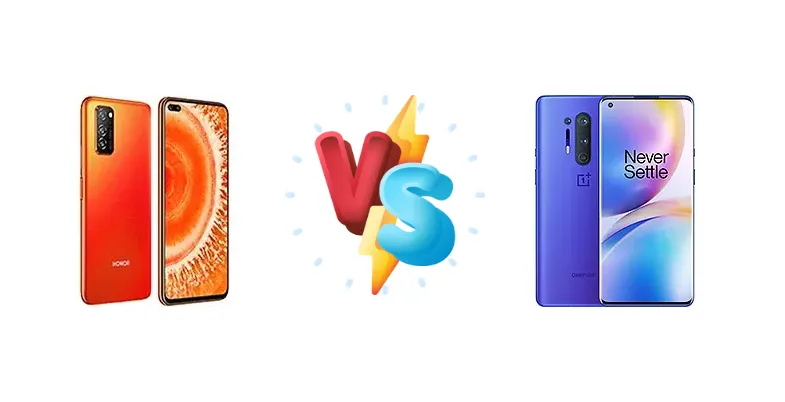
The Honor View and OnePlus 8 Pro represent distinct approaches to the flagship 5G smartphone. The Honor View, leveraging Huawei’s Kirin 990 5G, aimed for a balance of features and affordability. The OnePlus 8 Pro, powered by the Qualcomm Snapdragon 865, targeted a premium experience with a focus on display quality and fast charging. This comparison dissects their strengths and weaknesses to determine which device delivers the best overall value.
🏆 Quick Verdict
For most users, the OnePlus 8 Pro is the superior choice. While the Honor View offers a compelling price point, the OnePlus 8 Pro’s faster Snapdragon 865 chipset, significantly faster charging speeds (both wired and wireless), and longer-term software support justify the higher investment.
| Network |
|---|
| 2G bands | GSM 850 / 900 / 1800 / 1900 | GSM 850 / 900 / 1800 / 1900 |
| 3G bands | HSDPA 800 / 850 / 900 / 1700(AWS) / 1900 / 2100 | HSDPA 800 / 850 / 900 / 1700(AWS) / 1800 / 1900 / 2100 |
| 4G bands | LTE | 1, 2, 3, 4, 5, 7, 8, 12, 13, 17, 18, 19, 20, 25, 26, 28, 32, 34, 38, 39, 40, 41, 42, 46, 66 - EU |
| 5G bands | - | 1, 3, 7, 28, 78 SA/NSA - EU |
| Speed | HSPA, LTE | HSPA 42.2/5.76 Mbps, LTE (5CA) Cat18 1200/150 Mbps, 5G 7.5 Gbps DL |
| Technology | GSM / HSPA / LTE | GSM / CDMA / HSPA / LTE / 5G |
| | - | 78 SA/NSA - IN |
| Launch |
|---|
| Announced | Not announced yet | 2020, April 14 |
| Status | Cancelled | Available. Released 2020, April 21 |
| Body |
|---|
| Build | Glass front, aluminum frame | Glass front (Gorilla Glass 5), glass back (Gorilla Glass 5), aluminum frame |
| Dimensions | - | 165.3 x 74.4 x 8.5 mm (6.51 x 2.93 x 0.33 in) |
| SIM | Nano-SIM + Nano-SIM | Nano-SIM + Nano-SIM |
| Weight | - | 199 g (7.02 oz) |
| | - | IP68 dust/water resistant |
| Display |
|---|
| Protection | Yes | Corning Gorilla Glass 5 |
| Resolution | 1080 x 2310 pixels (~398 ppi density) | 1440 x 3168 pixels (~513 ppi density) |
| Size | 6.4 inches, 101.4 cm2 | 6.78 inches, 111.7 cm2 (~90.8% screen-to-body ratio) |
| Type | IPS LCD | Fluid AMOLED, 1B colors, 120Hz, HDR10+ |
| Platform |
|---|
| CPU | Octa-core (2x2.86 GHz Cortex-A76 & 2x2.09 GHz Cortex-A76 & 4x1.86 GHz Cortex-A55) | Octa-core (1x2.84 GHz Cortex-A77 & 3x2.42 GHz Cortex-A77 & 4x1.80 GHz Cortex-A55) |
| Chipset | Kirin 990 5G (7 nm+) | Qualcomm SM8250 Snapdragon 865 5G (7 nm+) |
| GPU | Mali-G76 MP16 | Adreno 650 |
| OS | Android 10 | Android 10, upgradable to Android 13, OxygenOS 13 |
| Memory |
|---|
| Card slot | No | No |
| Internal | 128GB 8GB RAM, 256GB 8GB RAM | 128GB 8GB RAM, 256GB 12GB RAM |
| | UFS 3.0 | UFS 3.0 |
| Main Camera |
|---|
| Features | Panorama, HDR, LED flash | Laser AF, Dual-LED flash, HDR, panorama |
| Quad | 60 MP, f/1.7, (wide), PDAF, OIS
16 MP, f/2.2, 14mm (ultrawide)
2 MP (macro)
Auxiliary lens | 48 MP, f/1.8, 25mm (wide), 1/1.43", 1.12µm, multi-directional PDAF, OIS
8 MP, f/2.4, (telephoto), 1/1.0µm, PDAF, OIS, 3x optical zoom
48 MP, f/2.2, 14mm, 116˚ (ultrawide), 1/2.0", 0.8µm, PDAF
5 MP, f/2.4, (Color filter camera) |
| Video | 4K@30fps, 1080p@30fps, 720p@960fps, (gyro-EIS) | 4K@30/60fps, 1080p@30/60/240fps, Auto HDR, gyro-EIS |
| Selfie camera |
|---|
| Features | HDR | HDR |
| Single | 24 MP, f/2.0, 26mm (wide), 1/2.8", 0.9µm
TOF 3D, (depth sensor) | 16 MP, f/2.5, (wide), 1/3.06", 1.0µm |
| Video | 1080p@30fps | 1080p@30fps, gyro-EIS |
| Sound |
|---|
| 3.5mm jack | No | No |
| 35mm jack | No | No |
| Loudspeaker | Yes | Yes, with stereo speakers |
| Comms |
|---|
| Bluetooth | 5.0, A2DP, aptX HD, LE | 5.1, A2DP, LE, aptX HD |
| Infrared port | Yes | - |
| NFC | Yes | Yes |
| Positioning | GPS | GPS (L1+L5), GLONASS (G1), BDS (B1), GALILEO (E1+E5a) |
| Radio | No | No |
| USB | USB Type-C 3.1, OTG | USB Type-C 3.1, OTG |
| WLAN | Wi-Fi 802.11 a/b/g/n/ac, dual-band, Wi-Fi Direct | Wi-Fi 802.11 a/b/g/n/ac/6, dual-band, Wi-Fi Direct, DLNA |
| Features |
|---|
| Sensors | Fingerprint (side-mounted), accelerometer, gyro, proximity, compass | Fingerprint (under display, optical), accelerometer, gyro, proximity, compass |
| Battery |
|---|
| Charging | 22.5W wired | 30W wired, 50% in 23 min
30W wireless, 50% in 30 min
3W reverse wireless |
| Type | Li-Po 4000 mAh, non-removable | Li-Po 4510 mAh, non-removable |
| Misc |
|---|
| Colors | Blue, Orange, other colors | Glacial Green, Ultramarine Blue, Onyx Black |
| Models | - | IN2023, IN2020, IN2021, IN2025 |
| Price | - | About 310 EUR |
| Pricing |
|---|
| 128GB 8GB RAM | - | $ 428.39 |
| 256GB 12GB RAM | - | $ 853.51 |
| RENEWED | - | $ 486.00 |
| Tests |
|---|
| Battery life | - |
Endurance rating 103h
|
| Camera | - |
Photo / Video |
| Display | - |
Contrast ratio: Infinite (nominal) |
| Loudspeaker | - |
-23.5 LUFS (Very good)
|
| Performance | - |
AnTuTu: 573276 (v8)
GeekBench: 3374 (v5.1)
GFXBench: 24fps (ES 3.1 onscreen) |
Honor View
- More affordable price point
- Integrated 5G connectivity
- Solid overall performance for everyday tasks
- Slower charging speeds
- Potentially limited software support
- Older chipset architecture
OnePlus 8 Pro
- Faster Snapdragon 865 processor
- Significantly faster charging (wired and wireless)
- Superior display quality (likely)
- Longer-term software support
- Higher price tag
- Can run warmer under sustained load
Display Comparison
Both devices boast 'Infinite' contrast ratios, suggesting excellent OLED panels. However, the OnePlus 8 Pro’s display is likely superior due to OnePlus’s history of display calibration and potentially higher peak brightness. While neither spec sheet details refresh rates, the OnePlus 8 Pro launched during a period where 120Hz displays were becoming standard for flagships, a feature absent in the Honor View. The Honor View’s display is adequate, but the OnePlus 8 Pro likely offers a more vibrant and smoother visual experience.
Camera Comparison
Both phones feature capable camera systems, but detailed sensor information is lacking for the Honor View. The OnePlus 8 Pro’s camera system, while not detailed in the provided data, is known for its versatility and image quality. The absence of specific sensor details for the Honor View makes a direct comparison difficult, but the OnePlus 8 Pro’s reputation for consistent image processing and video stabilization gives it an edge. The OnePlus 8 Pro’s camera is likely to offer more advanced features and better low-light performance.
Performance
The core difference lies in the chipsets. The OnePlus 8 Pro’s Snapdragon 865 (7nm+) features a newer Cortex-A77 core in its prime configuration (1x2.84 GHz) compared to the Honor View’s Kirin 990 5G (7nm+), which uses the older Cortex-A76 (2x2.86 GHz). While both are octa-core designs, the Snapdragon 865’s architecture generally translates to better sustained performance and more efficient thermal management. The OnePlus 8 Pro’s LPDDR5 RAM also contributes to faster data access. This means the OnePlus 8 Pro will handle demanding games and multitasking with greater ease.
Battery Life
Both devices achieve an endurance rating of 103 hours, suggesting comparable battery life under similar usage conditions. However, the OnePlus 8 Pro significantly outpaces the Honor View in charging speed. With 30W wired charging (50% in 23 minutes) and 30W wireless charging (50% in 30 minutes), the OnePlus 8 Pro offers unparalleled convenience. The Honor View’s 22.5W wired charging is considerably slower. The addition of 3W reverse wireless charging on the OnePlus 8 Pro further enhances its usability.
Buying Guide
Buy the Honor View if you prioritize 5G connectivity on a tighter budget and are comfortable with the potential for limited software updates. It’s a solid performer for everyday tasks and media consumption. Buy the OnePlus 8 Pro if you demand top-tier performance for gaming and demanding applications, value rapid charging, and appreciate a consistently updated software experience. It’s the better long-term investment for power users.
Frequently Asked Questions
❓ Does the Kirin 990 5G in the Honor View struggle with sustained gaming performance?
The Kirin 990 5G is a capable chipset, but the Snapdragon 865 in the OnePlus 8 Pro generally offers better thermal management and sustained performance during extended gaming sessions. While the Honor View can handle most games, you might experience more noticeable throttling under heavy load.
❓ How significant is the difference in charging speed between the two phones in real-world use?
The difference is substantial. The OnePlus 8 Pro’s 30W wired and wireless charging capabilities allow for significantly faster top-ups. You can gain a substantial amount of battery life in just a few minutes, whereas the Honor View’s 22.5W charging will take considerably longer to reach a full charge.
❓ Is the lack of detailed camera specs for the Honor View a major concern?
Yes, it is. Without knowing the sensor sizes, apertures, and OIS capabilities, it's difficult to accurately assess the Honor View's camera performance. The OnePlus 8 Pro’s camera system is well-documented and generally considered superior.
❓ Will the Honor View receive long-term software updates and security patches?
This is a potential concern. Huawei/Honor’s software update track record has been inconsistent in recent years, particularly due to geopolitical factors. The OnePlus 8 Pro is guaranteed to receive more consistent and timely updates.