
Honor View vs Huawei Mate 30 Pro 5G: A Deep Dive into Kirin 990 Performance and Features
| Phones Images | |||||
|---|---|---|---|---|---|
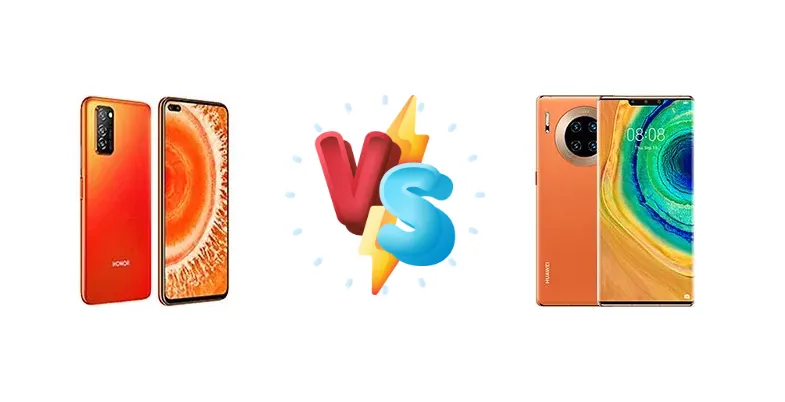
|
🏆 Quick Verdict
For the average user prioritizing fast charging and wireless convenience, the Huawei Mate 30 Pro 5G is the clear winner. Its 40W wired and 27W wireless charging significantly outperform the Honor View’s 22.5W wired charging. However, budget-conscious users may find the Honor View a compelling alternative if charging speed isn't paramount.
| PHONES | ||
|---|---|---|
| Phone Names | Honor View | Huawei Mate 30 Pro 5G |
| Network | ||
|---|---|---|
| 2G bands | GSM 850 / 900 / 1800 / 1900 | GSM 850 / 900 / 1800 / 1900 |
| 3G bands | HSDPA 800 / 850 / 900 / 1700(AWS) / 1900 / 2100 | HSDPA 800 / 850 / 900 / 1700(AWS) / 1900 / 2100 |
| 4G bands | LTE | 1, 2, 3, 4, 5, 6, 7, 8, 9, 12, 17, 18, 19, 20, 26, 28, 32, 34, 38, 39, 40, 41 - Global |
| 5G bands | - | 1, 3, 28, 38, 41, 77, 78, 79 NSA/Sub6 |
| Speed | HSPA, LTE | HSPA, LTE, 5G (2+ Gbps DL) |
| Technology | GSM / HSPA / LTE | GSM / HSPA / LTE / 5G |
| - | 1, 2, 3, 4, 5, 6, 7, 8, 9, 12, 17, 18, 19, 20, 26, 34, 38, 39, 40, 41 - China | |
| Launch | ||
|---|---|---|
| Announced | Not announced yet | 2019, September 19. Released 2019, October 23 |
| Status | Cancelled | Discontinued |
| Body | ||
|---|---|---|
| Build | Glass front, aluminum frame | Glass front (Gorilla Glass 6), glass back (Gorilla Glass 6), aluminum frame |
| Dimensions | - | 158.1 x 73.1 x 8.8 mm (6.22 x 2.88 x 0.35 in) |
| SIM | Nano-SIM + Nano-SIM | Nano-SIM + Nano-SIM |
| Weight | - | 198 g (6.98 oz) |
| - | IP68 dust/water resistant (up to 2m for 30 mins) | |
| Display | ||
|---|---|---|
| Protection | Yes | Corning Gorilla Glass 6 |
| Resolution | 1080 x 2310 pixels (~398 ppi density) | 1176 x 2400 pixels, 18.5:9 ratio (~409 ppi density) |
| Size | 6.4 inches, 101.4 cm2 | 6.53 inches, 108.7 cm2 (~94.1% screen-to-body ratio) |
| Type | IPS LCD | OLED, HDR10 |
| Platform | ||
|---|---|---|
| CPU | Octa-core (2x2.86 GHz Cortex-A76 & 2x2.09 GHz Cortex-A76 & 4x1.86 GHz Cortex-A55) | Octa-core (2x2.86 GHz Cortex-A76 & 2x2.36 GHz Cortex-A76 & 4x1.95 GHz Cortex-A55) |
| Chipset | Kirin 990 5G (7 nm+) | Kirin 990 5G (7 nm+) |
| GPU | Mali-G76 MP16 | Mali-G76 MP16 |
| OS | Android 10 | Android 10, EMUI 10, no Google Play Services |
| Memory | ||
|---|---|---|
| Card slot | No | Nano Memory (uses shared SIM slot) |
| Internal | 128GB 8GB RAM, 256GB 8GB RAM | 128GB 8GB RAM, 256GB 8GB RAM, 512GB 8GB RAM |
| UFS 3.0 | UFS 3.0 | |
| Main Camera | ||
|---|---|---|
| Features | Panorama, HDR, LED flash | Leica optics, color spectrum sensor, dual-LED dual-tone flash, panorama, HDR |
| Quad | 60 MP, f/1.7, (wide), PDAF, OIS 16 MP, f/2.2, 14mm (ultrawide) 2 MP (macro) Auxiliary lens | - |
| Triple | - | 40 MP, f/1.6, 27mm (wide), 1/1.7", PDAF, OIS 8 MP, f/2.4, 80mm (telephoto), 1/4.0", PDAF, OIS, 3x optical zoom 40 MP, f/1.8, 18mm (ultrawide), 1/1.54", PDAF TOF 3D, (depth) |
| Video | 4K@30fps, 1080p@30fps, 720p@960fps, (gyro-EIS) | 4K@30/60fps, 1080p@30/60/120fps, 1080p@960fps, 720p@7680fps, gyro-EIS |
| Selfie camera | ||
|---|---|---|
| Features | HDR | HDR, panorama |
| Single | 24 MP, f/2.0, 26mm (wide), 1/2.8", 0.9µm TOF 3D, (depth sensor) | 32 MP, f/2.0, 26mm (wide), 1/2.8", 0.8µm TOF 3D, (depth/biometrics sensor) |
| Video | 1080p@30fps | 1080p@30fps |
| Sound | ||
|---|---|---|
| 3.5mm jack | No | No |
| 35mm jack | No | No |
| Loudspeaker | Yes | Yes |
| - | 32-bit/384kHz audio | |
| Comms | ||
|---|---|---|
| Bluetooth | 5.0, A2DP, aptX HD, LE | 5.1, A2DP, aptX HD, LE |
| Infrared port | Yes | Yes |
| NFC | Yes | Yes |
| Positioning | GPS | GPS (L1+L5), GLONASS (L1), BDS (B1), GALILEO (E1+E5a), QZSS (L1+L5) |
| Radio | No | No |
| USB | USB Type-C 3.1, OTG | USB Type-C 3.1, OTG |
| WLAN | Wi-Fi 802.11 a/b/g/n/ac, dual-band, Wi-Fi Direct | Wi-Fi 802.11 a/b/g/n/ac, dual-band, DLNA, Wi-Fi Direct |
| Features | ||
|---|---|---|
| Sensors | Fingerprint (side-mounted), accelerometer, gyro, proximity, compass | Face ID, fingerprint (under display, optical), accelerometer, gyro, proximity, barometer, compass |
| Battery | ||
|---|---|---|
| Charging | 22.5W wired | 40W wired 27W wireless Reverse wireless |
| Type | Li-Po 4000 mAh, non-removable | Li-Po 4500 mAh, non-removable |
| Misc | ||
|---|---|---|
| Colors | Blue, Orange, other colors | Black, Space Silver, Cosmic Purple, Emerald Green, Orange, Forest Green |
| Models | - | LIO-N29, LIO-AL10, LIO-TL10 |
| Price | - | About 1440 EUR |
Honor View
- Potentially lower price point
- Capable Kirin 990 5G performance
- Solid all-around smartphone experience
- Slower 22.5W wired charging
- Lacks wireless charging capabilities
- Potentially less advanced camera system
Huawei Mate 30 Pro 5G
- 40W SuperCharge wired charging
- 27W wireless charging and reverse wireless charging
- Likely superior camera performance
- Higher price point
- Potentially larger and heavier design
- May have limited software support due to geopolitical factors
Display Comparison
While both devices likely feature OLED panels (based on brand history), specific details like resolution and refresh rate are missing. The core difference lies in the charging experience, not display technology. Both will likely offer vibrant colors and good viewing angles, but the Mate 30 Pro 5G’s curved display may offer a more immersive experience, though potentially with increased accidental touch input.
Camera Comparison
Without detailed camera specifications, a direct comparison is limited. However, Huawei’s Mate series historically prioritizes camera performance. The Mate 30 Pro 5G likely benefits from more advanced image processing algorithms and potentially larger sensor sizes, resulting in superior low-light performance and dynamic range. The Honor View, while capable, likely focuses on providing a balanced camera experience rather than pushing the boundaries of mobile photography.
Performance
Both phones are powered by the Kirin 990 5G (7nm+), but the CPU configuration differs slightly. The Mate 30 Pro 5G utilizes a 2x2.36 GHz Cortex-A76 configuration alongside its primary 2x2.86 GHz cores, compared to the Honor View’s 2x2.09 GHz Cortex-A76 setup. This suggests the Mate 30 Pro 5G may exhibit slightly better sustained performance in multi-threaded tasks, though the real-world difference will likely be minimal for most users. Both utilize 4x1.86/1.95 GHz Cortex-A55 cores for efficiency. Both devices likely employ LPDDR4X RAM, impacting memory bandwidth and overall responsiveness.
Battery Life
The most significant difference lies in charging. The Mate 30 Pro 5G’s 40W SuperCharge technology drastically reduces charging times compared to the Honor View’s 22.5W charging. Furthermore, the Mate 30 Pro 5G adds 27W wireless charging and reverse wireless charging, offering unparalleled convenience. While battery capacity isn’t specified, the faster charging speeds of the Mate 30 Pro 5G effectively mitigate any potential capacity disadvantage.
Buying Guide
Buy the Honor View if you need a capable 5G smartphone with a strong processor at a potentially lower price point, and aren't heavily reliant on extremely fast charging. Buy the Huawei Mate 30 Pro 5G if you prioritize the fastest possible wired and wireless charging, along with the added convenience of reverse wireless charging, and are willing to pay a premium for these features.