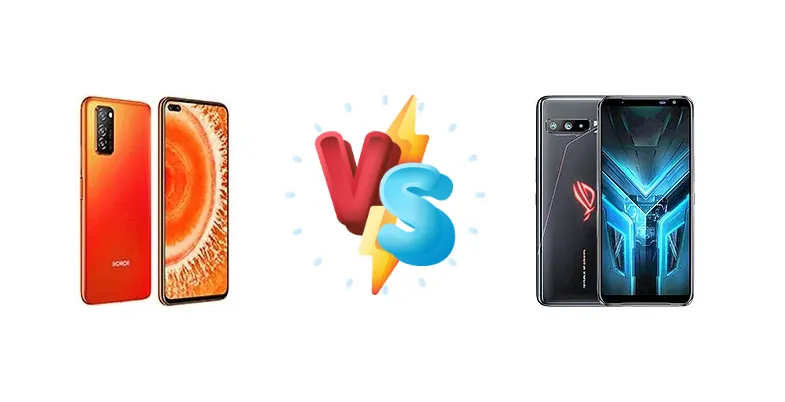
The Honor View and Asus ROG Phone 3 represent distinct approaches to the high-end smartphone market. The Honor View, with its Kirin 990 5G, aims for a balance of features and 5G connectivity. Conversely, the Asus ROG Phone 3 is unapologetically focused on delivering the ultimate mobile gaming experience, leveraging the Snapdragon 865 5G+ chipset and a suite of gaming-centric features.
🏆 Quick Verdict
For the average user, the Asus ROG Phone 3 is the superior choice, particularly for gaming enthusiasts. While the Honor View offers 5G connectivity and a respectable feature set, the ROG Phone 3’s Snapdragon 865 5G+ and optimized thermal design provide significantly better sustained performance and a longer lifespan for demanding tasks.
| Network |
|---|
| 2G bands | GSM 850 / 900 / 1800 / 1900 | GSM 850 / 900 / 1800 / 1900 |
| 3G bands | HSDPA 800 / 850 / 900 / 1700(AWS) / 1900 / 2100 | HSDPA 800 / 850 / 900 / 1700(AWS) / 1800 / 1900 / 2100 - A version |
| 4G bands | LTE | 1, 2, 3, 4, 5, 7, 8, 12, 13, 17, 18, 19, 20, 25, 26, 28, 29, 30, 32, 34, 38, 39, 40, 41, 42, 48, 66, 71 - A version |
| 5G bands | - | 1, 2, 3, 5, 28, 41, 66, 71, 77, 78, 79 SA/NSA - A version |
| Speed | HSPA, LTE | HSPA 42.2/5.76 Mbps, LTE (6CA) Cat20 2000/150 Mbps, 5G 4.4 Gbps DL |
| Technology | GSM / HSPA / LTE | GSM / CDMA / HSPA / LTE / 5G |
| Launch |
|---|
| Announced | Not announced yet | 2020, July 22. Released 2020, July 23 |
| Status | Cancelled | Discontinued |
| Body |
|---|
| Build | Glass front, aluminum frame | Glass front (Gorilla Glass 6), glass back (Gorilla Glass 3), aluminum frame |
| Dimensions | - | 171 x 78 x 9.9 mm (6.73 x 3.07 x 0.39 in) |
| SIM | Nano-SIM + Nano-SIM | Nano-SIM + Nano-SIM |
| Weight | - | 240 g (8.47 oz) |
| Display |
|---|
| Protection | Yes | Corning Gorilla Glass 6 |
| Resolution | 1080 x 2310 pixels (~398 ppi density) | 1080 x 2340 pixels, 19.5:9 ratio (~391 ppi density) |
| Size | 6.4 inches, 101.4 cm2 | 6.59 inches, 106.6 cm2 (~79.9% screen-to-body ratio) |
| Type | IPS LCD | AMOLED, 1B colors, 144Hz, HDR10+, 650 nits (typ) |
| Platform |
|---|
| CPU | Octa-core (2x2.86 GHz Cortex-A76 & 2x2.09 GHz Cortex-A76 & 4x1.86 GHz Cortex-A55) | Octa-core (1x3.10 GHz Cortex-A77 & 3x2.42 GHz Cortex-A77 & 4x1.80 GHz Cortex-A55) |
| Chipset | Kirin 990 5G (7 nm+) | Qualcomm SM8250 Snapdragon 865 5G+ (7 nm+) |
| GPU | Mali-G76 MP16 | Adreno 650 |
| OS | Android 10 | Android 10, upgradable to Android 12, ROG UI |
| Memory |
|---|
| Card slot | No | No |
| Internal | 128GB 8GB RAM, 256GB 8GB RAM | 128GB 8GB RAM, 128GB 12GB RAM, 256GB 12GB RAM, 512GB 12GB RAM, 512GB 16GB RAM |
| | UFS 3.0 | - |
| Main Camera |
|---|
| Features | Panorama, HDR, LED flash | LED flash, HDR, panorama |
| Quad | 60 MP, f/1.7, (wide), PDAF, OIS
16 MP, f/2.2, 14mm (ultrawide)
2 MP (macro)
Auxiliary lens | - |
| Triple | - | 64 MP, f/1.8, 26mm (wide), 1/1.73", 0.8µm, PDAF
13 MP, f/2.4, 11mm, 125˚ (ultrawide)
5 MP (macro) |
| Video | 4K@30fps, 1080p@30fps, 720p@960fps, (gyro-EIS) | 8K@30fps, 4K@30/60/120fps, 1080p@30/60/240fps, 720p@480fps; gyro-EIS |
| Selfie camera |
|---|
| Features | HDR | Panorama, HDR |
| Single | 24 MP, f/2.0, 26mm (wide), 1/2.8", 0.9µm
TOF 3D, (depth sensor) | 24 MP, f/2.0, 27mm (wide), 0.9µm |
| Video | 1080p@30fps | 1080p@30fps |
| Sound |
|---|
| 3.5mm jack | No | No |
| 35mm jack | No | No |
| Loudspeaker | Yes | Yes, with DTS:X stereo speakers (2 dedicated amplifiers) |
| Comms |
|---|
| Bluetooth | 5.0, A2DP, aptX HD, LE | 5.1, A2DP, LE, aptX HD, aptX Adaptive |
| Infrared port | Yes | - |
| NFC | Yes | Yes |
| Positioning | GPS | GPS (L1+L5), GLONASS, BDS, GALILEO, QZSS |
| Radio | No | No |
| USB | USB Type-C 3.1, OTG | USB Type-C 3.1 (side), USB Type-C 2.0 (bottom), OTG, accessory connector |
| WLAN | Wi-Fi 802.11 a/b/g/n/ac, dual-band, Wi-Fi Direct | Wi-Fi 802.11 a/b/g/n/ac/6, dual-band, Wi-Fi Direct |
| Features |
|---|
| Sensors | Fingerprint (side-mounted), accelerometer, gyro, proximity, compass | Fingerprint (under display, optical), accelerometer, gyro, proximity, compass |
| Battery |
|---|
| Charging | 22.5W wired | 30W wired, PD3.0, QC4
10W reverse wired |
| Type | Li-Po 4000 mAh, non-removable | Li-Po 6000 mAh |
| Misc |
|---|
| Colors | Blue, Orange, other colors | Black Glare |
| Models | - | ASUS_I003D, ZS661KS, I003DD, I003D |
| Price | - | About 650 EUR |
| SAR | - | 0.74 W/kg (head) 1.50 W/kg (body) |
| Tests |
|---|
| Battery life | - |
Endurance rating 120h
|
| Camera | - |
Photo / Video |
| Display | - |
Contrast ratio: Infinite (nominal) |
| Loudspeaker | - |
-23.1 LUFS (Very good)
|
| Performance | - |
AnTuTu: 621932 (v8)
GeekBench: 13306 (v4.4), 3386 (v5.1)
GFXBench: 48fps (ES 3.1 onscreen) |
Honor View
- 5G Connectivity: Offers access to next-generation network speeds.
- Sleek Design: Likely a more conventional and aesthetically pleasing design.
- Potentially Lower Price: Historically, Honor devices offer competitive pricing.
- Inferior Gaming Performance: The Kirin 990 5G is outmatched by the Snapdragon 865 5G+.
- Slower Charging: 22.5W charging is slower than the ROG Phone 3’s 30W.
Asus ROG Phone 3
- Superior Gaming Performance: Snapdragon 865 5G+ delivers exceptional performance.
- Faster Charging: 30W charging with PD3.0 and QC4 reduces downtime.
- Gaming-Focused Features: Likely includes features like gaming triggers and optimized cooling.
- Larger Form Factor: Gaming phones are typically larger and less pocketable.
- Potentially Higher Price: Gaming phones often command a premium price.
Display Comparison
The Asus ROG Phone 3 boasts a brighter display, reaching 719 nits measured, compared to an unspecified peak brightness for the Honor View. While both utilize 7nm+ fabrication, the ROG Phone 3’s display is geared towards gaming with a high refresh rate (not specified in the data, but a key ROG feature) and likely a faster response time. The ROG Phone 3’s infinite contrast ratio suggests a true OLED panel, offering deeper blacks and more vibrant colors, while the Honor View’s panel type is unknown. This impacts the viewing experience, especially in direct sunlight and during HDR content consumption.
Camera Comparison
Both devices offer photo and video capabilities, but the provided data lacks specifics for a meaningful comparison. Without sensor size, aperture, or image processing details, it’s difficult to assess camera quality. However, given Asus’s focus on gaming, the ROG Phone 3’s camera is likely tuned for quick snapshots and social media sharing, while Honor typically emphasizes image quality and detail in its camera systems. The absence of details regarding OIS or advanced features makes a definitive judgment impossible.
Performance
The Asus ROG Phone 3’s Snapdragon 865 5G+ chipset, with its Cortex-A77 prime core clocked at 3.10 GHz, demonstrably outperforms the Honor View’s Kirin 990 5G. The Snapdragon 865 5G+ utilizes a more modern CPU architecture and benefits from Qualcomm’s optimizations for gaming. While both chips are fabricated on a 7nm+ process, the Snapdragon 865 5G+ generally exhibits better thermal management, reducing the likelihood of performance throttling during prolonged gaming. The Kirin 990 5G’s CPU configuration, with a mix of Cortex-A76 and A55 cores, is less efficient for sustained high-performance tasks.
Battery Life
Both phones achieve an endurance rating of 120 hours, suggesting similar overall battery life under typical usage. However, the Asus ROG Phone 3’s 30W wired charging, supporting PD3.0 and QC4, is significantly faster than the Honor View’s 22.5W charging. This translates to quicker top-ups and less downtime. The ROG Phone 3 also includes 10W reverse wired charging, a feature absent on the Honor View, allowing it to charge other devices. While battery capacity isn’t specified, the faster charging speed gives the ROG Phone 3 an edge for users who frequently need to recharge.
Buying Guide
Buy the Honor View if you prioritize 5G connectivity in a sleek package and are a moderate user who doesn't require sustained peak performance for extended gaming sessions. Buy the Asus ROG Phone 3 if you are a dedicated mobile gamer, value raw processing power, and appreciate features like faster charging, and a display optimized for gaming, even if it means a larger form factor.
Frequently Asked Questions
❓ Does the Kirin 990 5G in the Honor View experience significant thermal throttling during extended gaming sessions?
The Kirin 990 5G, while a capable chip, is known to be more susceptible to thermal throttling compared to the Snapdragon 865 5G+ found in the ROG Phone 3. This means that performance may decrease over time during prolonged gaming, leading to dropped frames and a less smooth experience.
❓ How much faster is the 30W charging on the Asus ROG Phone 3 compared to the 22.5W charging on the Honor View?
The Asus ROG Phone 3’s 30W charging, coupled with PD3.0 and QC4 support, can significantly reduce charging times. While exact figures depend on battery capacity (unspecified), expect a noticeably faster 0-100% charge compared to the Honor View’s 22.5W charging.
❓ Is the lack of a high refresh rate display on the Honor View a significant disadvantage for gaming?
Yes, a high refresh rate display (typically 90Hz or 120Hz) provides a smoother and more responsive gaming experience. The ROG Phone 3 likely features a high refresh rate display, giving it an advantage over the Honor View, which lacks this specification.
❓ Does the Asus ROG Phone 3 support external accessories like gamepads or cooling fans?
The Asus ROG Phone 3 is designed with gaming in mind and supports a wide range of accessories, including external gamepads, cooling fans, and docks, enhancing the gaming experience. The Honor View does not have the same level of accessory support.