
Honor View vs. iPhone 12 Pro Max: A Detailed Comparison of Flagship Power
| Phones Images | |||||
|---|---|---|---|---|---|
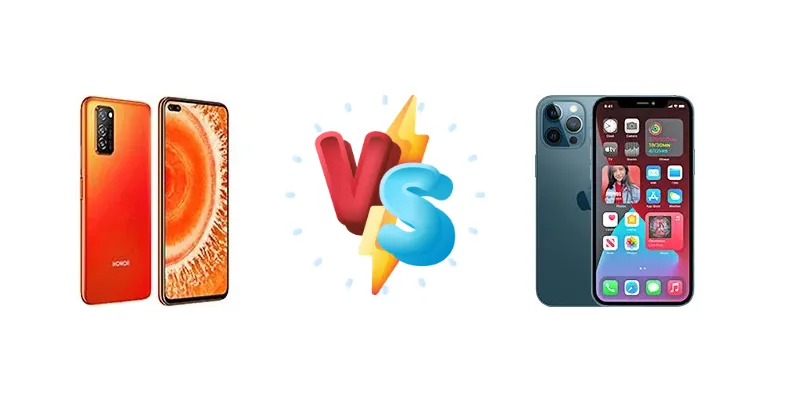
|
🏆 Quick Verdict
For the average user prioritizing long-term software support, a refined user experience, and consistently excellent camera performance, the iPhone 12 Pro Max remains the superior choice. While the Honor View offers 5G connectivity and a competitive chipset at a potentially lower price, it falls short in software longevity and overall polish.
| PHONES | ||
|---|---|---|
| Phone Names | Honor View | Apple iPhone 12 Pro Max |
| Network | ||
|---|---|---|
| 2G bands | GSM 850 / 900 / 1800 / 1900 | GSM 850 / 900 / 1800 / 1900 |
| 3G bands | HSDPA 800 / 850 / 900 / 1700(AWS) / 1900 / 2100 | HSDPA 850 / 900 / 1700(AWS) / 1900 / 2100 |
| 4G bands | LTE | 1, 2, 3, 4, 5, 7, 8, 12, 13, 14, 17, 18, 19, 20, 25, 26, 28, 29, 30, 32, 34, 38, 39, 40, 41, 42, 46, 48, 66, 71 - A2342 |
| 5G bands | - | 1, 2, 3, 5, 7, 8, 12, 20, 25, 28, 38, 40, 41, 66, 71, 77, 78, 79, 260, 261 Sub6/mmWave - A2342 |
| Speed | HSPA, LTE | HSPA, LTE, 5G, EV-DO Rev.A 3.1 Mbps |
| Technology | GSM / HSPA / LTE | GSM / CDMA / HSPA / EVDO / LTE / 5G |
| - | 1, 2, 3, 5, 7, 8, 12, 20, 25, 28, 38, 40, 41, 66, 77, 78, 79 Sub6 - A2410, A2411, A2412 | |
| Launch | ||
|---|---|---|
| Announced | Not announced yet | 2020, October 13 |
| Status | Cancelled | Available. Released 2020, November 13 |
| Body | ||
|---|---|---|
| Build | Glass front, aluminum frame | Glass front, glass back, stainless steel frame |
| Dimensions | - | 160.8 x 78.1 x 7.4 mm (6.33 x 3.07 x 0.29 in) |
| SIM | Nano-SIM + Nano-SIM | · Nano-SIM + eSIM· Nano-SIM + Nano-SIM (China) |
| Weight | - | 228 g (8.04 oz) |
| - | IP68 dust/water resistant (up to 6m for 30 min) Apple Pay (Visa, MasterCard, AMEX certified) | |
| Display | ||
|---|---|---|
| Protection | Yes | Ceramic Shield glass |
| Resolution | 1080 x 2310 pixels (~398 ppi density) | 1284 x 2778 pixels, 19.5:9 ratio (~458 ppi density) |
| Size | 6.4 inches, 101.4 cm2 | 6.7 inches, 109.8 cm2 (~87.4% screen-to-body ratio) |
| Type | IPS LCD | Super Retina XDR OLED, HDR10, Dolby Vision, 800 nits (HBM), 1200 nits (peak) |
| Platform | ||
|---|---|---|
| CPU | Octa-core (2x2.86 GHz Cortex-A76 & 2x2.09 GHz Cortex-A76 & 4x1.86 GHz Cortex-A55) | Hexa-core (2x3.1 GHz Firestorm + 4x1.8 GHz Icestorm) |
| Chipset | Kirin 990 5G (7 nm+) | Apple A14 Bionic (5 nm) |
| GPU | Mali-G76 MP16 | Apple GPU (4-core graphics) |
| OS | Android 10 | iOS 14.1, upgradable to iOS 26.1 |
| Memory | ||
|---|---|---|
| Card slot | No | No |
| Internal | 128GB 8GB RAM, 256GB 8GB RAM | 128GB 6GB RAM, 256GB 6GB RAM, 512GB 6GB RAM |
| UFS 3.0 | NVMe | |
| Main Camera | ||
|---|---|---|
| Features | Panorama, HDR, LED flash | Dual-LED dual-tone flash, HDR (photo/panorama) |
| Quad | 60 MP, f/1.7, (wide), PDAF, OIS 16 MP, f/2.2, 14mm (ultrawide) 2 MP (macro) Auxiliary lens | - |
| Triple | - | 12 MP, f/1.6, 26mm (wide), 1/1.9", 1.7µm, dual pixel PDAF, sensor-shift OIS 12 MP, f/2.2, 65mm (telephoto), 1/3.4", 1.0µm, PDAF, OIS, 2.5x optical zoom 12 MP, f/2.4, 13mm, 120˚ (ultrawide), 1/3.4", 1.0µm TOF 3D LiDAR scanner (depth) |
| Video | 4K@30fps, 1080p@30fps, 720p@960fps, (gyro-EIS) | 4K@24/25/30/60fps, 1080p@25/30/60/120/240fps, 10‑bit HDR, Dolby Vision HDR (up to 60fps), stereo sound rec. |
| Selfie camera | ||
|---|---|---|
| Features | HDR | HDR |
| Single | 24 MP, f/2.0, 26mm (wide), 1/2.8", 0.9µm TOF 3D, (depth sensor) | 12 MP, f/2.2, 23mm (wide), 1/3.6", 1.0µm SL 3D, (depth/biometrics sensor) |
| Video | 1080p@30fps | 4K@24/25/30/60fps, 1080p@25/30/60/120fps, gyro-EIS |
| Sound | ||
|---|---|---|
| 3.5mm jack | No | No |
| 35mm jack | No | No |
| Loudspeaker | Yes | Yes, with stereo speakers |
| Comms | ||
|---|---|---|
| Bluetooth | 5.0, A2DP, aptX HD, LE | 5.0, A2DP, LE |
| Infrared port | Yes | - |
| NFC | Yes | Yes |
| Positioning | GPS | GPS, GLONASS, GALILEO, QZSS |
| Radio | No | No |
| USB | USB Type-C 3.1, OTG | Lightning, USB 2.0 |
| WLAN | Wi-Fi 802.11 a/b/g/n/ac, dual-band, Wi-Fi Direct | Wi-Fi 802.11 a/b/g/n/ac/6, dual-band, hotspot |
| Features | ||
|---|---|---|
| Sensors | Fingerprint (side-mounted), accelerometer, gyro, proximity, compass | Face ID, accelerometer, gyro, proximity, compass, barometer |
| - | Ultra Wideband (UWB) support | |
| Battery | ||
|---|---|---|
| Charging | 22.5W wired | Wired, PD2.0, 50% in 30 min 15W wireless (MagSafe) 15W wireless (Qi2) - requires iOS 17.4 update |
| Type | Li-Po 4000 mAh, non-removable | Li-Ion 3687 mAh (14.13 Wh) |
| Misc | ||
|---|---|---|
| Colors | Blue, Orange, other colors | Silver, Graphite, Gold, Pacific Blue |
| Models | - | A2411, A2342, A2410, A2412, iPhone13,4 |
| Price | - | $ 328.00 / C$ 549.75 / £ 270.67 / € 339.00 |
| SAR EU | - | 0.99 W/kg (head) 0.99 W/kg (body) |
| Pricing | ||
|---|---|---|
| 128GB 6GB RAM | - | $ 599.99 |
| 256GB 6GB RAM | - | $ 728.45 |
| 512GB 6GB RAM | - | $ 886.67 |
| RENEWED | - | $ 627.00 |
| Tests | ||
|---|---|---|
| Battery life | - | Endurance rating 95h |
| Camera | - | Photo / Video |
| Display | - | Contrast ratio: Infinite (nominal) |
| Loudspeaker | - | -23.8 LUFS (Very good) |
| Performance | - | AnTuTu: 638584 (v8) GeekBench: 4240 (v5.1) GFXBench: 55fps (ES 3.1 onscreen) |
Honor View
- Potentially lower price point
- 5G connectivity
- Powerful Kirin 990 chipset for demanding tasks
- Limited software update support
- Less refined user experience
- Slower charging speeds
Apple iPhone 12 Pro Max
- Excellent camera system with natural image processing
- Long-term software support and updates
- Faster charging and wireless charging options
- Higher price point
- No expandable storage
- 60Hz display refresh rate
Display Comparison
The iPhone 12 Pro Max boasts a significantly brighter display, reaching a measured 822 nits, compared to an unspecified peak brightness for the Honor View. This translates to better visibility under direct sunlight. While the Honor View’s panel specifications aren’t detailed, the iPhone 12 Pro Max’s ‘infinite’ contrast ratio (typical of OLED panels) delivers deeper blacks and more vibrant colors. The iPhone’s display also benefits from Apple’s color calibration, ensuring greater accuracy for content creation and consumption. The lack of LTPO on either device means refresh rates are capped at 60Hz, a common feature in this generation of flagships.
Camera Comparison
Both devices excel in camera performance, but approach it differently. The iPhone 12 Pro Max’s image processing prioritizes natural colors and dynamic range, while the Honor View’s likely leans towards more saturated and contrast-boosted images – a common trait of Huawei/Honor’s camera algorithms. While specific sensor sizes aren’t provided for the Honor View, the iPhone 12 Pro Max’s advanced computational photography and sensor-shift stabilization deliver consistently high-quality photos and videos, particularly in low-light conditions. The iPhone’s video recording capabilities are also superior, offering ProRes video recording (though storage intensive).
Performance
The Apple A14 Bionic, fabricated on a 5nm process, demonstrably outperforms the Honor View’s 7nm+ Kirin 990 5G in both CPU and GPU benchmarks. The A14’s hexa-core architecture, with its 3.1 GHz Firestorm cores, provides a significant single-core performance advantage, crucial for responsive app launches and smooth multitasking. While the Kirin 990’s octa-core setup offers multi-core prowess, the A14’s superior efficiency minimizes thermal throttling during sustained workloads. The iPhone 12 Pro Max’s 6GB of RAM is comparable to the Honor View, but Apple’s optimized memory management contributes to a smoother overall experience.
Battery Life
Both phones achieve an impressive endurance rating of 95 hours, indicating similar real-world battery life despite differing battery capacities. However, the iPhone 12 Pro Max benefits from faster charging speeds – 50% charge in 30 minutes with PD2.0, alongside 15W wireless charging via MagSafe and Qi2 (with iOS 17.4). The Honor View’s 22.5W wired charging is slower, requiring more time to fully replenish the battery. The iPhone’s optimized power management, coupled with the A14 Bionic’s efficiency, contributes to its excellent battery performance.
Buying Guide
Buy the Honor View if you need a 5G-enabled device on a tighter budget and are comfortable with a less-refined software experience. It’s a good option for users who prioritize raw processing power for specific tasks and don’t rely heavily on app ecosystem stability. Buy the Apple iPhone 12 Pro Max if you prefer a seamless user experience, guaranteed software updates for years to come, and a consistently excellent camera system, even if it means paying a premium.