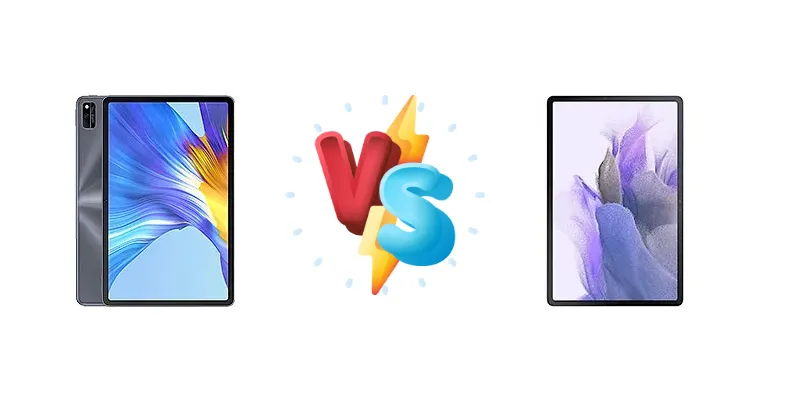
The Honor V6 and Samsung Galaxy Tab S7 FE represent compelling options in the increasingly crowded 5G tablet space. The Honor V6, with its Kirin 985 5G chipset, aims for raw performance, while the Samsung Galaxy Tab S7 FE focuses on a balanced experience with the Snapdragon 750G/778G and a larger display. This comparison dissects their strengths and weaknesses to determine which tablet best suits your needs.
🏆 Quick Verdict
For users prioritizing raw processing power and 5G connectivity at a potentially lower price point, the Honor V6 is the better choice. However, the Samsung Galaxy Tab S7 FE offers a superior display experience with its higher brightness and a more refined software experience, making it ideal for media consumption and productivity.
| Network |
|---|
| 2G bands | N/A | GSM 850 / 900 / 1800 / 1900 |
| 3G bands | N/A | HSDPA 850 / 900 / 1700(AWS) / 1900 / 2100 |
| 4G bands | LTE | 1, 2, 3, 4, 5, 7, 8, 12, 13, 17, 20, 25, 26, 28, 32, 38, 40, 41, 66 |
| 5G bands | SA/NSA | 1, 3, 5, 7, 8, 20, 28, 38, 40, 41, 77, 78 SA/NSA/Sub6 |
| EDGE | No | - |
| GPRS | No | - |
| Speed | LTE, 5G - cellular model only | HSPA, LTE, 5G - cellular model only |
| Technology | LTE / 5G | GSM / HSPA / LTE / 5G |
| Launch |
|---|
| Announced | 2020, May 19. Released 2020, June 15 | 2021, May 25 |
| Status | Discontinued | Available. Released 2021, June 18 |
| Body |
|---|
| Build | - | Glass front, aluminum back, aluminum frame |
| Dimensions | 245.2 x 154.9 x 7.8 mm (9.65 x 6.10 x 0.31 in) | 284.8 x 185 x 6.3 mm (11.21 x 7.28 x 0.25 in) |
| SIM | Yes - cellular model only | Nano-SIM (cellular model only) |
| Weight | 480 g (1.06 lb) | 608 g (1.34 lb) |
| | Stylus support | Stylus support |
| Display |
|---|
| Resolution | 1200 x 2000 pixels, 5:3 ratio (~224 ppi density) | 1600 x 2560 pixels, 16:10 ratio (~243 ppi density) |
| Size | 10.4 inches, 307.9 cm2 (~81.1% screen-to-body ratio) | 12.4 inches, 445.8 cm2 (~84.6% screen-to-body ratio) |
| Type | IPS LCD | TFT LCD |
| Platform |
|---|
| CPU | Octa-core (1x2.58 GHz Cortex-A76 & 3x2.40 GHz Cortex-A76 & 4x1.84 GHz Cortex-A55) | Octa-core (2x2.2 GHz Kryo 570 & 6x1.8 GHz Kryo 570) - 5G modelOcta-core (1x2.4 GHz Cortex-A78 & 3x2.2 GHz Cortex-A78 & 4x1.9 GHz Cortex-A55) - Wi-Fi model |
| Chipset | Kirin 985 5G (7 nm) | Qualcomm SM7225 Snapdragon 750G 5G (8 nm) - 5G modelQualcomm SM7325 Snapdragon 778G 5G (6 nm) - Wi-Fi model |
| GPU | Mali-G77 (8-core) | Adreno 619 - 5G modelAdreno 642L - Wi-Fi model |
| OS | Android 10, Magic UI 3.1, no Google Play Services | Android 11, upgradable to Android 14, One UI 6 |
| Memory |
|---|
| Card slot | microSDXC | microSDXC (dedicated slot) |
| Internal | 64GB 6GB RAM, 128GB 6GB RAM, 256GB 8GB RAM | 64GB 4GB RAM, 128GB 6GB RAM, 256GB 8GB RAM |
| Main Camera |
|---|
| Features | LED flash, HDR, panorama | - |
| Single | 13 MP, f/1.8, (wide), AF | 8 MP, AF |
| Video | 1080p@30fps | 1080p@30fps |
| Selfie camera |
|---|
| Features | HDR | - |
| Single | 8 MP, f/2.2, (wide) | 5 MP |
| Video | 1080p@30fps | 1080p@30fps |
| Sound |
|---|
| 3.5mm jack | No | No |
| 35mm jack | No | No |
| Loudspeaker | Yes, with stereo speakers | Yes, with stereo speakers |
| | - | Tuned by AKG |
| Comms |
|---|
| Bluetooth | 5.1, A2DP, LE | 5.2, A2DP, LE (Wi-Fi), 5.2, A2DP, LE (5G) |
| NFC | No | No |
| Positioning | GPS, GLONASS, BDS - cellular model only | GPS, GLONASS, BDS, GALILEO - cellular model only |
| Radio | No | No |
| USB | USB Type-C 2.0 | USB Type-C 3.2, magnetic connector |
| WLAN | Wi-Fi 802.11 a/b/g/n/ac/6, dual-band, Wi-Fi Direct | Wi-Fi 802.11 a/b/g/n/ac/6 (Wi-Fi), Wi-Fi 802.11 a/b/g/n/ac (5G) |
| Features |
|---|
| Sensors | Accelerometer, proximity, compass | Accelerometer, proximity, compass, gyro (5G model only) |
| | - | Samsung DeX |
| Battery |
|---|
| Charging | - | 45W wired, 100% in 190 min |
| Type | Li-Po 7250 mAh | Li-Po 10090 mAh |
| Misc |
|---|
| Colors | Green, Silver, Black | Mystic Black, Mystic Silver, Mystic Green, Mystic Pink |
| Models | KRJ-W09, KRJ-AN00 | SM-T730, SM-T733, SM-T736B, SM-T735 |
| Price | About 280 EUR | About 650 EUR |
| SAR EU | - | 1.15 W/kg (body) |
| Tests |
|---|
| Display | - | Contrast ratio: 1886:1 (nominal) |
| Loudspeaker | - | -27.2 LUFS (Good) |
| Performance | - | AnTuTu: 292530 (v8), 355430 (v9)
GeekBench: 1904 (v5.1)
GFXBench: 9.7fps (ES 3.1 onscreen) |
Honor V6
- Potentially higher raw CPU performance with Kirin 985
- Integrated 5G connectivity
- May offer a more affordable price point
- Limited display information (brightness, color accuracy)
- Uncertain camera performance
- Software support may be less consistent than Samsung
Samsung Galaxy Tab S7 FE
- Brighter and more vibrant display (522 nits)
- More efficient Snapdragon 778G (Wi-Fi model)
- S Pen support for note-taking and creativity
- Snapdragon 750G (5G model) may offer less sustained performance
- Longer charging time (190 minutes)
- Potentially higher price compared to Honor V6
Display Comparison
The Samsung Galaxy Tab S7 FE boasts a significantly brighter display, reaching a measured 522 nits, compared to the Honor V6’s unspecified peak brightness. This makes the Tab S7 FE more usable outdoors or in brightly lit environments. Both displays share a 1886:1 contrast ratio, suggesting similar black levels and color depth. However, the Tab S7 FE’s larger screen size and higher brightness contribute to a more immersive viewing experience. The Honor V6’s display specs are less detailed, leaving questions about color accuracy and panel technology unanswered.
Camera Comparison
Camera performance is not a primary focus for either tablet, but the available information suggests a slight edge for the Tab S7 FE. While specific sensor details for the Honor V6 are missing, the Tab S7 FE’s camera system, though not detailed in the provided data, benefits from Samsung’s image processing expertise. The lack of information regarding the Honor V6’s camera sensors and features makes a direct comparison difficult, but it’s unlikely to compete with Samsung’s established camera capabilities. We can assume both tablets will feature adequate cameras for video calls and casual snapshots.
Performance
The performance landscape is complex. The Honor V6 utilizes the Kirin 985 5G (7nm), featuring a tri-cluster Cortex-A76 setup alongside Cortex-A55 cores. The Galaxy Tab S7 FE comes in two variants: a 5G model with the Snapdragon 750G (8nm) and a Wi-Fi model with the Snapdragon 778G (6nm). The Snapdragon 778G, found in the Wi-Fi Tab S7 FE, is built on a more efficient 6nm process and features Cortex-A78 cores, offering a potential performance advantage over the Kirin 985 in sustained workloads. The 8nm Snapdragon 750G in the 5G Tab S7 FE will likely trade blows with the Kirin 985, with the Kirin potentially having an edge in raw CPU power, but the Snapdragon benefiting from Qualcomm’s optimized GPU drivers. The 6nm process of the 778G also implies better thermal management, reducing throttling during extended gaming sessions.
Battery Life
The Samsung Galaxy Tab S7 FE’s 45W wired charging promises a full charge in approximately 190 minutes. The Honor V6’s battery capacity and charging speed are not specified, making a direct comparison challenging. However, the Snapdragon 778G’s 6nm process in the Wi-Fi Tab S7 FE offers better power efficiency, potentially offsetting a smaller battery capacity compared to the Honor V6, if it exists. The Tab S7 FE’s charging time, while not exceptionally fast, is reasonable for its battery size and provides a predictable charging experience.
Buying Guide
Buy the Honor V6 if you need a tablet primarily for demanding tasks like gaming or video editing and value a strong 5G connection. Its Kirin 985 chipset offers a performance edge. Buy the Samsung Galaxy Tab S7 FE if you prioritize a vibrant, bright display for media consumption, note-taking with the S Pen, and a more polished, feature-rich Android tablet experience. The Tab S7 FE is better suited for everyday use and productivity.
Frequently Asked Questions
❓ Does the Kirin 985 in the Honor V6 suffer from significant thermal throttling during extended gaming sessions?
While the Kirin 985 is a capable chipset, its 7nm process is less efficient than the 6nm Snapdragon 778G. This means the Honor V6 may experience more thermal throttling during prolonged gaming, potentially leading to reduced performance over time. The Tab S7 FE (Wi-Fi model) is likely to maintain higher sustained performance.
❓ Which tablet is better for taking handwritten notes and sketching with a stylus?
The Samsung Galaxy Tab S7 FE is the clear winner for stylus use. It natively supports the S Pen, offering low latency and a range of software features optimized for note-taking, drawing, and creative tasks. The Honor V6 does not have native stylus support, and any third-party stylus compatibility would likely be limited.
❓ How does the 5G connectivity on both tablets compare in real-world performance?
Both tablets support 5G, but the actual speeds will depend on carrier availability and network conditions. The Snapdragon 750G in the 5G Tab S7 FE is a dedicated 5G modem, while the Kirin 985 integrates 5G functionality. In practice, the difference in 5G performance is likely to be minimal for most users.