
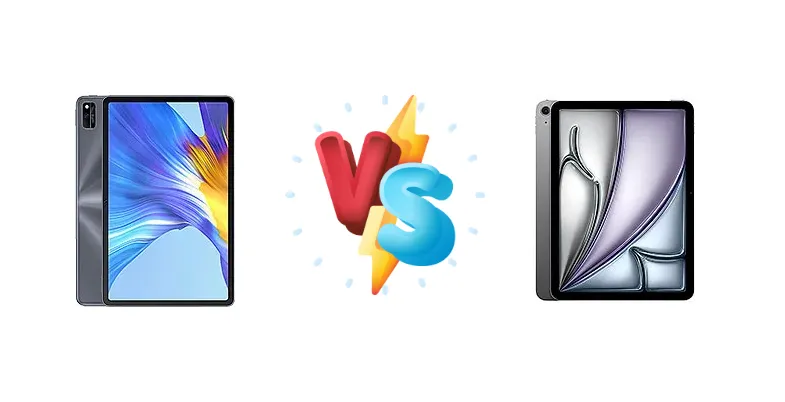
iPad Air 11 (2025) vs Honor V6: A Deep Dive into Performance and Value
| Phones Images | |||||
|---|---|---|---|---|---|
|
🏆 Quick Verdict
For the average user prioritizing sustained performance and long-term battery health, the Apple iPad Air 11 (2025) is the clear winner. The M3 chip’s architectural advantages and the reported 62-hour endurance outweigh the Honor V6’s 5G connectivity and potentially lower price point.
| PHONES | ||
|---|---|---|
| Phone Names | Honor V6 | Apple iPad Air 11 (2025) |
| Network | ||
|---|---|---|
| 2G bands | N/A | GSM 850 / 900 / 1800 / 1900 |
| 3G bands | N/A | HSDPA 850 / 900 / 1700(AWS) / 1900 / 2100 |
| 4G bands | LTE | 1, 2, 3, 4, 5, 7, 8, 11, 12, 13, 14, 17, 18, 19, 20, 21, 25, 26, 28, 29, 30, 32, 34, 38, 39, 40, 41, 42, 48, 66, 71 - A3267 |
| 5G bands | SA/NSA | 1, 2, 3, 5, 7, 8, 12, 14, 20, 25, 26, 28, 29, 30, 38, 40, 41, 48, 66, 70, 71, 75, 76, 77, 78, 79 SA/NSA/Sub6 - A3267, A3270 |
| EDGE | No | - |
| GPRS | No | - |
| Speed | LTE, 5G - cellular model only | HSPA, LTE, 5G - cellular model only |
| Technology | LTE / 5G | GSM / HSPA / LTE / 5G |
| Launch | ||
|---|---|---|
| Announced | 2020, May 19. Released 2020, June 15 | 2025, March 04 |
| Status | Discontinued | Available. Released 2025, March 12 |
| Body | ||
|---|---|---|
| Build | - | Glass front, aluminum back, aluminum frame |
| Dimensions | 245.2 x 154.9 x 7.8 mm (9.65 x 6.10 x 0.31 in) | 247.6 x 178.5 x 6.1 mm (9.75 x 7.03 x 0.24 in) |
| SIM | Yes - cellular model only | eSIM (cellular model only) |
| Weight | 480 g (1.06 lb) | 460 g (1.01 lb) |
| Stylus support | - | |
| Display | ||
|---|---|---|
| Protection | - | Scratch-resistant glass, oleophobic coating, Mohs level 4 |
| Resolution | 1200 x 2000 pixels, 5:3 ratio (~224 ppi density) | 1640 x 2360 pixels (~264 ppi density) |
| Size | 10.4 inches, 307.9 cm2 (~81.1% screen-to-body ratio) | 11.0 inches, 357.6 cm2 (~80.9% screen-to-body ratio) |
| Type | IPS LCD | Liquid Retina IPS LCD, 500 nits (typ) |
| Platform | ||
|---|---|---|
| CPU | Octa-core (1x2.58 GHz Cortex-A76 & 3x2.40 GHz Cortex-A76 & 4x1.84 GHz Cortex-A55) | Octa-core (4 performance cores and 4 efficiency cores) |
| Chipset | Kirin 985 5G (7 nm) | Apple M3 |
| GPU | Mali-G77 (8-core) | Apple GPU (9-core graphics) |
| OS | Android 10, Magic UI 3.1, no Google Play Services | iPadOS 18.3.2, upgradable to iPadOS 26.1 |
| Memory | ||
|---|---|---|
| Card slot | microSDXC | No |
| Internal | 64GB 6GB RAM, 128GB 6GB RAM, 256GB 8GB RAM | 128GB 8GB RAM, 256GB 8GB RAM, 512GB 8GB RAM, 1TB 8GB RAM |
| Main Camera | ||
|---|---|---|
| Features | LED flash, HDR, panorama | HDR |
| Single | 13 MP, f/1.8, (wide), AF | 12 MP, f/1.8, (wide), 1/3.0", 1.22µm, dual pixel PDAF |
| Video | 1080p@30fps | 4K@24/25/30/60fps, 1080p@25/30/60/120/240fps; gyro-EIS |
| Selfie camera | ||
|---|---|---|
| Features | HDR | HDR |
| Single | 8 MP, f/2.2, (wide) | 12 MP, f/2.0, 122˚ (ultrawide) |
| Video | 1080p@30fps | 1080p@25/30/60fps; gyro-EIS |
| Sound | ||
|---|---|---|
| 3.5mm jack | No | - |
| 35mm jack | No | No |
| Loudspeaker | Yes, with stereo speakers | Yes, with stereo speakers |
| Comms | ||
|---|---|---|
| Bluetooth | 5.1, A2DP, LE | 5.3, A2DP, LE |
| NFC | No | No |
| Positioning | GPS, GLONASS, BDS - cellular model only | GPS, GLONASS (5G model only) |
| Radio | No | No |
| USB | USB Type-C 2.0 | USB Type-C 3.1 Gen2, DisplayPort, magnetic connector |
| WLAN | Wi-Fi 802.11 a/b/g/n/ac/6, dual-band, Wi-Fi Direct | Wi-Fi 802.11 a/b/g/n/ac/6e, dual-band, hotspot |
| Features | ||
|---|---|---|
| Sensors | Accelerometer, proximity, compass | Fingerprint (top-mounted), accelerometer, gyro, compass, barometer |
| Battery | ||
|---|---|---|
| Type | Li-Po 7250 mAh | Li-Po 7606 mAh (28.93 Wh) |
| Misc | ||
|---|---|---|
| Colors | Green, Silver, Black | Space Gray, Starlight, Purple, Blue |
| Models | KRJ-W09, KRJ-AN00 | A3267, A3270, A3266 |
| Price | About 280 EUR | About 700 EUR |
| SAR | - | 1.10 W/kg (body) |
| SAR EU | - | 1.41 W/kg (body) |
| EU LABEL | ||
|---|---|---|
| Battery | - | 62:00h endurance, 1000 cycles |
| Energy | - | Class G |
| Free fall | - | Class E (0 falls) |
| Repairability | - | Class C |
Honor V6
- Integrated 5G connectivity for on-the-go access.
- Potentially lower price point compared to the iPad.
- More compact and portable form factor.
- Older chipset architecture (Kirin 985) limits performance.
- Likely shorter battery life compared to the iPad.
- Smaller screen size may not be ideal for productivity.
Apple iPad Air 11 (2025)
- Significantly faster and more efficient Apple M3 chip.
- Exceptional battery life (62 hours) and longevity (1000 cycles).
- Larger screen size enhances productivity and media consumption.
- Higher price point.
- Requires separate data plan or Wi-Fi connectivity.
- Larger form factor may be less convenient for some users.
Display Comparison
The context data lacks display specifics for both devices. However, given Apple’s history, the iPad Air 11 (2025) likely features a high-quality IPS LCD or potentially even a mini-LED panel with ProMotion (adaptive refresh rate), offering superior color accuracy and brightness compared to the Honor V6. The larger 11-inch form factor of the iPad also provides a more immersive viewing experience. The Honor V6, being a phone, will have a smaller display, likely OLED, but potentially with lower peak brightness and color gamut coverage.
Camera Comparison
Without specific camera details for the Honor V6, it’s difficult to make a precise comparison. However, Apple typically prioritizes image quality and computational photography. The iPad Air 11 (2025) will likely feature a capable camera system optimized for video conferencing and casual photography. The Honor V6, as a phone, may offer more versatile camera features, but image processing quality is likely to be lower than Apple’s. The absence of sensor details for the Honor V6 makes a definitive statement impossible, but Apple’s image signal processor (ISP) is generally considered best-in-class.
Performance
The core of this comparison lies in the chipsets. Apple’s M3, built on a likely 3nm or 4nm process, utilizes a unified memory architecture and a combination of performance and efficiency cores. This design prioritizes both peak performance and power efficiency. The Honor V6’s Kirin 985 (7nm) is a capable 5G chipset, but its older architecture (Cortex-A76 cores) and process node will result in lower single-core and multi-core performance compared to the M3. The M3’s GPU will also significantly outperform the Kirin 985’s integrated graphics, making the iPad Air 11 (2025) the superior choice for demanding tasks like video editing and gaming. The M3’s LPDDR5X RAM support further enhances memory bandwidth.
Battery Life
The iPad Air 11 (2025) boasts a significant advantage in battery endurance with a reported 62 hours of use and 1000 charge cycles. This suggests a larger battery capacity and optimized power management. While the Honor V6’s battery capacity is unknown, its smaller form factor likely limits its capacity. The M3’s efficiency further contributes to the iPad’s longevity. The 1000 cycle claim for the iPad also indicates a longer lifespan before significant battery degradation, a crucial factor for long-term value.
Buying Guide
Buy the Honor V6 if you need a dedicated 5G mobile device with a focus on affordability and are comfortable with a smartphone-centric ecosystem. It’s ideal for users heavily reliant on mobile data and seeking a capable all-rounder. Buy the Apple iPad Air 11 (2025) if you prioritize a larger screen for productivity, a smoother and more responsive user experience thanks to the M3 chip, and exceptional battery longevity, even if it means a higher initial investment.