
Honor V40 5G vs vivo X60 Pro+: A Detailed Comparison of Flagship Androids
| Phones Images | |||||
|---|---|---|---|---|---|
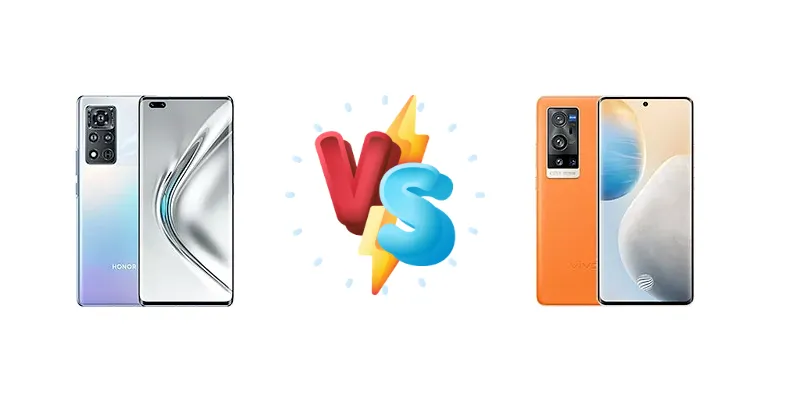
|
🏆 Quick Verdict
For most users, the vivo X60 Pro+ is the superior choice. While the Honor V40 5G offers competitive charging speeds and a respectable feature set, the Snapdragon 888 in the X60 Pro+ provides a noticeable performance advantage, particularly in demanding tasks and gaming, justifying its higher price point.
| PHONES | ||
|---|---|---|
| Phone Names | Honor V40 5G | vivo X60 Pro+ |
| Network | ||
|---|---|---|
| 2G bands | GSM 850 / 900 / 1800 / 1900 | GSM 850 / 900 / 1800 / 1900 |
| 3G bands | HSDPA 800 / 850 / 900 / 1700(AWS) / 1800 / 1900 / 2100 | HSDPA 850 / 900 / 1700(AWS) / 1900 / 2100 |
| 4G bands | 1, 2, 3, 4, 5, 8, 18, 19, 26, 34, 38, 39, 40, 41 | 1, 2, 3, 4, 5, 7, 8, 12, 17, 18, 19, 20, 26, 28, 34, 38, 39, 40, 41 - International |
| 5G bands | 1, 28, 38, 41, 77, 78, 79 SA/NSA | 1, 28, 41, 77, 78 SA/NSA - International |
| Speed | HSPA, LTE, 5G | HSPA, LTE, 5G |
| Technology | GSM / CDMA / HSPA / CDMA2000 / LTE / 5G | GSM / CDMA / HSPA / CDMA2000 / LTE / 5G |
| CDMA2000 1x | - | |
| Launch | ||
|---|---|---|
| Announced | 2021, January 22 | 2021, January 21 |
| Status | Available. Released 2021, January 22 | Available. Released 2021, January 30 |
| Body | ||
|---|---|---|
| Build | - | Glass front, eco leather back, aluminum frame |
| Dimensions | 163.1 x 74.3 x 8 mm (6.42 x 2.93 x 0.31 in) | 158.6 x 73.4 x 9.1 mm (6.24 x 2.89 x 0.36 in) |
| SIM | Nano-SIM + Nano-SIM | Nano-SIM + Nano-SIM |
| Weight | 189 g (6.67 oz) | 191 g (6.74 oz) |
| Display | ||
|---|---|---|
| Resolution | 1236 x 2676 pixels, 19.5:9 ratio (~440 ppi density) | 1080 x 2376 pixels (~398 ppi density) |
| Size | 6.72 inches, 110.4 cm2 (~91.1% screen-to-body ratio) | 6.56 inches, 104.6 cm2 (~89.8% screen-to-body ratio) |
| Type | AMOLED, 1B colors, HDR10, 120Hz, 800 nits (peak) | Super AMOLED, 120Hz, HDR10+, 1300 nits (peak) |
| Always-on display | - | |
| Platform | ||
|---|---|---|
| CPU | Octa-core (4x2.6 GHz Cortex-A77 & 4x2.0 GHz Cortex-A55) | Octa-core (1x2.84 GHz Cortex-X1 & 3x2.42 GHz Cortex-A78 & 4x1.80 GHz Cortex-A55 |
| Chipset | Mediatek Dimensity 1000+ (7 nm) | Qualcomm SM8350 Snapdragon 888 5G (5 nm) |
| GPU | Mali-G77 MC9 | Adreno 660 |
| OS | Android 10, Magic UI 4.0, no Google Play Services | Android 11, Funtouch 12 (International), OriginOS 1.0 (China) |
| Memory | ||
|---|---|---|
| Card slot | No | No |
| Internal | 128GB 8GB RAM, 256GB 8GB RAM | 128GB 8GB RAM, 256GB 12GB RAM |
| UFS 2.1 | - | |
| Main Camera | ||
|---|---|---|
| Features | Laser AF, LED flash, panorama, HDR | Laser AF, color spectrum sensor, Zeiss optics, Zeiss T* lens coating, Pixel Shift, dual-LED dual-tone flash, HDR, panorama |
| Quad | - | 50 MP, f/1.6, (wide), 1/1.31", 1.2µm, dual pixel PDAF, OIS 8 MP, f/3.4, 125mm (periscope telephoto), 1/4.0", PDAF, OIS, 5x optical zoom 32 MP, f/2.1, 50mm (telephoto), 1/2.8", 0.8µm, PDAF, 2x optical zoom 48 MP, f/2.2, 114˚ (ultrawide), 1/2.0", 0.8µm, gimbal OIS, PDAF |
| Triple | 50 MP, f/1.9, (wide), 1/1.56", 1.0µm, PDAF 8 MP, f/2.4, 120˚, 17mm (ultrawide) 2 MP (macro) | - |
| Video | 4K, 1080p, 720p@1920fps, HDR, gyro-EIS | 8K@30fps, 4K@30/60fps, 1080p@30/60fps, gyro-EIS, HDR10+ |
| Selfie camera | ||
|---|---|---|
| Dual | 16 MP, f/2.0, (wide) Color spectrum sensor | - |
| Features | HDR | HDR |
| Single | - | 32 MP, f/2.5, 24mm (wide), 1/2.8", 0.8µm |
| Video | 1080p@30fps, gyro-EIS | 1080p@30fps |
| Sound | ||
|---|---|---|
| 3.5mm jack | No | - |
| 35mm jack | No | No |
| Loudspeaker | Yes, with stereo speakers | Yes |
| Comms | ||
|---|---|---|
| Bluetooth | 5.1, A2DP, LE | 5.2, A2DP, LE, aptX HD |
| Infrared port | Yes | - |
| NFC | Yes | Yes |
| Positioning | GPS (L1+L5), GLONASS, BDS, GALILEO, QZSS | GPS (L1+L5), GLONASS, BDS, GALILEO, NavIC |
| Radio | No | No |
| USB | USB Type-C, OTG | USB Type-C 2.0, OTG |
| WLAN | Wi-Fi 802.11 a/b/g/n/ac/6, dual-band, Wi-Fi Direct | Wi-Fi 802.11 a/b/g/n/ac/6, dual-band, Wi-Fi Direct |
| Features | ||
|---|---|---|
| Sensors | Fingerprint (under display, optical), accelerometer, gyro, proximity, compass | Fingerprint (under display, optical), accelerometer, gyro, compass |
| Battery | ||
|---|---|---|
| Charging | 66W wired, 60% in 15 min, 100% in 35 min 50W wireless, 50% in 35 min 5W reverse wired | 55W wired |
| Type | Li-Po 4000 mAh | 4200 mAh |
| Misc | ||
|---|---|---|
| Colors | Midnight Black, Rose Gold, Titanium Silver | Orange, Emperor Blue |
| Models | YOK-AN10 | V2056A, V2047 |
| Price | About 460 EUR | About 800 EUR |
| SAR | - | 0.80 W/kg (head) 0.47 W/kg (body) |
Honor V40 5G
- Extremely fast 66W wired charging
- Competitive 50W wireless charging
- Potentially more affordable price point
- Less powerful Dimensity 1000+ chipset
- Limited camera information
- Unknown display specifications
vivo X60 Pro+
- Powerful Snapdragon 888 5G chipset
- High peak display brightness (816 nits)
- Excellent battery endurance (91h)
- Slower charging speed compared to Honor V40 5G
- Potential for thermal throttling under heavy load
- Higher price point
Display Comparison
The vivo X60 Pro+ boasts a measured peak brightness of 816 nits, suggesting a more visible display in direct sunlight compared to the Honor V40 5G, for which display brightness data is unavailable. While both likely utilize OLED panels for vibrant colors, the X60 Pro+'s higher brightness is a tangible advantage. The absence of refresh rate information for the V40 makes a direct comparison difficult, but the X60 Pro+ likely offers a smoother visual experience if it supports a higher refresh rate.
Camera Comparison
The vivo X60 Pro+ is positioned as a camera-centric device, though specific sensor details are missing. The focus is on photo and video capabilities, suggesting a more sophisticated image processing pipeline. The Honor V40 5G’s camera specs are not provided, making a direct sensor comparison impossible. However, given the X60 Pro+'s flagship status, it likely features a larger main sensor and more advanced optical image stabilization (OIS) than the V40. The X60 Pro+’s image processing is likely tuned for vibrant colors and detailed images, while the V40’s may prioritize a more natural look. The absence of information on the V40’s camera features makes a definitive assessment challenging.
Performance
The core difference lies in the chipsets: the Honor V40 5G uses the Mediatek Dimensity 1000+ (7nm) while the vivo X60 Pro+ features the Qualcomm Snapdragon 888 5G (5nm). The Snapdragon 888, built on a smaller 5nm process, offers superior transistor density and therefore, improved performance and efficiency. The Snapdragon 888’s Cortex-X1 prime core (2.84 GHz) significantly outperforms the Cortex-A77 in the Dimensity 1000+ (2.6 GHz). This translates to faster app loading, smoother multitasking, and better sustained performance in graphically intensive games. The Snapdragon 888’s Adreno 660 GPU also provides a substantial leap in graphics processing power. However, the 5nm node can be prone to thermal throttling under sustained load, a potential concern for extended gaming sessions.
Battery Life
The vivo X60 Pro+ boasts an endurance rating of 91 hours, indicating excellent battery life. The Honor V40 5G excels in charging speed, offering 66W wired charging (60% in 15 minutes, 100% in 35 minutes) and 50W wireless charging (50% in 35 minutes). The X60 Pro+ offers 55W wired charging, which is still fast but slower than the V40. While the X60 Pro+’s battery capacity is unknown, its endurance rating suggests efficient power management. The V40’s faster charging is a significant advantage for users who need to quickly replenish their battery, while the X60 Pro+ prioritizes overall longevity.
Buying Guide
Buy the Honor V40 5G if you prioritize extremely fast charging – both wired and wireless – and are comfortable with a slightly less powerful processor. It’s ideal for users who frequently top up their phones and don’t engage in intensive mobile gaming. Buy the vivo X60 Pro+ if you demand top-tier performance, a more refined camera system, and are willing to pay a premium for the Snapdragon 888’s capabilities and the associated software optimizations.