
Honor V40 5G vs Huawei P50 Pro: A Deep Dive into Flagship Choices
| Phones Images | |||||
|---|---|---|---|---|---|
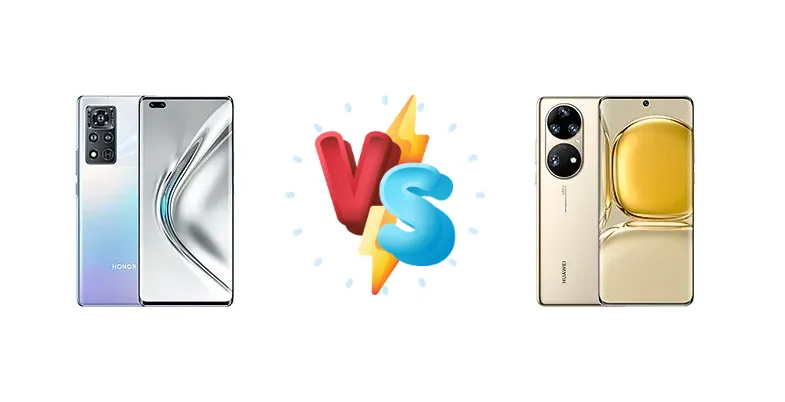
|
🏆 Quick Verdict
For the average user prioritizing speed and value, the Honor V40 5G emerges as the stronger contender. Its Dimensity 1000+ delivers excellent performance, coupled with incredibly fast 66W wired and 50W wireless charging. While the P50 Pro boasts a potentially superior camera system, the chipset variations and software constraints make the V40 a more consistently reliable choice.
| PHONES | ||
|---|---|---|
| Phone Names | Honor V40 5G | Huawei P50 Pro |
| Network | ||
|---|---|---|
| 2G bands | GSM 850 / 900 / 1800 / 1900 | GSM 850 / 900 / 1800 / 1900 |
| 3G bands | HSDPA 800 / 850 / 900 / 1700(AWS) / 1800 / 1900 / 2100 | HSDPA 800 / 850 / 900 / 1700(AWS) / 1900 / 2100 |
| 4G bands | 1, 2, 3, 4, 5, 8, 18, 19, 26, 34, 38, 39, 40, 41 | 1, 2, 3, 4, 5, 6, 7, 8, 9, 12, 17, 18, 19, 20, 26, 28, 34, 38, 39, 40, 41 - China |
| 5G bands | 1, 28, 38, 41, 77, 78, 79 SA/NSA | - |
| Speed | HSPA, LTE, 5G | HSPA, LTE |
| Technology | GSM / CDMA / HSPA / CDMA2000 / LTE / 5G | GSM / CDMA / HSPA / CDMA2000 / LTE |
| CDMA2000 1x | 1, 2, 3, 4, 5, 7, 8, 12, 17, 18, 19, 20, 26, 28, 32, 34, 38, 39, 40, 41, 66 - International | |
| Launch | ||
|---|---|---|
| Announced | 2021, January 22 | 2021, July 29 |
| Status | Available. Released 2021, January 22 | Available. Released 2021, August 12 |
| Body | ||
|---|---|---|
| Build | - | Glass front, glass back, aluminum frame |
| Dimensions | 163.1 x 74.3 x 8 mm (6.42 x 2.93 x 0.31 in) | 158.8 x 72.8 x 8.5 mm (6.25 x 2.87 x 0.33 in) |
| SIM | Nano-SIM + Nano-SIM | · Nano-SIM· Nano-SIM + Nano-SIM |
| Weight | 189 g (6.67 oz) | 195 g (6.88 oz) |
| - | IP68 dust/water resistant (up to 1.5m for 30 min) | |
| Display | ||
|---|---|---|
| Resolution | 1236 x 2676 pixels, 19.5:9 ratio (~440 ppi density) | 1228 x 2700 pixels (~450 ppi density) |
| Size | 6.72 inches, 110.4 cm2 (~91.1% screen-to-body ratio) | 6.6 inches, 105.4 cm2 (~91.2% screen-to-body ratio) |
| Type | AMOLED, 1B colors, HDR10, 120Hz, 800 nits (peak) | OLED, 1B colors, 120Hz |
| Always-on display | - | |
| Platform | ||
|---|---|---|
| CPU | Octa-core (4x2.6 GHz Cortex-A77 & 4x2.0 GHz Cortex-A55) | Octa-core (1x3.13 GHz Cortex-A77 & 3x2.54 GHz Cortex-A77 & 4x2.05 GHz Cortex-A55)Octa-core (1x2.84 GHz Cortex-X1 & 3x2.42 GHz Cortex-A78 & 4x1.80 GHz Cortex-A55) |
| Chipset | Mediatek Dimensity 1000+ (7 nm) | Kirin 9000 (5 nm)Qualcomm SM8350 Snapdragon 888 4G (5 nm) |
| GPU | Mali-G77 MC9 | Mali-G78 MP24Adreno 660 |
| OS | Android 10, Magic UI 4.0, no Google Play Services | HarmonyOS 2.0 (China), EMUI 14.2 (Europe), no Google Play Services |
| Memory | ||
|---|---|---|
| Card slot | No | Nano Memory (uses shared SIM slot) |
| Internal | 128GB 8GB RAM, 256GB 8GB RAM | 128GB 8GB RAM, 256GB 8GB RAM, 512GB 8GB RAM, 512GB 12GB RAM |
| UFS 2.1 | - | |
| Main Camera | ||
|---|---|---|
| Features | Laser AF, LED flash, panorama, HDR | Laser AF, color spectrum sensor, Leica optics, dual-LED flash, panorama, HDR |
| Quad | - | 50 MP, f/1.8, 23mm (wide), PDAF, OIS 64 MP, f/3.5, 90mm (periscope telephoto), PDAF, OIS, 3.5x optical zoom, 7x lossless zoom 13 MP, f/2.2, 13mm (ultrawide), AF 40 MP, f/1.6, 23mm (B/W), AF |
| Single | - | 13 MP, f/2.4, (wide), AF |
| Triple | 50 MP, f/1.9, (wide), 1/1.56", 1.0µm, PDAF 8 MP, f/2.4, 120˚, 17mm (ultrawide) 2 MP (macro) | - |
| Video | 4K, 1080p, 720p@1920fps, HDR, gyro-EIS | 4K@30/60fps, 1080p@30/60fps, 1080p@960fps; gyro-EIS |
| Selfie camera | ||
|---|---|---|
| Dual | 16 MP, f/2.0, (wide) Color spectrum sensor | - |
| Features | HDR | Panorama, HDR |
| Single | - | 13 MP, f/2.4, (wide), AF |
| Video | 1080p@30fps, gyro-EIS | 4K@30fps, 1080p@30/60/240fps |
| Sound | ||
|---|---|---|
| 3.5mm jack | No | No |
| 35mm jack | No | No |
| Loudspeaker | Yes, with stereo speakers | Yes, with stereo speakers |
| Comms | ||
|---|---|---|
| Bluetooth | 5.1, A2DP, LE | 5.2, A2DP, LE |
| Infrared port | Yes | Yes |
| NFC | Yes | Yes |
| Positioning | GPS (L1+L5), GLONASS, BDS, GALILEO, QZSS | GPS (L1+L5), GLONASS (L1), BDS (B1I+B1c+B2a+B2b), GALILEO (E1+E5a+E5b), QZSS (L1+L5), NavIC |
| Radio | No | No |
| USB | USB Type-C, OTG | USB Type-C 3.1, OTG |
| WLAN | Wi-Fi 802.11 a/b/g/n/ac/6, dual-band, Wi-Fi Direct | Wi-Fi 802.11 a/b/g/n/ac/6, dual-band, Wi-Fi Direct |
| Features | ||
|---|---|---|
| Sensors | Fingerprint (under display, optical), accelerometer, gyro, proximity, compass | Fingerprint (under display, optical), accelerometer, gyro, proximity, compass, barometer |
| Battery | ||
|---|---|---|
| Charging | 66W wired, 60% in 15 min, 100% in 35 min 50W wireless, 50% in 35 min 5W reverse wired | 66W wired 50W wireless Reverse wireless charging |
| Type | Li-Po 4000 mAh | Li-Po 4360 mAh |
| Misc | ||
|---|---|---|
| Colors | Midnight Black, Rose Gold, Titanium Silver | Golden Black, Cocoa Gold, Pearl White, Charm Pink |
| Models | YOK-AN10 | JAD-AL50, JAD-LX9, JAD-AL00 |
| Price | About 460 EUR | $ 196.62 / £ 329.00 / € 473.13 |
| Tests | ||
|---|---|---|
| Battery life | - | Endurance rating 76h |
| Camera | - | Photo / Video |
| Display | - | Contrast ratio: Infinite (nominal) |
| Loudspeaker | - | -27.3 LUFS (Good) |
| Performance | - | AnTuTu: 793876 (v8), 786215 (v9) GeekBench: 3145 (v5.1) GFXBench: 44fps (ES 3.1 onscreen) |
Honor V40 5G
- Faster charging speeds (66W wired, 50W wireless)
- Potentially lower price point
- Strong performance from Dimensity 1000+
- 7nm chipset may run hotter than 5nm alternatives
- Limited information on display specifications
Huawei P50 Pro
- Potentially superior camera system
- High display brightness (754 nits)
- Kirin 9000 or Snapdragon 888 4G chipset options
- Snapdragon 888 4G variant lacks 5G connectivity
- Software limitations due to ongoing restrictions
- Chipset variability (Kirin vs Snapdragon)
Display Comparison
The Huawei P50 Pro’s display achieves a measured peak brightness of 754 nits, providing excellent visibility in outdoor conditions. While the Honor V40 5G’s display specifications aren’t provided, it’s reasonable to expect a comparable brightness level given its flagship status. Both devices offer an 'infinite' contrast ratio, typical of OLED panels. The P50 Pro’s display quality is likely to be a strong point, but without detailed specs for the V40, a definitive advantage is difficult to ascertain. The absence of refresh rate information for the V40 is a notable omission.
Camera Comparison
Both the Honor V40 5G and Huawei P50 Pro are marketed as having exceptional camera systems, but specifics are limited. The P50 Pro’s strength likely resides in its image processing algorithms and potentially larger sensor size, though details are absent. Huawei has a long history of computational photography excellence. The V40 5G’s camera capabilities are less defined, but it’s reasonable to assume it offers a versatile set of lenses. Without detailed sensor specifications or sample images, it’s impossible to definitively declare a winner. The P50 Pro’s focus on 'Photo/Video' suggests a broader feature set and potentially superior video recording capabilities.
Performance
The core difference lies in the chipsets. The Huawei P50 Pro offers two options: the Kirin 9000 (5nm) and the Qualcomm Snapdragon 888 4G (also 5nm). The Kirin 9000 features a more complex CPU configuration with a 3.13 GHz Cortex-A77 prime core, alongside additional A77 cores, while the Snapdragon 888 4G utilizes a Cortex-X1 prime core clocked at 2.84 GHz. The Honor V40 5G’s Dimensity 1000+ (7nm) employs a more traditional quad-core A77/A55 setup. The 5nm process of both P50 Pro chipsets theoretically offers better power efficiency and thermal performance compared to the V40’s 7nm Dimensity chip. However, the Dimensity 1000+ is still a very capable performer, and the 4G limitation of the Snapdragon variant on the P50 Pro is a significant drawback for users requiring 5G connectivity.
Battery Life
Both phones share a 66W wired charging capability, promising rapid replenishment. The Honor V40 5G boasts 66W wired charging, reaching 60% in 15 minutes and 100% in 35 minutes, alongside 50W wireless charging (50% in 35 minutes). The P50 Pro mirrors the 66W wired and 50W wireless charging speeds, with reverse wireless charging also available. Both devices achieve an endurance rating of 76 hours, suggesting similar real-world battery life despite potential differences in battery capacity (not specified for the V40). The faster charging speeds of both devices are a significant advantage over slower-charging competitors.
Buying Guide
Buy the Honor V40 5G if you need a phone that excels in everyday tasks, gaming, and benefits from incredibly fast charging speeds, all at a potentially lower price point. Buy the Huawei P50 Pro if you prioritize camera versatility and are willing to accept potential software limitations and the variability of chipset options (Kirin 9000 or Snapdragon 888 4G) in exchange for a potentially more polished photographic experience.