
Honor V30 Pro vs OnePlus 8 Pro: A Detailed Comparison of Flagship Power
| Phones Images | |||||
|---|---|---|---|---|---|
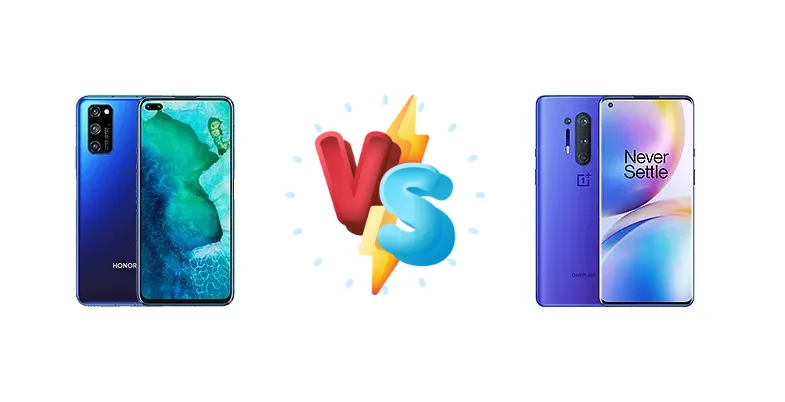
|
🏆 Quick Verdict
For most users, the OnePlus 8 Pro is the superior choice, offering a more refined experience with its Snapdragon 865 chipset and generally better software support. However, the Honor V30 Pro presents a compelling value proposition, particularly for those prioritizing fast charging and a lower upfront cost.
| PHONES | ||
|---|---|---|
| Phone Names | Honor V30 Pro | OnePlus 8 Pro |
| Network | ||
|---|---|---|
| 2G bands | GSM 850 / 900 / 1800 / 1900 | GSM 850 / 900 / 1800 / 1900 |
| 3G bands | HSDPA 800 / 850 / 900 / 1700(AWS) / 1900 / 2100 | HSDPA 800 / 850 / 900 / 1700(AWS) / 1800 / 1900 / 2100 |
| 4G bands | 1, 2, 3, 4, 5, 7, 8, 12, 17, 18, 19, 26, 34, 38, 39, 40, 41 | 1, 2, 3, 4, 5, 7, 8, 12, 13, 17, 18, 19, 20, 25, 26, 28, 32, 34, 38, 39, 40, 41, 42, 46, 66 - EU |
| 5G bands | 1, 3, 41, 77, 78, 79 SA/NSA | 1, 3, 7, 28, 78 SA/NSA - EU |
| Speed | HSPA, LTE, 5G (2+ Gbps DL) | HSPA 42.2/5.76 Mbps, LTE (5CA) Cat18 1200/150 Mbps, 5G 7.5 Gbps DL |
| Technology | GSM / HSPA / LTE / 5G | GSM / CDMA / HSPA / LTE / 5G |
| - | 78 SA/NSA - IN | |
| Launch | ||
|---|---|---|
| Announced | 2019, November. Released 2019, December | 2020, April 14 |
| Status | Discontinued | Available. Released 2020, April 21 |
| Body | ||
|---|---|---|
| Build | Glass front, glass back, aluminum frame | Glass front (Gorilla Glass 5), glass back (Gorilla Glass 5), aluminum frame |
| Dimensions | 162.7 x 75.8 x 8.8 mm (6.41 x 2.98 x 0.35 in) | 165.3 x 74.4 x 8.5 mm (6.51 x 2.93 x 0.33 in) |
| SIM | Nano-SIM + Nano-SIM | Nano-SIM + Nano-SIM |
| Weight | 206 g (7.27 oz) | 199 g (7.02 oz) |
| - | IP68 dust/water resistant | |
| Display | ||
|---|---|---|
| Protection | Yes | Corning Gorilla Glass 5 |
| Resolution | 1080 x 2400 pixels, 20:9 ratio (~400 ppi density) | 1440 x 3168 pixels (~513 ppi density) |
| Size | 6.57 inches, 104.7 cm2 (~84.9% screen-to-body ratio) | 6.78 inches, 111.7 cm2 (~90.8% screen-to-body ratio) |
| Type | IPS LCD | Fluid AMOLED, 1B colors, 120Hz, HDR10+ |
| Platform | ||
|---|---|---|
| CPU | Octa-core (2x2.86 GHz Cortex-A76 & 2x2.36 GHz Cortex-A76 & 4x1.95 GHz Cortex-A55) | Octa-core (1x2.84 GHz Cortex-A77 & 3x2.42 GHz Cortex-A77 & 4x1.80 GHz Cortex-A55) |
| Chipset | Kirin 990 5G (7 nm+) | Qualcomm SM8250 Snapdragon 865 5G (7 nm+) |
| GPU | Mali-G76 MP16 | Adreno 650 |
| OS | Android 10, Magic UI 3, no Google Play Services | Android 10, upgradable to Android 13, OxygenOS 13 |
| Memory | ||
|---|---|---|
| Card slot | No | No |
| Internal | 128GB 8GB RAM, 256GB 8GB RAM | 128GB 8GB RAM, 256GB 12GB RAM |
| UFS 3.0 | UFS 3.0 | |
| Main Camera | ||
|---|---|---|
| Features | Laser AF, LED flash, HDR, panorama | Laser AF, Dual-LED flash, HDR, panorama |
| Quad | - | 48 MP, f/1.8, 25mm (wide), 1/1.43", 1.12µm, multi-directional PDAF, OIS 8 MP, f/2.4, (telephoto), 1/1.0µm, PDAF, OIS, 3x optical zoom 48 MP, f/2.2, 14mm, 116˚ (ultrawide), 1/2.0", 0.8µm, PDAF 5 MP, f/2.4, (Color filter camera) |
| Triple | 40 MP, f/1.6, 27mm (wide), 1/1.7", PDAF, OIS 8 MP, f/2.4, 80mm (telephoto), 1/4.0", PDAF, OIS, 3x optical zoom 12 MP, f/2.2, 16mm (ultrawide), 1.4µm, AF | - |
| Video | 4K@30fps, 1080p@30fps, 720p@960fps, (gyro-EIS) | 4K@30/60fps, 1080p@30/60/240fps, Auto HDR, gyro-EIS |
| Selfie camera | ||
|---|---|---|
| Dual | 32 MP, f/2.0, 26mm (wide), 1/2.8", 0.8µm 8 MP, f/2.2, 17mm (ultrawide) | - |
| Features | HDR | HDR |
| Single | - | 16 MP, f/2.5, (wide), 1/3.06", 1.0µm |
| Video | 4K@30fps, 1080p@30fps | 1080p@30fps, gyro-EIS |
| Sound | ||
|---|---|---|
| 3.5mm jack | No | No |
| 35mm jack | No | No |
| Loudspeaker | Yes | Yes, with stereo speakers |
| Comms | ||
|---|---|---|
| Bluetooth | 5.1, A2DP, LE | 5.1, A2DP, LE, aptX HD |
| Infrared port | Yes | - |
| NFC | Yes | Yes |
| Positioning | GPS (L1+L5), GLONASS, BDS, GALILEO, QZSS | GPS (L1+L5), GLONASS (G1), BDS (B1), GALILEO (E1+E5a) |
| Radio | No | No |
| USB | USB Type-C 2.0, OTG | USB Type-C 3.1, OTG |
| WLAN | Wi-Fi 802.11 a/b/g/n/ac, dual-band, Wi-Fi Direct | Wi-Fi 802.11 a/b/g/n/ac/6, dual-band, Wi-Fi Direct, DLNA |
| Features | ||
|---|---|---|
| Sensors | Fingerprint (side-mounted), accelerometer, gyro, proximity, compass | Fingerprint (under display, optical), accelerometer, gyro, proximity, compass |
| Battery | ||
|---|---|---|
| Charging | 40W wired, 70% in 30 min 27W wireless Reverse wireless | 30W wired, 50% in 23 min 30W wireless, 50% in 30 min 3W reverse wireless |
| Type | Li-Po 4100 mAh, non-removable | Li-Po 4510 mAh, non-removable |
| Misc | ||
|---|---|---|
| Colors | Ocean Blue, Galaxy Black, Icelandic frost | Glacial Green, Ultramarine Blue, Onyx Black |
| Models | OXF-AN10 | IN2023, IN2020, IN2021, IN2025 |
| Price | About 500 EUR | About 310 EUR |
| Pricing | ||
|---|---|---|
| 128GB 8GB RAM | - | $ 428.39 |
| 256GB 12GB RAM | - | $ 853.51 |
| RENEWED | - | $ 486.00 |
| Tests | ||
|---|---|---|
| Battery life | - | Endurance rating 103h |
| Camera | Photo / Video | Photo / Video |
| Display | - | Contrast ratio: Infinite (nominal) |
| Loudspeaker | - | -23.5 LUFS (Very good) |
| Performance | AnTuTu: 381241 (v7), 500571 (v8) GeekBench: 12824 (v4.4), 3204 (v5.1) GFXBench: 35fps (ES 3.1 onscreen) | AnTuTu: 573276 (v8) GeekBench: 3374 (v5.1) GFXBench: 24fps (ES 3.1 onscreen) |
Honor V30 Pro
- Significantly faster wired charging (40W)
- Faster wireless charging (27W)
- More affordable price point
- Reverse wireless charging
- Lower peak display brightness
- Potentially limited software support
- Less powerful chipset
- Uncertain camera performance
OnePlus 8 Pro
- Superior performance with Snapdragon 865
- Smoother display with 120Hz refresh rate
- Better software support and updates
- Generally more refined camera system
- Higher price
- Slower wired charging (30W)
- Limited reverse wireless charging (3W)
- Can run warmer under sustained load
Display Comparison
Both phones utilize 7nm+ fabrication, but diverge significantly in display characteristics. The OnePlus 8 Pro boasts an 'Infinite' contrast ratio, typical of OLED panels, while the Honor V30 Pro achieves a 1230:1 contrast ratio. More critically, the Honor V30 Pro’s display peaks at 534 nits, significantly lower than what’s expected from a flagship in 2020, impacting outdoor visibility. While both offer vibrant colors, the OnePlus 8 Pro’s display is likely to provide a more immersive and readable experience in bright conditions. The OnePlus 8 Pro also benefits from a 120Hz refresh rate, absent on the V30 Pro, resulting in smoother scrolling and animations.
Camera Comparison
Both devices feature versatile camera systems, but details beyond 'Photo/Video' capabilities are limited. The OnePlus 8 Pro’s camera system, known for its color science and dynamic range, likely benefits from Qualcomm’s image signal processor (ISP) within the Snapdragon 865. Without specific sensor size or aperture information for the V30 Pro, it’s difficult to make a direct comparison. However, OnePlus’s reputation for computational photography suggests a more refined image processing pipeline. The absence of detailed camera specs for the V30 Pro makes a definitive assessment challenging, but the OnePlus 8 Pro is generally considered to have a more capable and consistent camera system.
Performance
The core difference lies in the chipsets: the Honor V30 Pro features the Kirin 990 5G, while the OnePlus 8 Pro utilizes the Qualcomm Snapdragon 865 5G. Both are 7nm+ chips, but the Snapdragon 865’s Cortex-A77 prime core (2.84 GHz) offers a slight architectural advantage over the Kirin 990’s Cortex-A76 (2.86 GHz). The Snapdragon 865 also benefits from Qualcomm’s Adreno 650 GPU, providing superior graphics performance. While the Kirin 990 is no slouch, the Snapdragon 865 delivers a more consistent and powerful experience, particularly in demanding games and applications. The OnePlus 8 Pro’s availability with 12GB of RAM, paired with LPDDR5, further enhances multitasking capabilities.
Battery Life
The OnePlus 8 Pro boasts an endurance rating of 103 hours, indicating solid battery life. The Honor V30 Pro’s battery capacity is not specified, but its charging capabilities are a standout feature. It supports 40W wired charging, achieving 70% charge in just 30 minutes, and 27W wireless charging, reaching 50% in 30 minutes. The OnePlus 8 Pro offers 30W wired charging (50% in 23 minutes) and 30W wireless charging (50% in 30 minutes). While the OnePlus 8 Pro has comparable endurance, the Honor V30 Pro’s faster wired charging is a significant advantage for users who prioritize quick top-ups. The V30 Pro also includes reverse wireless charging, a feature present but limited to 3W on the OnePlus 8 Pro.
Buying Guide
Buy the Honor V30 Pro if you need exceptionally fast 40W wired and 27W wireless charging, and are comfortable with the potential for limited software updates and a less polished user experience. Buy the OnePlus 8 Pro if you prioritize raw performance, a smoother software experience with OxygenOS, and a longer lifespan of software support, even if it comes at a higher price.