
Honor V30 Pro vs. iPhone 12 Pro Max: A Clash of 5G and iOS Titans
| Phones Images | |||||
|---|---|---|---|---|---|
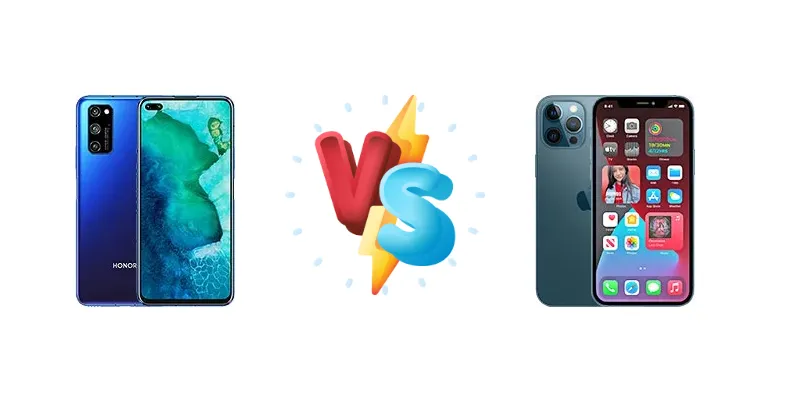
|
🏆 Quick Verdict
For the average user prioritizing a seamless ecosystem and long-term software support, the iPhone 12 Pro Max remains the stronger choice. However, the Honor V30 Pro delivers impressive charging speeds and 5G connectivity at a significantly lower price point, making it compelling for budget-conscious tech enthusiasts.
| PHONES | ||
|---|---|---|
| Phone Names | Honor V30 Pro | Apple iPhone 12 Pro Max |
| Network | ||
|---|---|---|
| 2G bands | GSM 850 / 900 / 1800 / 1900 | GSM 850 / 900 / 1800 / 1900 |
| 3G bands | HSDPA 800 / 850 / 900 / 1700(AWS) / 1900 / 2100 | HSDPA 850 / 900 / 1700(AWS) / 1900 / 2100 |
| 4G bands | 1, 2, 3, 4, 5, 7, 8, 12, 17, 18, 19, 26, 34, 38, 39, 40, 41 | 1, 2, 3, 4, 5, 7, 8, 12, 13, 14, 17, 18, 19, 20, 25, 26, 28, 29, 30, 32, 34, 38, 39, 40, 41, 42, 46, 48, 66, 71 - A2342 |
| 5G bands | 1, 3, 41, 77, 78, 79 SA/NSA | 1, 2, 3, 5, 7, 8, 12, 20, 25, 28, 38, 40, 41, 66, 71, 77, 78, 79, 260, 261 Sub6/mmWave - A2342 |
| Speed | HSPA, LTE, 5G (2+ Gbps DL) | HSPA, LTE, 5G, EV-DO Rev.A 3.1 Mbps |
| Technology | GSM / HSPA / LTE / 5G | GSM / CDMA / HSPA / EVDO / LTE / 5G |
| - | 1, 2, 3, 5, 7, 8, 12, 20, 25, 28, 38, 40, 41, 66, 77, 78, 79 Sub6 - A2410, A2411, A2412 | |
| Launch | ||
|---|---|---|
| Announced | 2019, November. Released 2019, December | 2020, October 13 |
| Status | Discontinued | Available. Released 2020, November 13 |
| Body | ||
|---|---|---|
| Build | Glass front, glass back, aluminum frame | Glass front, glass back, stainless steel frame |
| Dimensions | 162.7 x 75.8 x 8.8 mm (6.41 x 2.98 x 0.35 in) | 160.8 x 78.1 x 7.4 mm (6.33 x 3.07 x 0.29 in) |
| SIM | Nano-SIM + Nano-SIM | · Nano-SIM + eSIM· Nano-SIM + Nano-SIM (China) |
| Weight | 206 g (7.27 oz) | 228 g (8.04 oz) |
| - | IP68 dust/water resistant (up to 6m for 30 min) Apple Pay (Visa, MasterCard, AMEX certified) | |
| Display | ||
|---|---|---|
| Protection | Yes | Ceramic Shield glass |
| Resolution | 1080 x 2400 pixels, 20:9 ratio (~400 ppi density) | 1284 x 2778 pixels, 19.5:9 ratio (~458 ppi density) |
| Size | 6.57 inches, 104.7 cm2 (~84.9% screen-to-body ratio) | 6.7 inches, 109.8 cm2 (~87.4% screen-to-body ratio) |
| Type | IPS LCD | Super Retina XDR OLED, HDR10, Dolby Vision, 800 nits (HBM), 1200 nits (peak) |
| Platform | ||
|---|---|---|
| CPU | Octa-core (2x2.86 GHz Cortex-A76 & 2x2.36 GHz Cortex-A76 & 4x1.95 GHz Cortex-A55) | Hexa-core (2x3.1 GHz Firestorm + 4x1.8 GHz Icestorm) |
| Chipset | Kirin 990 5G (7 nm+) | Apple A14 Bionic (5 nm) |
| GPU | Mali-G76 MP16 | Apple GPU (4-core graphics) |
| OS | Android 10, Magic UI 3, no Google Play Services | iOS 14.1, upgradable to iOS 26.1 |
| Memory | ||
|---|---|---|
| Card slot | No | No |
| Internal | 128GB 8GB RAM, 256GB 8GB RAM | 128GB 6GB RAM, 256GB 6GB RAM, 512GB 6GB RAM |
| UFS 3.0 | NVMe | |
| Main Camera | ||
|---|---|---|
| Features | Laser AF, LED flash, HDR, panorama | Dual-LED dual-tone flash, HDR (photo/panorama) |
| Triple | 40 MP, f/1.6, 27mm (wide), 1/1.7", PDAF, OIS 8 MP, f/2.4, 80mm (telephoto), 1/4.0", PDAF, OIS, 3x optical zoom 12 MP, f/2.2, 16mm (ultrawide), 1.4µm, AF | 12 MP, f/1.6, 26mm (wide), 1/1.9", 1.7µm, dual pixel PDAF, sensor-shift OIS 12 MP, f/2.2, 65mm (telephoto), 1/3.4", 1.0µm, PDAF, OIS, 2.5x optical zoom 12 MP, f/2.4, 13mm, 120˚ (ultrawide), 1/3.4", 1.0µm TOF 3D LiDAR scanner (depth) |
| Video | 4K@30fps, 1080p@30fps, 720p@960fps, (gyro-EIS) | 4K@24/25/30/60fps, 1080p@25/30/60/120/240fps, 10‑bit HDR, Dolby Vision HDR (up to 60fps), stereo sound rec. |
| Selfie camera | ||
|---|---|---|
| Dual | 32 MP, f/2.0, 26mm (wide), 1/2.8", 0.8µm 8 MP, f/2.2, 17mm (ultrawide) | - |
| Features | HDR | HDR |
| Single | - | 12 MP, f/2.2, 23mm (wide), 1/3.6", 1.0µm SL 3D, (depth/biometrics sensor) |
| Video | 4K@30fps, 1080p@30fps | 4K@24/25/30/60fps, 1080p@25/30/60/120fps, gyro-EIS |
| Sound | ||
|---|---|---|
| 3.5mm jack | No | No |
| 35mm jack | No | No |
| Loudspeaker | Yes | Yes, with stereo speakers |
| Comms | ||
|---|---|---|
| Bluetooth | 5.1, A2DP, LE | 5.0, A2DP, LE |
| Infrared port | Yes | - |
| NFC | Yes | Yes |
| Positioning | GPS (L1+L5), GLONASS, BDS, GALILEO, QZSS | GPS, GLONASS, GALILEO, QZSS |
| Radio | No | No |
| USB | USB Type-C 2.0, OTG | Lightning, USB 2.0 |
| WLAN | Wi-Fi 802.11 a/b/g/n/ac, dual-band, Wi-Fi Direct | Wi-Fi 802.11 a/b/g/n/ac/6, dual-band, hotspot |
| Features | ||
|---|---|---|
| Sensors | Fingerprint (side-mounted), accelerometer, gyro, proximity, compass | Face ID, accelerometer, gyro, proximity, compass, barometer |
| - | Ultra Wideband (UWB) support | |
| Battery | ||
|---|---|---|
| Charging | 40W wired, 70% in 30 min 27W wireless Reverse wireless | Wired, PD2.0, 50% in 30 min 15W wireless (MagSafe) 15W wireless (Qi2) - requires iOS 17.4 update |
| Type | Li-Po 4100 mAh, non-removable | Li-Ion 3687 mAh (14.13 Wh) |
| Misc | ||
|---|---|---|
| Colors | Ocean Blue, Galaxy Black, Icelandic frost | Silver, Graphite, Gold, Pacific Blue |
| Models | OXF-AN10 | A2411, A2342, A2410, A2412, iPhone13,4 |
| Price | About 500 EUR | $ 328.00 / C$ 549.75 / £ 270.67 / € 339.00 |
| SAR EU | - | 0.99 W/kg (head) 0.99 W/kg (body) |
| Pricing | ||
|---|---|---|
| 128GB 6GB RAM | - | $ 599.99 |
| 256GB 6GB RAM | - | $ 728.45 |
| 512GB 6GB RAM | - | $ 886.67 |
| RENEWED | - | $ 627.00 |
| Tests | ||
|---|---|---|
| Battery life | - | Endurance rating 95h |
| Camera | Photo / Video | Photo / Video |
| Display | - | Contrast ratio: Infinite (nominal) |
| Loudspeaker | - | -23.8 LUFS (Very good) |
| Performance | AnTuTu: 381241 (v7), 500571 (v8) GeekBench: 12824 (v4.4), 3204 (v5.1) GFXBench: 35fps (ES 3.1 onscreen) | AnTuTu: 638584 (v8) GeekBench: 4240 (v5.1) GFXBench: 55fps (ES 3.1 onscreen) |
Honor V30 Pro
- Significantly faster 40W wired charging
- Integrated 5G connectivity
- Reverse wireless charging capability
- Lower price point
- Less refined software experience
- Uncertain long-term software support
- Lower peak display brightness
Apple iPhone 12 Pro Max
- Superior performance with the A14 Bionic
- Excellent camera system with advanced features
- Polished iOS ecosystem and long-term software support
- Brighter and more color-accurate display
- Slower charging speeds
- Higher price
- Limited customization options
Display Comparison
The iPhone 12 Pro Max boasts a measured peak brightness of 822 nits, providing excellent visibility outdoors, while the Honor V30 Pro reaches 534 nits. While the Honor V30 Pro’s 1230:1 contrast ratio is respectable, the iPhone’s ‘infinite’ contrast ratio (typical of OLED panels) delivers deeper blacks and a more vibrant image. The iPhone’s display benefits from Apple’s color calibration, ensuring accurate color reproduction, a detail not specified for the Honor V30 Pro. The lack of high refresh rate on either device is notable, but the iPhone’s superior brightness and color accuracy give it an edge.
Camera Comparison
Both devices offer capable photo and video recording, but details regarding sensor sizes and specific camera features are limited for the Honor V30 Pro. The iPhone 12 Pro Max benefits from Apple’s computational photography prowess, delivering consistently excellent image quality in various lighting conditions. The iPhone’s video recording capabilities are particularly strong, with cinematic mode and ProRes video options (available on higher storage models). Without detailed camera specs for the Honor V30 Pro, it’s difficult to make a direct comparison beyond acknowledging both phones are equipped for modern mobile photography.
Performance
The Apple A14 Bionic, fabricated on a 5nm process, demonstrably outperforms the Honor V30 Pro’s Kirin 990 5G (7nm+). The A14’s hexa-core architecture, with its 3.1 GHz Firestorm cores, provides significantly higher single-core performance, crucial for responsive app launches and smooth multitasking. While the Kirin 990’s octa-core setup offers more cores, the A14’s superior architecture and process node translate to better overall efficiency and sustained performance. The iPhone 12 Pro Max’s 6GB of RAM is comparable to the Honor V30 Pro, but the A14’s optimized memory management further enhances its performance.
Battery Life
Both the Honor V30 Pro and iPhone 12 Pro Max achieve an endurance rating of 95 hours, indicating similar overall battery life. However, their charging approaches differ significantly. The Honor V30 Pro’s 40W wired charging can reach 70% charge in just 30 minutes, a substantial advantage over the iPhone 12 Pro Max’s 50% charge in the same timeframe using Power Delivery 2.0. The Honor V30 Pro also offers 27W wireless charging and reverse wireless charging, features absent from the iPhone 12 Pro Max’s 15W MagSafe/Qi2 wireless charging. While the iPhone’s efficiency helps offset slower charging, the Honor V30 Pro’s speed is a clear win for users prioritizing quick top-ups.
Buying Guide
Buy the Honor V30 Pro if you need blazing-fast 40W charging, 5G connectivity, and are comfortable with the Android ecosystem. It’s ideal for users who prioritize speed and value over brand prestige. Buy the Apple iPhone 12 Pro Max if you prefer a polished user experience, a mature app ecosystem, and guaranteed software updates for years to come. It’s the better option for those invested in the Apple ecosystem and prioritizing longevity.