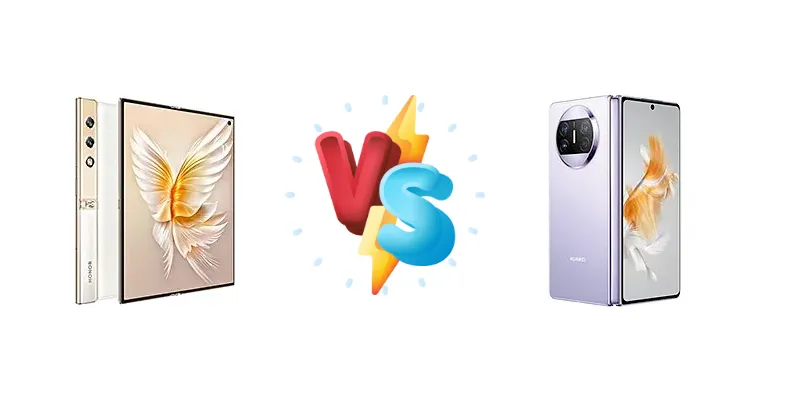
The foldable phone market is maturing, offering increasingly refined experiences. We pit the Honor V Purse, a more accessibly priced foldable, against the premium Huawei Mate X3, a flagship boasting top-tier specs. This comparison dissects their key differences to help you determine which foldable best suits your needs and budget.
🏆 Quick Verdict
For most users, the Huawei Mate X3 emerges as the superior choice. Its Snapdragon 8+ Gen 1 chipset delivers significantly faster performance, complemented by 66W wired and 50W wireless charging. While the Honor V Purse offers a unique aesthetic, the Mate X3’s raw power and charging capabilities justify its higher price.
| Network |
|---|
| 2G bands | GSM 850 / 900 / 1800 / 1900 | GSM 850 / 900 / 1800 / 1900 |
| 3G bands | HSDPA 800 / 850 / 900 / 2100 | HSDPA 800 / 850 / 900 / 1700(AWS) / 1900 / 2100 |
| 4G bands | 1, 3, 4, 45, 8, 19, 28, 34, 38, 39, 40, 41 | 1, 2, 3, 4, 5, 7, 8, 12, 17, 18, 19, 20, 26, 28, 34, 38, 39, 40, 41 |
| 5G bands | 1, 5, 8, 28, 41, 78 SA/NSA | - |
| Speed | HSPA, LTE, 5G | HSPA, LTE |
| Technology | GSM / CDMA / HSPA / CDMA2000 / LTE / 5G | GSM / CDMA / HSPA / EVDO / LTE |
| | - | CDMA2000 1xEV-DO |
| Launch |
|---|
| Announced | 2023, September 19 | 2023, March 23 |
| Status | Available. Released 2023, September 19 | Available. Released 2023, April 08 |
| Body |
|---|
| Build | - | Glass front, glass back or eco leather back, aluminum frame |
| Dimensions | Unfolded: 156.5 x 135.6 x 4.3 mmFolded: 156.5 x 74.7 x 8.6 mm | Unfolded: 156.9 x 141.5 x 5.3 mmFolded: 156.9 x 72.4 x 11.1 mm |
| SIM | Nano-SIM + Nano-SIM | Nano-SIM + Nano-SIM |
| Weight | 214 g (7.55 oz) | 239 g or 241 g (8.43 oz) |
| | - | IPX8 dust/water resistant (up to 1.5m for 30 min) |
| Display |
|---|
| Protection | - | Kunlun Glass (cover display only) |
| Resolution | 2016 x 2348 pixels (~401 ppi density) | 2224 x 2496 pixels (~426 ppi density) |
| Size | 7.71 inches, 189.5 cm2 (~89.3% screen-to-body ratio) | 7.85 inches, 197.5 cm2 (~88.9% screen-to-body ratio) |
| Type | Foldable OLED, 1B colors, 90Hz, 1600 nits (peak) | Foldable OLED, 1B colors, 120Hz |
| | - | Cover display:
OLED, 120Hz, 6.4 inches, 1080 x 2504 pixels |
| Platform |
|---|
| CPU | Octa-core (4x2.4 GHz Cortex-A78 & 4x1.8 GHz Cortex-A55) | Octa-core (1x3.19 GHz Cortex-X2 & 3x2.75 GHz Cortex-A710 & 4x2.0 GHz Cortex-A510) |
| Chipset | Qualcomm SM7325 Snapdragon 778G 5G (6 nm) | Qualcomm SM8475 Snapdragon 8+ Gen 1 4G (4 nm) |
| GPU | Adreno 642L | Adreno 730 |
| OS | Android 13, MagicOS 7.2 | HarmonyOS 3.1 (China), EMUI 13.1 (Europe), no Google Play Services |
| Memory |
|---|
| Card slot | No | Nano Memory (uses shared SIM slot) |
| Internal | 256GB 16GB RAM, 512GB 16GB RAM | 256GB 12GB RAM, 512GB 12GB RAM, 1TB 12GB RAM |
| | - | UFS |
| Main Camera |
|---|
| Dual | 50 MP, f/1.9, (wide), PDAF
12 MP, f/2.2, 120˚ (ultrawide) | - |
| Features | LED flash, panorama, HDR | Laser AF, color spectrum sensor, LED flash, panorama, HDR |
| Triple | - | 50 MP, f/1.8, 23mm (wide), PDAF, OIS
12 MP, f/3.4, 125mm (periscope telephoto), PDAF, OIS, 5x optical zoom
13 MP, f/2.2, 13mm (ultrawide), AF |
| Video | 4K@30fps, 1080p@30fps | 4K@30/60fps, 1080p@30/60fps, gyro-EIS |
| Selfie camera |
|---|
| Features | - | HDR, panorama |
| Single | 8 MP, f/2.0, (wide) | 8 MP, f/2.4, (wide)
Cover camera:
8 MP, f/2.4, (wide) |
| Video | 1080p@30fps | 4K@30fps, 1080p@30fps |
| Sound |
|---|
| 3.5mm jack | - | No |
| 35mm jack | No | No |
| Loudspeaker | Yes, with stereo speakers | Yes, with stereo speakers |
| Comms |
|---|
| Bluetooth | 5.2, A2DP, LE, aptX HD | 5.2, A2DP, LE |
| Infrared port | - | Yes |
| NFC | Yes | Yes |
| Positioning | GPS, GLONASS, GALILEO, BDS | GPS (L1+L5), GLONASS (B1I+B1c+B2a), BDS (B1I+B1c+B2a), GALILEO (E1+E5a), QZSS (L1+L5), NavIC |
| Radio | No | No |
| USB | USB Type-C 2.0, OTG | USB Type-C 3.1, DisplayPort 1.2, OTG |
| WLAN | Wi-Fi 802.11 a/b/g/n/ac/6, dual-band, Wi-Fi Direct | Wi-Fi 802.11 a/b/g/n/ac/6, dual-band, Wi-Fi Direct |
| Features |
|---|
| Sensors | Fingerprint (side-mounted), accelerometer, gyro, proximity, compass | Fingerprint (side-mounted), accelerometer, gyro, proximity, compass, barometer, altimeter |
| | - | BDS Satellite Message |
| Battery |
|---|
| Charging | 35W wired
5W reverse wired | 66W wired
50W wireless
7.5W reverse wireless |
| Type | Li-Po 4500 mAh | Market-dependent versions:· Li-Po 4800 mAh (Global)· Si/C Li-Ion 5060 mAh (China only) |
| Misc |
|---|
| Colors | Black, Gold, Blue | Black, White, Violet, Dark Green, Gold |
| Models | VCA-AN00 | ALT-AL00, ALT-L29 |
| Price | About 770 EUR | About 1500 EUR |
| Tests |
|---|
| Battery life | - |
Endurance rating 81h
|
| Camera | - |
Photo / Video |
| Display | - |
Contrast ratio: Infinite (nominal) |
| Loudspeaker | - |
-26.3 LUFS (Good)
|
| Performance | - |
AnTuTu: 993592 (v9)
GeekBench: 4283 (v5.5), 4512 (v6)
GFXBench: 41fps (ES 3.1 onscreen) |
Honor V Purse
- Unique 'purse' design offers a distinct aesthetic.
- More affordable price point makes it accessible to a wider audience.
- Compact folded form factor enhances portability.
- Snapdragon 778G chipset offers significantly lower performance.
- Slower 35W charging limits convenience.
- Limited camera details suggest a less capable system.
Huawei Mate X3
- Snapdragon 8+ Gen 1 delivers flagship-level performance.
- 66W wired and 50W wireless charging provide rapid power-ups.
- Higher peak brightness and infinite contrast ratio enhance display quality.
- Higher price point may be prohibitive for some users.
- Larger size when unfolded may be less convenient for one-handed use.
- 4G connectivity limits data speeds in some regions.
Display Comparison
The Huawei Mate X3 boasts a measured peak brightness of 926 nits, suggesting a more visible outdoor experience compared to the Honor V Purse, for which brightness data is unavailable. While both utilize folding OLED panels, the Mate X3’s infinite contrast ratio (nominal) indicates deeper blacks and a more vibrant image. The V Purse’s smaller form factor when folded may appeal to those prioritizing pocketability, but the Mate X3’s larger unfolded display offers a more immersive viewing experience. Details regarding refresh rates and panel technology (LTPO) are missing for both, but the Mate X3’s higher price point suggests a potentially more advanced panel.
Camera Comparison
Both devices feature photo and video capabilities, but detailed camera specifications are lacking. Without sensor size or aperture information, a direct comparison is difficult. However, given the Mate X3’s flagship positioning, it likely incorporates a more sophisticated camera system with larger sensors and advanced image processing algorithms. The Honor V Purse, targeting a more budget-conscious segment, likely features a more modest camera setup. The absence of details regarding OIS (Optical Image Stabilization) on either device makes it impossible to assess low-light performance or video stabilization capabilities.
Performance
The core difference lies in the chipsets. The Huawei Mate X3’s Snapdragon 8+ Gen 1 4G (4nm) significantly outperforms the Honor V Purse’s Snapdragon 778G 5G (6nm). The 8+ Gen 1 features a Cortex-X2 prime core clocked at 3.19 GHz, alongside Cortex-A710 and A510 cores, providing a substantial leap in CPU and GPU performance. The 778G’s Cortex-A78 and A55 cores are capable, but geared towards efficiency rather than outright speed. This translates to smoother multitasking, faster app loading times, and superior gaming performance on the Mate X3. The 4nm process node of the 8+ Gen 1 also contributes to better thermal efficiency, minimizing throttling during sustained workloads.
Battery Life
Both devices share an endurance rating of 81 hours, suggesting comparable battery life under similar usage conditions. However, the Mate X3’s charging capabilities are far superior. It supports 66W wired charging, 50W wireless charging, and 7.5W reverse wireless charging, allowing for significantly faster top-ups. The Honor V Purse is limited to 35W wired charging and 5W reverse wired charging. This means the Mate X3 can go from 0-100% much quicker, and its wireless charging option provides added convenience.
Buying Guide
Buy the Honor V Purse if you prioritize a unique, purse-like design and are comfortable with mid-range performance for everyday tasks. It’s ideal for users who value style and portability over raw power. Buy the Huawei Mate X3 if you demand flagship-level performance for demanding applications, gaming, and content creation, and appreciate faster charging speeds and a more established foldable experience.
Frequently Asked Questions
❓ Does the Snapdragon 8+ Gen 1 in the Mate X3 suffer from significant thermal throttling during extended gaming sessions?
While the Snapdragon 8+ Gen 1 was known to run warm, the Mate X3’s larger chassis and potentially improved cooling solutions should mitigate throttling compared to smaller devices. The 4nm process node also contributes to better thermal efficiency, allowing for sustained performance during demanding tasks.
❓ Is the Honor V Purse’s 35W charging speed slow enough to be a major inconvenience in daily use?
35W charging is adequate for overnight charging, but significantly slower than the Mate X3’s 66W wired and 50W wireless options. Users who frequently need to quickly top up their battery may find the slower charging speed frustrating.
❓ Given the lack of detailed camera specs, what can we reasonably expect from the Honor V Purse’s camera performance?
Based on its mid-range positioning, the Honor V Purse likely features a capable but not exceptional camera system. Expect decent image quality in good lighting conditions, but potentially struggles in low-light scenarios. Don't expect features like advanced zoom capabilities or highly detailed image processing.
❓ Does the Huawei Mate X3 support 5G connectivity, or is it limited to 4G due to the chipset?
The Huawei Mate X3 utilizes a 4G variant of the Snapdragon 8+ Gen 1. This means it is limited to 4G LTE connectivity and does not support 5G networks. This is a significant drawback for users in areas with 5G coverage.