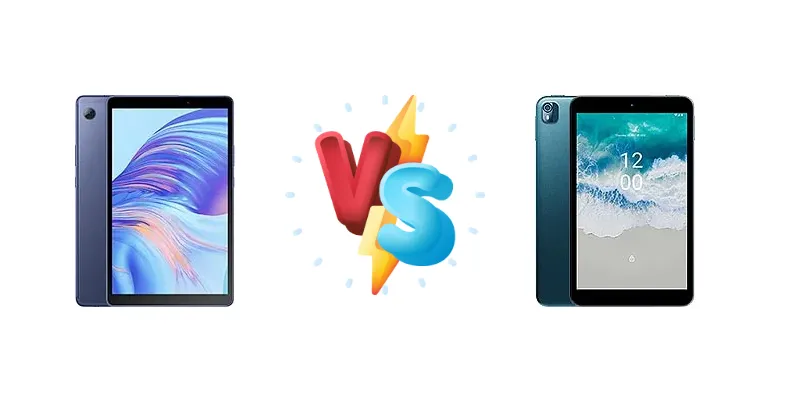
The Honor Tablet X7 and Nokia T10 represent the entry-level Android tablet space, catering to users seeking affordability without completely sacrificing functionality. Both devices aim to provide a capable experience for media consumption, light productivity, and casual gaming, but they achieve this with different hardware approaches. This comparison dissects their key specifications to determine which tablet delivers the best value.
🏆 Quick Verdict
For most users, the Nokia T10 emerges as the slightly better choice. While both tablets share 10W charging, the Nokia T10’s Unisoc T606 chipset, built on a more efficient 12nm process, offers a noticeable performance advantage over the Honor X7’s older Mediatek Helio P22T, making it better suited for multitasking and demanding apps.
| Network |
|---|
| 2G bands | GSM 850 / 900 / 1800 / 1900 | GSM 850 / 900 / 1800 / 1900 |
| 3G bands | HSDPA 800 / 850 / 900 / 1900 / 2100 | HSDPA 850 / 900 / 2100 |
| 4G bands | 1, 3, 5, 7, 8, 18, 19, 20, 26, 28, 38, 40, 41 | 1, 3, 5, 7, 8, 20, 28, 38, 40, 41 |
| Speed | HSPA, LTE - cellular model only | HSPA 42.2/5.76 Mbps, LTE Cat4 150/50 Mbps |
| Technology | GSM / HSPA / LTE | GSM / HSPA / LTE |
| Launch |
|---|
| Announced | 2021, May 07 | 2022, July 12 |
| Status | Available. Released 2021, May 07 | Available. Released 2022, August 20 |
| Body |
|---|
| Build | - | Glass front, plastic back, plastic frame |
| Dimensions | 199.7 x 121.1 x 8.5 mm (7.86 x 4.77 x 0.33 in) | 208 x 123.2 x 9 mm (8.19 x 4.85 x 0.35 in) |
| SIM | Nano-SIM (cellular model only) | Nano-SIM |
| Weight | 325 g (11.46 oz) | 375 g (13.23 oz) |
| | Stylus support | Splash resistant |
| Display |
|---|
| Resolution | 800 x 1280 pixels, 16:10 ratio (~189 ppi density) | 800 x 1280 pixels, 16:10 ratio (~189 ppi density) |
| Size | 8.0 inches, 185.6 cm2 (~76.7% screen-to-body ratio) | 8.0 inches, 185.6 cm2 (~72.4% screen-to-body ratio) |
| Type | IPS LCD, 300 nits (typ) | IPS LCD, 360 nits (typ), 450 nits (peak) |
| Platform |
|---|
| CPU | Octa-core (4x2.3 GHz Cortex-A53 & 4x1.8 GHz Cortex-A53) | Octa-core (2x1.6 GHz Cortex-A75 & 6x1.6 GHz Cortex-A55) |
| Chipset | Mediatek MT8768T Helio P22T | Unisoc T606 (12 nm) |
| GPU | PowerVR GE8320 | Mali-G57 MP1 |
| OS | Android 10, Magic UI 4.0, no Google Play Services | Android 12, upgradable to Android 13 |
| Memory |
|---|
| Card slot | microSDXC | microSDXC |
| Internal | 32GB 3GB RAM | 32GB 3GB RAM, 64GB 4GB RAM |
| | eMMC 5.1 | - |
| Main Camera |
|---|
| Features | HDR, panorama | LED flash |
| Single | 5 MP, f/2.2, AF | 8 MP, 1/4.0", 1.12µm, AF |
| Video | 1080p@30fps | 1080p |
| Selfie camera |
|---|
| Single | 2 MP, f/2.4 | 2 MP, 1/5.0", 1.65µm |
| Video | 720p@30fps | 720p |
| Sound |
|---|
| 3.5mm jack | Yes | Yes |
| 35mm jack | Yes | Yes |
| Loudspeaker | Yes | Yes, with stereo speakers |
| Comms |
|---|
| Bluetooth | 5.1, A2DP, LE | 5.0, A2DP, LE |
| NFC | No | No |
| Positioning | GPS, GLONASS, GALILEO, BDS - cellular model only | GPS, GLONASS, GALILEO |
| Radio | No | No |
| USB | microUSB 2.0, OTG | USB Type-C 2.0, OTG |
| WLAN | Wi-Fi 802.11 a/b/g/n/ac, dual-band, Wi-Fi Direct | Wi-Fi 802.11 a/b/g/n/ac, dual-band |
| Features |
|---|
| Sensors | Accelerometer | Accelerometer, proximity |
| Battery |
|---|
| Charging | 10W wired | 10W wired |
| Type | Li-Po 5100 mAh | Li-Po 5250 mAh |
| Misc |
|---|
| Colors | Dark Blue | Ocean Blue |
| Models | KOB2-W09HN | TA-1503, TA-1472, TA-1462, TA-1457 |
| Price | About 120 EUR | About 160 EUR |
| SAR | - | 1.19 W/kg (body) |
| SAR EU | - | 0.27 W/kg (head) 1.57 W/kg (body) |
Honor Tablet X7
- Potentially lower price point.
- Simple and straightforward Android experience.
- Suitable for very basic tasks.
- Older, less efficient chipset.
- Likely slower performance in multitasking.
- Inferior CPU architecture compared to the Nokia T10.
Nokia T10
- More modern and efficient Unisoc T606 chipset.
- Improved CPU architecture for better responsiveness.
- Better suited for multitasking and demanding apps.
- 12nm process node for improved power efficiency.
- May be slightly more expensive.
- 10W charging remains slow.
- Camera performance is likely similar to the Honor X7.
Display Comparison
Neither Honor nor Nokia provide display specifications beyond resolution in their marketing materials. However, given the price points, both likely utilize IPS LCD panels. The absence of details like peak brightness or color gamut coverage suggests neither tablet will excel in outdoor visibility or color accuracy. Bezels are expected to be substantial on both devices, reflecting their budget nature. The display experience will likely be similar, prioritizing affordability over visual fidelity.
Camera Comparison
Both tablets are unlikely to impress in the camera department. Given the target market, camera quality is not a priority. Details are scarce, but it’s safe to assume both feature basic sensors suitable for casual snapshots in good lighting conditions. Focusing on sensor size or aperture is irrelevant given the likely image quality. Image processing will likely be minimal, resulting in images lacking detail and dynamic range. Neither tablet should be considered for serious photography.
Performance
The core difference lies in the chipsets. The Nokia T10’s Unisoc T606, fabricated on a 12nm process, features a more modern CPU architecture with 2x Cortex-A75 cores alongside 6x Cortex-A55 cores, clocked at 1.6 GHz. This contrasts with the Honor X7’s Mediatek Helio P22T, utilizing 4x Cortex-A53 cores at 2.3 GHz and 4x Cortex-A53 cores at 1.8 GHz. While the P22T’s higher clock speeds might seem advantageous, the older architecture and less efficient process node mean the T606 will likely deliver superior sustained performance and better power efficiency. The T606’s Cortex-A75 cores provide a significant boost in single-core performance, crucial for app responsiveness. The Nokia T10 will handle multitasking and moderately demanding apps with greater ease.
Battery Life
Both the Honor Tablet X7 and Nokia T10 are equipped with 10W wired charging, indicating a similar charging experience. While battery capacity isn’t specified, the Unisoc T606’s superior power efficiency in the Nokia T10 could translate to slightly longer battery life despite potentially similar capacity. Expect a full charge to take well over 3 hours in both cases, and battery life to be dependent on usage patterns – heavy gaming or video streaming will drain the battery considerably faster.
Buying Guide
Buy the Honor Tablet X7 if your primary use case revolves around extremely basic tasks like reading ebooks, light web browsing, and infrequent video playback, and you prioritize a potentially lower initial cost. Buy the Nokia T10 if you need a tablet capable of handling more demanding applications, smoother multitasking, and a more responsive user experience, even if it means a slightly higher price point. The Nokia T10 is the better all-rounder.
Frequently Asked Questions
❓ Will the Nokia T10 handle multiple apps running simultaneously without significant slowdown?
The Nokia T10’s Unisoc T606 chipset, with its Cortex-A75 cores, is better equipped for multitasking than the Honor X7’s Helio P22T. While it won’t rival flagship performance, you should experience smoother app switching and less lag when running several apps concurrently.
❓ Is the Unisoc T606 chipset known for overheating under sustained load, like during gaming?
The Unisoc T606 is generally considered to be thermally efficient for its class. While it may experience some throttling during extended gaming sessions, it’s unlikely to overheat to the point of causing performance issues or discomfort. The 12nm process contributes to better heat management compared to older, larger node chipsets.
❓ Can either of these tablets reliably handle video conferencing for work or school?
Both tablets *can* handle video conferencing, but the Nokia T10 will provide a more stable experience. The more powerful processor will reduce the likelihood of dropped frames or audio issues during calls, especially when other apps are running in the background.
❓ What type of storage do these tablets use, and is it expandable?
While not explicitly stated, both tablets likely utilize eMMC storage to keep costs down. Expandability via microSD card is a common feature in this price segment and is highly probable for both the Honor X7 and Nokia T10, allowing users to increase storage capacity.