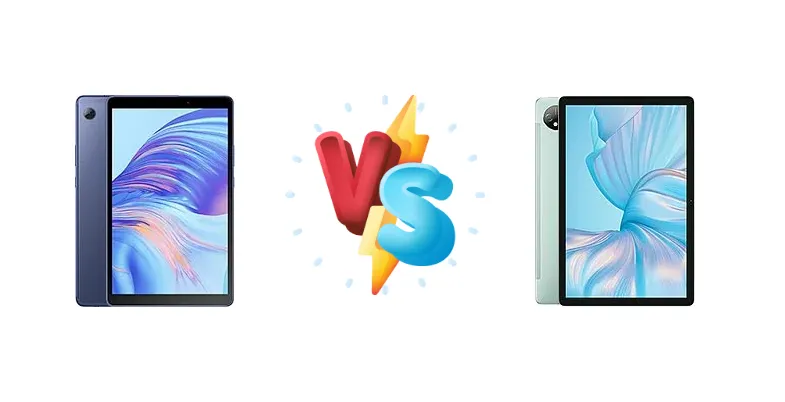
The budget tablet market is fiercely competitive, and the Honor Tablet X7 and Blackview Tab 80 represent compelling options for users seeking affordable entertainment and productivity. Both tablets aim to deliver a functional experience without breaking the bank, but they achieve this through different approaches to chipset selection and core architecture. This comparison will dissect those differences to determine which tablet offers the best value.
🏆 Quick Verdict
For the average user prioritizing everyday tasks like web browsing, video streaming, and light productivity, the Blackview Tab 80 edges out the Honor Tablet X7. The Unisoc T606’s more modern Cortex-A75 cores provide a noticeable performance uplift in responsiveness and multitasking, despite both devices sharing the same 10W charging.
| Network |
|---|
| 2G bands | GSM 850 / 900 / 1800 / 1900 | GSM 850 / 900 / 1800 / 1900 |
| 3G bands | HSDPA 800 / 850 / 900 / 1900 / 2100 | HSDPA 900 / 2100 |
| 4G bands | 1, 3, 5, 7, 8, 18, 19, 20, 26, 28, 38, 40, 41 | 1, 3, 7, 8, 20, 40 |
| Speed | HSPA, LTE - cellular model only | HSPA, LTE |
| Technology | GSM / HSPA / LTE | GSM / HSPA / LTE |
| Launch |
|---|
| Announced | 2021, May 07 | 2023, September |
| Status | Available. Released 2021, May 07 | Available. Released 2023, September |
| Body |
|---|
| Dimensions | 199.7 x 121.1 x 8.5 mm (7.86 x 4.77 x 0.33 in) | 241 x 156 x 7.5 mm (9.49 x 6.14 x 0.30 in) |
| SIM | Nano-SIM (cellular model only) | Nano-SIM + Nano-SIM |
| Weight | 325 g (11.46 oz) | 484 g (1.07 lb) |
| | Stylus support | - |
| Display |
|---|
| Resolution | 800 x 1280 pixels, 16:10 ratio (~189 ppi density) | 800 x 1280 pixels, 16:10 ratio (~149 ppi density) |
| Size | 8.0 inches, 185.6 cm2 (~76.7% screen-to-body ratio) | 10.1 inches, 295.8 cm2 (~78.7% screen-to-body ratio) |
| Type | IPS LCD, 300 nits (typ) | IPS LCD |
| Platform |
|---|
| CPU | Octa-core (4x2.3 GHz Cortex-A53 & 4x1.8 GHz Cortex-A53) | Octa-core (2x1.6 GHz Cortex-A75 & 6x1.6 GHz Cortex-A55) |
| Chipset | Mediatek MT8768T Helio P22T | Unisoc T606 (12 nm) |
| GPU | PowerVR GE8320 | Mali-G57 MP1 |
| OS | Android 10, Magic UI 4.0, no Google Play Services | Android 13, Doke OS_P 3.0 |
| Memory |
|---|
| Card slot | microSDXC | microSDXC (uses shared SIM slot) |
| Internal | 32GB 3GB RAM | 64GB 4GB RAM, 128GB 4GB RAM, 128GB 8GB RAM |
| | eMMC 5.1 | - |
| Main Camera |
|---|
| Dual | - | 13 MP
secondary unspecified camera |
| Features | HDR, panorama | LED flash |
| Single | 5 MP, f/2.2, AF | - |
| Video | 1080p@30fps | 1080p@30fps |
| Selfie camera |
|---|
| Single | 2 MP, f/2.4 | 8 MP |
| Video | 720p@30fps | 1080p@30fps |
| Sound |
|---|
| 3.5mm jack | Yes | - |
| 35mm jack | Yes | Yes |
| Loudspeaker | Yes | Yes, with stereo speakers |
| Comms |
|---|
| Bluetooth | 5.1, A2DP, LE | 5.0, A2DP |
| NFC | No | No |
| Positioning | GPS, GLONASS, GALILEO, BDS - cellular model only | GPS, GLONASS, GALILEO, BDS |
| Radio | No | FM Radio |
| USB | microUSB 2.0, OTG | USB Type-C, OTG |
| WLAN | Wi-Fi 802.11 a/b/g/n/ac, dual-band, Wi-Fi Direct | Wi-Fi 802.11 a/b/g/n/ac, dual-band |
| Features |
|---|
| Sensors | Accelerometer | Accelerometer |
| Battery |
|---|
| Charging | 10W wired | 10W wired |
| Type | Li-Po 5100 mAh | 7680 mAh |
| Misc |
|---|
| Colors | Dark Blue | Grey, Blue, Green |
| Models | KOB2-W09HN | - |
| Price | About 120 EUR | - |
Honor Tablet X7
- Established Brand Reputation (Honor)
- Potentially better software optimization (Honor)
- Familiar User Interface (Honor)
- Older Chipset Architecture (MT8768T)
- Less Responsive Performance
- Potentially lower efficiency
Blackview Tab 80
- More Modern Chipset (Unisoc T606)
- Improved Multitasking Performance
- Better CPU Efficiency
- Less Established Brand (Blackview)
- Potential Software Quirks
- Long-term software support uncertain
Display Comparison
Neither Honor nor Blackview provide detailed display specifications beyond the basic panel size. However, the choice of chipsets suggests potential differences in graphics rendering capabilities, which could impact video playback smoothness. Without knowing the panel technology (IPS, TFT) or resolution, it’s difficult to assess color accuracy or viewing angles. Both are likely to be 1080p panels given the target price point, but this remains unconfirmed. The absence of high refresh rate support is expected in this segment.
Camera Comparison
Given the price bracket, camera performance is unlikely to be a deciding factor. Both tablets likely feature basic camera setups focused on video calls and casual snapshots. Detailed sensor information is unavailable, but it’s safe to assume both will rely on relatively low-resolution sensors. Image processing will be basic, and low-light performance will be limited. Focusing on megapixel counts would be misleading; the image signal processor (ISP) within the chipset plays a more crucial role, and the Unisoc T606 likely offers a slight advantage in this area due to its newer design.
Performance
The core difference lies in the chipsets. The Honor Tablet X7 utilizes the Mediatek MT8768T Helio P22T, featuring an older architecture with four Cortex-A53 cores clocked at 2.3 GHz and another four at 1.8 GHz. The Blackview Tab 80, conversely, employs the Unisoc T606, a 12nm process chip with a more efficient configuration: two Cortex-A75 cores at 1.6 GHz and six Cortex-A55 cores also at 1.6 GHz. The A75 cores represent a significant architectural improvement over the A53, offering better single-core performance and improved efficiency. This translates to snappier app launches and smoother multitasking on the Blackview Tab 80. While both use similar RAM configurations (likely 3-4GB), the Unisoc chipset’s superior architecture will be the bottleneck for performance.
Battery Life
Both tablets are equipped with 10W wired charging, indicating a similar charging experience – expect around 3-4 hours for a full charge. Battery capacity is not specified, but given the similar size and target market, they likely fall within the 5000-6000 mAh range. The Unisoc T606’s improved efficiency could translate to slightly longer battery life during typical usage on the Blackview Tab 80, offsetting any potential capacity differences. However, heavy gaming or prolonged video streaming will drain the battery quickly on both devices.
Buying Guide
Buy the Honor Tablet X7 if you prioritize a brand with a longer track record in the tablet space and anticipate primarily static tasks like reading ebooks or watching pre-downloaded videos. Buy the Blackview Tab 80 if you need a tablet that feels more responsive during multitasking, app switching, and light gaming, and are comfortable with a less established brand.
Frequently Asked Questions
❓ Will the Blackview Tab 80 struggle with demanding games like PUBG Mobile?
While the Unisoc T606 is an improvement over the Helio P22T, it's not a gaming powerhouse. PUBG Mobile will likely be playable at low to medium settings with reduced frame rates. Expect some stuttering and frame drops during intense action. The Honor Tablet X7 will likely perform even worse in graphically demanding games.
❓ How does the software experience differ between Honor and Blackview?
Honor typically uses a customized version of Android with its own UI elements (Magic UI). This generally offers a polished and refined experience, but can include pre-installed bloatware. Blackview often uses a near-stock Android experience, which is lighter and faster, but may lack some of the advanced features found in Honor’s software. Software update frequency is also a concern with Blackview.
❓ Is the 10W charging speed sufficient for daily use?
10W charging is slow by modern standards. Both tablets will take several hours to fully charge. It’s best to charge them overnight. This is a common compromise in the budget tablet segment, and neither device offers a faster charging solution.
❓ Which tablet is better for video streaming services like Netflix and YouTube?
Both tablets are capable of handling video streaming, but the Blackview Tab 80’s more efficient chipset may result in slightly longer playback times. The lack of detailed display specs makes it difficult to assess video quality differences, but both are likely to offer a satisfactory viewing experience at 1080p resolution.