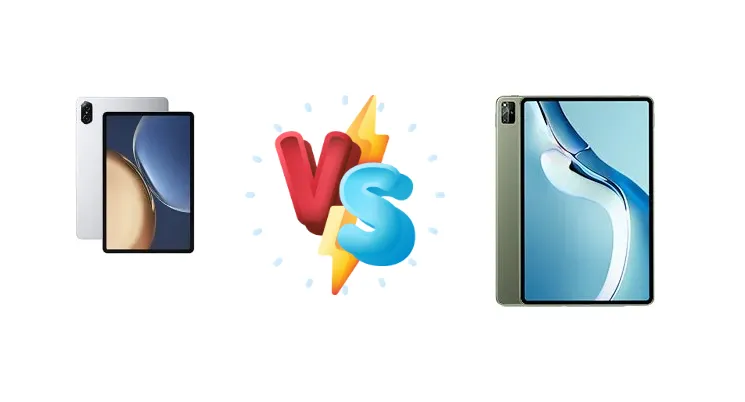
Both the Honor Tablet V7 Pro and the Huawei MatePad Pro 12.6 (2021) aim for the premium Android tablet space, but they take different approaches. The Honor prioritizes value with a Mediatek chipset, while the Huawei leverages its in-house Kirin silicon and offers faster charging capabilities. This comparison dissects the key differences to determine which tablet best suits your needs.
🏆 Quick Verdict
For most users, the Huawei MatePad Pro 12.6 (2021) is the superior choice, primarily due to its faster 40W charging and the more efficient Kirin 9000E chipset. However, the Honor V7 Pro presents a compelling value proposition if budget is a primary concern and charging speed isn't critical.
| Network |
|---|
| 2G bands | GSM 850 / 900 / 1800 / 1900 | GSM 850 / 900 / 1800 / 1900 |
| 3G bands | HSDPA 800 / 850 / 900 / 1900 / 2100 | HSDPA 800 / 850 / 900 / 1700(AWS) / 1900 / 2100 |
| 4G bands | LTE | 1, 2, 3, 4, 5, 7, 8, 9, 12, 17, 18, 19, 20, 26, 28, 32, 34, 38, 39, 40, 41, 42, 66 |
| 5G bands | SA/NSA | 1, 3, 5, 7, 8, 28, 38, 40, 41, 66, 77, 78, 79, 80, 84 SA/NSA |
| Speed | HSPA, LTE, 5G - cellular model only | HSPA, LTE, 5G - cellular model only |
| Technology | GSM / HSPA / LTE / 5G | GSM / HSPA / LTE / 5G |
| Launch |
|---|
| Announced | 2021, August 13 | 2021, June 02 |
| Status | Available. Released 2021, August 19 | Available. Released 2021, June 25 |
| Body |
|---|
| Dimensions | 252.1 x 163.4 x 7.3 mm (9.93 x 6.43 x 0.29 in) | 286.5 x 184.7 x 6.7 mm (11.28 x 7.27 x 0.26 in) |
| SIM | Nano-SIM (cellular model only) | Nano-SIM (cellular model only) |
| Weight | 485 g (1.07 lb) | 609 g (1.34 lb) |
| | Stylus support | - |
| Display |
|---|
| Protection | Aluminosilicate glass | - |
| Resolution | 1600 x 2560 pixels, 16:10 ratio (~274 ppi density) | 2560 x 1600 pixels, 16:10 ratio (~240 ppi density) |
| Size | 11.0 inches, 350.9 cm2 (~85.2% screen-to-body ratio) | 12.6 inches, 460.3 cm2 (~87.0% screen-to-body ratio) |
| Type | IPS LCD, 120Hz, 300 nits (typ) | OLED |
| Platform |
|---|
| CPU | Octa-core (4x2.6 GHz Cortex-A78 & 4x2.0 GHz Cortex-A55) | Octa-core (1x3.13 GHz Cortex-A77 & 3x2.54 GHz Cortex-A77 & 4x2.05 GHz Cortex-A55) |
| Chipset | Mediatek MT8797 Kompanio 1300T (6 nm) | Kirin 9000E 5G (5 nm) - Wi-Fi modelKirin 9000 5G (5 nm) - 5G model |
| GPU | Mali-G77 MC9 | Mali-G78 MP22 - Wi-Fi modelMali-G78 MP24 - 5G model |
| OS | Android 11, Magic UI 5.0 | HarmonyOS 2.0 |
| Memory |
|---|
| Card slot | microSDXC (dedicated slot) | Nano Memory (dedicated slot) |
| Internal | 128GB 6GB RAM, 128GB 8GB RAM, 256GB 8GB RAM | 128GB 8GB RAM, 256GB 4GB RAM, 256GB 8GB RAM, 256GB 12GB RAM, 512GB 12GB RAM |
| Main Camera |
|---|
| Dual | 13 MP, (wide), AF
2 MP (macro) | 13 MP, f/1.8, (wide), PDAF
8 MP, f/2.4, (ultrawide)
TOF 3D |
| Features | LED flash, HDR | LED flash, HDR, panorama |
| Single | 5 MP | - |
| Video | 4K@30fps | 4K@30fps, 1080p@30fps |
| Selfie camera |
|---|
| Single | 5 MP | 8 MP, f/2.0 |
| Video | 1080p@30fps | 1080p@30fps |
| Sound |
|---|
| 3.5mm jack | No | No |
| 35mm jack | No | No |
| Loudspeaker | Yes, with stereo speakers (4 speakers) | Yes, with stereo speakers (8 speakers) |
| Comms |
|---|
| Bluetooth | 5.1, A2DP, LE | 5.2, A2DP, LE |
| NFC | No | No |
| Positioning | GPS, GLONASS, GALILEO, BDS - cellular model only | GPS, GLONASS, BDS, GALILEO, QZSS - cellular model only |
| Radio | No | No |
| USB | USB-C | USB Type-C 3.1, OTG |
| WLAN | Wi-Fi 802.11 a/b/g/n/ac/6, dual-band, Wi-Fi Direct | Wi-Fi 802.11 a/b/g/n/ac/6, dual-band, Wi-Fi Direct |
| Features |
|---|
| Sensors | Accelerometer | Accelerometer, gyro, proximity, compass |
| Battery |
|---|
| Charging | 22.5W wired, 100% in 125 min | 40W wired
27W wireless
10W wireless reversed
5W reverse wired |
| Type | Li-Po 7250 mAh | Li-Po 10,050 mAh |
| Misc |
|---|
| Colors | Gold, Blue, Silver | Matte Gray, Green, Silver |
| Models | - | WGR-W09, WGR-W19, WGR-AN19 |
| Price | About 330 EUR | About 800 EUR |
| Tests |
|---|
| Display | - |
Contrast ratio: Infinite (nominal) |
| Loudspeaker | - |
-23.1 LUFS (Very good)
|
Honor Tablet V7 Pro
- More affordable price point
- Competent performance for everyday tasks
- Decent battery life (estimated)
- Slower charging speed (22.5W)
- Less powerful chipset compared to Kirin 9000E
- Display brightness likely lower than Huawei
Huawei MatePad Pro 12.6 (2021)
- Faster 40W wired and 27W wireless charging
- More powerful and efficient Kirin 9000E chipset
- Brighter and higher contrast display
- Higher price tag
- Potential software limitations due to Huawei's ecosystem
- No detailed camera specifications available
Display Comparison
The Huawei MatePad Pro 12.6 boasts a measured peak brightness of 382 nits, a significant advantage for outdoor visibility compared to the Honor V7 Pro (brightness data unavailable). While both likely utilize IPS LCD panels given the era, the Huawei’s infinite contrast ratio (nominal) suggests a higher quality panel with deeper blacks. The larger 12.6-inch screen size of the Huawei also provides a more immersive viewing experience. Bezels are comparable, but the Huawei’s overall display quality is likely superior due to its brightness and contrast.
Camera Comparison
Neither tablet is a photography powerhouse, but the Huawei MatePad Pro 12.6 likely holds an edge. While specific camera specs are unavailable for both, Huawei’s image processing algorithms are generally more refined. The absence of detailed camera information suggests both tablets prioritize other features over photographic capabilities. Any camera differences would likely be marginal and not a deciding factor for most buyers.
Performance
The core difference lies in the chipsets. The Huawei MatePad Pro 12.6 utilizes the Kirin 9000E 5G (or Kirin 9000 in the 5G model), built on a 5nm process. This offers a performance and efficiency advantage over the Honor V7 Pro’s Mediatek MT8797 Kompanio 1300T, fabricated on a 6nm node. The Kirin 9000E’s CPU configuration – a single high-performance Cortex-A77 core at 3.13 GHz, alongside three more Cortex-A77 cores – provides a burst of speed for demanding tasks. The Honor’s CPU, while an octa-core design, relies on Cortex-A78 cores clocked at 2.6 GHz, which are generally less efficient than the Kirin’s A77 setup. This translates to potentially better sustained performance and thermal management on the Huawei.
Battery Life
The Huawei MatePad Pro 12.6 significantly outpaces the Honor V7 Pro in charging speed, offering 40W wired charging, 27W wireless, and even reverse wireless charging. The Honor V7 Pro is limited to 22.5W wired charging, taking a considerably longer 125 minutes to reach 100%. While battery capacity isn’t specified for either device, the faster charging of the Huawei is a substantial convenience factor, especially for users who rely on their tablets throughout the day.
Buying Guide
Buy the Honor Tablet V7 Pro if you need a capable tablet for everyday tasks, media consumption, and light productivity, and are prioritizing affordability. Buy the Huawei MatePad Pro 12.6 (2021) if you demand faster performance for demanding applications, appreciate quicker charging times (including wireless options), and are willing to pay a premium for a more refined experience.
Frequently Asked Questions
❓ Does the Kirin 9000E chipset in the Huawei MatePad Pro 12.6 experience throttling under sustained load?
The Kirin 9000E, built on a 5nm process, is generally more thermally efficient than the Mediatek Kompanio 1300T. While some throttling is inevitable with any high-performance chipset, the Huawei is likely to maintain higher sustained performance during demanding tasks like gaming or video editing.
❓ Is the 22.5W charging on the Honor Tablet V7 Pro slow enough to be a major inconvenience?
The 22.5W charging on the Honor V7 Pro takes 125 minutes for a full charge. This is considerably slower than the Huawei’s 40W charging. If you frequently find yourself needing to quickly top up your tablet, the slower charging speed could be a significant drawback.
❓ How does the software experience differ between the Honor Tablet V7 Pro and the Huawei MatePad Pro 12.6 (2021)?
Both tablets run Android-based operating systems, but Huawei’s MatePad Pro uses EMUI, which lacks full Google Mobile Services (GMS) due to US trade restrictions. This means no pre-installed Google apps and requires sideloading or using Huawei’s AppGallery. Honor, having become independent, typically offers a more standard Android experience with full GMS support.