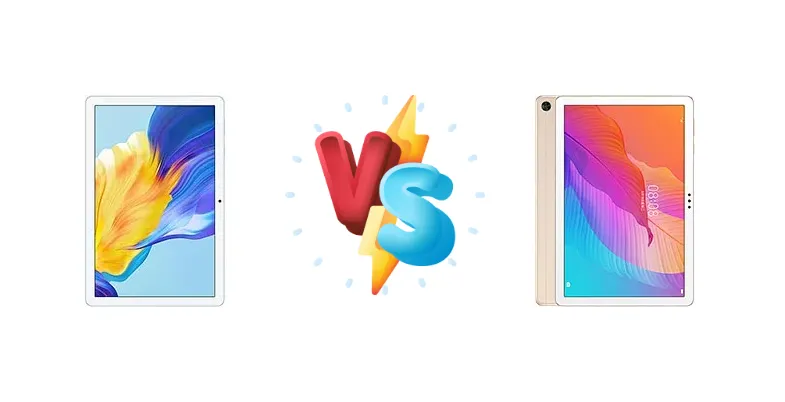
The Honor Tab 7 and Huawei MatePad T 10s represent the entry-level end of the Android tablet market. Both aim to provide a functional tablet experience without breaking the bank, but they achieve this with different hardware approaches. This comparison dissects the core differences – specifically the Mediatek MT8786 in the Honor Tab 7 versus the Kirin 710A in the MatePad T 10s – to determine which tablet offers the best performance and value for typical users.
🏆 Quick Verdict
For most users, the Honor Tab 7 emerges as the slightly better choice. Its Mediatek MT8786 chipset, featuring newer Cortex-A75 cores, provides a noticeable performance edge in multitasking and application responsiveness compared to the older Cortex-A73 cores of the Kirin 710A. While both offer similar 10W charging, the Tab 7’s CPU architecture translates to a smoother overall experience.
| Network |
|---|
| 2G bands | GSM 850 / 900 / 1800 / 1900 | GSM 850 / 900 / 1800 / 1900 |
| 3G bands | HSDPA 2100 | HSDPA 850 / 900 / 1700(AWS) / 1900 / 2100 |
| 4G bands | LTE | 1, 3, 5, 7, 8, 18, 19, 20, 26, 28, 38, 40, 41 |
| Speed | HSPA, LTE - cellular model only | HSPA, LTE - cellular model only |
| Technology | GSM / HSPA / LTE | GSM / HSPA / LTE |
| Launch |
|---|
| Announced | 2021, March 23 | 2020, September 09. Released 2020, September 09 |
| Status | Available. Released 2021, March 27 | Discontinued |
| Body |
|---|
| Dimensions | 240.2 x 159 x 7.6 mm (9.46 x 6.26 x 0.30 in) | 240.2 x 159 x 7.9 mm (9.46 x 6.26 x 0.31 in) |
| SIM | Nano-SIM (cellular model only) | Nano-SIM (cellular model only) |
| Weight | 460 g (1.01 lb) | 450 g (0.99 lb) |
| | - | Stylus support |
| Display |
|---|
| Resolution | 1200 x 1920 pixels, 16:10 ratio (~224 ppi density) | 1200 x 1920 pixels, 16:10 ratio (~224 ppi density) |
| Size | 10.1 inches, 295.8 cm2 (~77.4% screen-to-body ratio) | 10.1 inches, 295.8 cm2 (~77.4% screen-to-body ratio) |
| Type | IPS LCD | IPS LCD |
| Platform |
|---|
| CPU | Octa-core (2x2.0 GHz Cortex-A75 & 6x1.8 GHz Cortex-A55) | Octa-core (4x2.0 GHz Cortex-A73 & 4x1.7 GHz Cortex-A53) |
| Chipset | Mediatek MT8786 | Kirin 710A (14 nm) |
| GPU | - | Mali-G51 MP4 |
| OS | Android 10, Magic UI 4.1, no Google Play Services | Android 10, EMUI 10.1, no Google Play Services |
| Memory |
|---|
| Card slot | microSDXC | microSDXC |
| Internal | 64GB 4GB RAM, 128GB 4GB RAM | 16GB 2GB RAM, 32GB 2GB RAM, 64GB 3GB RAM, 64GB 4GB RAM, 128GB 4GB RAM |
| | - | eMMC 5.1 |
| Main Camera |
|---|
| Features | HDR, panorama | HDR, panorama |
| Single | 5 MP, f/2.2, AF | 5 MP, f/2.2, PDAF |
| Video | 1080p@30fps | 1080p@30fps |
| Selfie camera |
|---|
| Single | 2 MP, f/2.4 | 2 MP, f/2.4 |
| Video | 720p@30fps | - |
| Sound |
|---|
| 3.5mm jack | No | Yes |
| 35mm jack | No | Yes |
| Loudspeaker | Yes, with stereo speakers | Yes, with stereo speakers |
| | - | Tuned by Harman Kardon |
| Comms |
|---|
| Bluetooth | 5.1, A2DP, LE | 5.0, A2DP, LE |
| NFC | No | No |
| Positioning | GPS, GLONASS, BDS - cellular model only | GPS, GLONASS, BDS - cellular model only |
| Radio | No | No |
| USB | USB Type-C 2.0, OTG | USB Type-C 2.0, OTG |
| WLAN | Wi-Fi 802.11 a/b/g/n/ac, dual-band, Wi-Fi Direct | Wi-Fi 802.11 a/b/g/n/ac, dual-band, Wi-Fi Direct |
| Features |
|---|
| Sensors | Accelerometer | Accelerometer, proximity |
| Battery |
|---|
| Charging | 10W wired | 10W wired |
| Type | Li-Po 5100 mAh | Li-Po 5100 mAh |
| Misc |
|---|
| Colors | Mint Green, Space Gray | Gold, Deepsea Blue |
| Models | AGM3-W09HN | AGS3-L09, AGS3-W09, AGS3K-W09 |
| Price | About 180 EUR | About 200 EUR |
Honor Tab 7
- More modern CPU architecture (Cortex-A75) for better performance.
- Likely smoother multitasking experience.
- Potentially slightly better battery efficiency.
- May not have the same level of Huawei ecosystem integration.
- Brand recognition may be lower than Huawei in some markets.
Huawei MatePad T 10s
- Strong integration within the Huawei ecosystem.
- Potentially lower price point.
- Established brand reputation.
- Older CPU architecture (Cortex-A73) resulting in lower performance.
- May struggle with demanding applications.
- Limited performance headroom for future software updates.
Display Comparison
Neither tablet boasts a standout display. Both are likely to feature IPS LCD panels, common in this price bracket. Without specific resolution or brightness data, it’s safe to assume both offer adequate, but not exceptional, viewing experiences. The focus here isn’t on visual fidelity, but rather on functional usability. Bezels are likely to be substantial on both devices, maximizing screen real estate within a budget-friendly form factor.
Camera Comparison
Camera performance is unlikely to be a deciding factor for either tablet. Both are positioned as budget devices, and camera quality typically takes a backseat. Without specific sensor details, it’s reasonable to expect basic 5MP or 8MP cameras on both the front and rear. Image processing will likely be minimal, resulting in acceptable photos in good lighting conditions but struggling in low light. Focusing on camera specs here would be misleading given the target market.
Performance
The core difference lies in the chipsets. The Honor Tab 7’s Mediatek MT8786 utilizes a more modern CPU architecture with 2x 2.0 GHz Cortex-A75 cores and 6x 1.8 GHz Cortex-A55 cores. This contrasts with the Huawei MatePad T 10s’ Kirin 710A, which employs 4x 2.0 GHz Cortex-A73 cores and 4x 1.7 GHz Cortex-A53 cores. The Cortex-A75 offers a significant IPC (Instructions Per Clock) improvement over the A73, meaning the Tab 7 will execute tasks more efficiently. While both are octa-core, the architectural advantage favors the Honor Tab 7, particularly in demanding applications. Both likely feature similar RAM configurations (2-4GB), further emphasizing the CPU’s role in overall performance.
Battery Life
Both tablets are equipped with 10W wired charging, indicating a similar charging experience. Actual battery life will depend on usage patterns, but the capacity is likely similar (around 5100mAh). The MT8786’s potentially better efficiency could translate to slightly longer battery life on the Honor Tab 7, but the difference is unlikely to be substantial. Neither tablet supports fast charging, so expect a several-hour charge time from 0-100%.
Buying Guide
Buy the Honor Tab 7 if you prioritize a more responsive user experience for everyday tasks like browsing, video streaming, and light gaming. Its newer CPU architecture will handle multitasking more efficiently. Buy the Huawei MatePad T 10s if you are deeply embedded in the Huawei ecosystem and value the potential for seamless integration with other Huawei devices, or if you find it at a significantly lower price point, accepting a slight performance compromise.
Frequently Asked Questions
❓ Will the Honor Tab 7 handle demanding games like PUBG Mobile?
While the Honor Tab 7 can run PUBG Mobile, expect to play at lower graphics settings and frame rates. The Mediatek MT8786 isn't a gaming powerhouse, and sustained performance may be limited. The MatePad T 10s will likely offer a similar, or slightly worse, gaming experience.
❓ Does the Huawei MatePad T 10s support Huawei's M-Pencil or other accessories?
The MatePad T 10s does *not* officially support Huawei's M-Pencil. While third-party styluses might work, compatibility and functionality are not guaranteed. The Honor Tab 7 also lacks official stylus support.
❓ What version of Android do these tablets run?
Both tablets likely ship with Android 10 or 11, potentially with a custom UI overlay from Honor and Huawei respectively. Software update support is limited on budget tablets, so don't expect frequent updates to the latest Android versions.
❓ Is the Kirin 710A chipset known for overheating?
The Kirin 710A is a relatively older chipset and can experience some thermal throttling under sustained load. However, given the tablet form factor and the relatively low power draw of these devices, overheating is unlikely to be a major issue for typical usage scenarios.