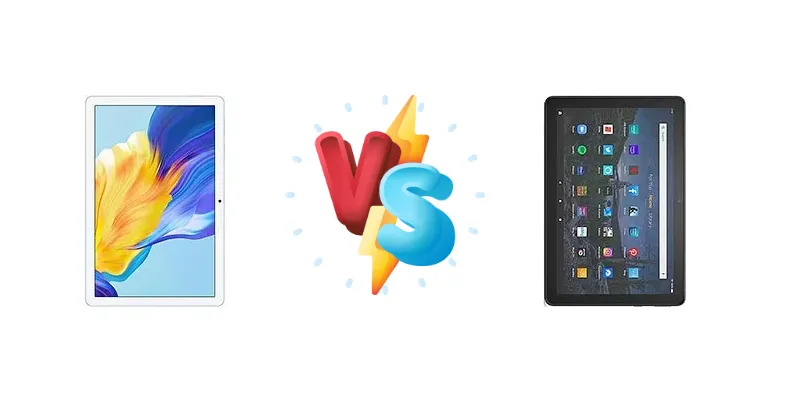
The sub-$200 tablet market is fiercely competitive, offering options for casual users, students, and families. The Honor Tab 7 and Amazon Fire HD 10 Plus (2021) represent two compelling choices, but cater to different priorities. The Honor Tab 7 aims for a more standard Android experience, while the Fire HD 10 Plus leans heavily into Amazon’s ecosystem. This comparison dissects their core components to determine which tablet delivers the most bang for your buck.
🏆 Quick Verdict
For users prioritizing a cleaner Android experience and slightly better raw processing power, the Honor Tab 7 is the superior choice. However, the Amazon Fire HD 10 Plus (2021) offers the convenience of wireless charging and deeper integration with Amazon services, making it ideal for Prime members.
| Network |
|---|
| 2G bands | GSM 850 / 900 / 1800 / 1900 | N/A |
| 3G bands | HSDPA 2100 | - |
| 4G bands | LTE | - |
| EDGE | - | No |
| GPRS | - | No |
| Speed | HSPA, LTE - cellular model only | - |
| Technology | GSM / HSPA / LTE | No cellular connectivity |
| Launch |
|---|
| Announced | 2021, March 23 | 2021, April 27. Released 2021, May 26 |
| Status | Available. Released 2021, March 27 | Discontinued |
| Body |
|---|
| Dimensions | 240.2 x 159 x 7.6 mm (9.46 x 6.26 x 0.30 in) | 247 x 166 x 9.2 mm (9.72 x 6.54 x 0.36 in) |
| SIM | Nano-SIM (cellular model only) | No |
| Weight | 460 g (1.01 lb) | 468 g (1.03 lb) |
| Display |
|---|
| Protection | - | Aluminosilicate glass |
| Resolution | 1200 x 1920 pixels, 16:10 ratio (~224 ppi density) | 1920 x 1200 pixels, 16:10 ratio (~224 ppi density) |
| Size | 10.1 inches, 295.8 cm2 (~77.4% screen-to-body ratio) | 10.1 inches, 295.8 cm2 (~72.1% screen-to-body ratio) |
| Type | IPS LCD | IPS LCD |
| Platform |
|---|
| CPU | Octa-core (2x2.0 GHz Cortex-A75 & 6x1.8 GHz Cortex-A55) | Octa-core (4x2.0 GHz Cortex-A73 & 4x2.0 GHz Cortex-A53) |
| Chipset | Mediatek MT8786 | Mediatek MT8183 Helio P60T (12 nm) |
| GPU | - | Mali-G72 MP3 |
| OS | Android 10, Magic UI 4.1, no Google Play Services | Android 9.0 (Pie), Fire OS 7 |
| Memory |
|---|
| Card slot | microSDXC | microSDXC (dedicated slot) |
| Internal | 64GB 4GB RAM, 128GB 4GB RAM | 32GB 4GB RAM, 64GB 4GB RAM |
| | - | eMMC 5.1 |
| Main Camera |
|---|
| Features | HDR, panorama | - |
| Single | 5 MP, f/2.2, AF | 5 MP |
| Video | 1080p@30fps | 720p |
| Selfie camera |
|---|
| Single | 2 MP, f/2.4 | 2 MP |
| Video | 720p@30fps | 720p |
| Sound |
|---|
| 3.5mm jack | No | Yes |
| 35mm jack | No | Yes |
| Loudspeaker | Yes, with stereo speakers | Yes, with stereo speakers |
| Comms |
|---|
| Bluetooth | 5.1, A2DP, LE | 5.0, A2DP, LE |
| NFC | No | No |
| Positioning | GPS, GLONASS, BDS - cellular model only | No |
| Radio | No | No |
| USB | USB Type-C 2.0, OTG | USB Type-C 2.0, OTG |
| WLAN | Wi-Fi 802.11 a/b/g/n/ac, dual-band, Wi-Fi Direct | Wi-Fi 802.11 a/b/g/n/ac, dual-band |
| Features |
|---|
| Sensors | Accelerometer | Accelerometer |
| | - | Text-to-Speech English-language content reader |
| Battery |
|---|
| Charging | 10W wired | Wireless |
| Type | Li-Po 5100 mAh | Li-Ion |
| Misc |
|---|
| Colors | Mint Green, Space Gray | Slate |
| Models | AGM3-W09HN | T76N2P |
| Price | About 180 EUR | About 150 EUR |
Honor Tab 7
- More powerful processor for smoother performance
- Standard Android experience with Google Play Store access
- Potentially better multitasking capabilities
- Slower 10W wired charging only
- No wireless charging support
- Likely less optimized software experience compared to Amazon's Fire OS
Amazon Fire HD 10 Plus (2021)
- Convenient wireless charging support
- Deep integration with Amazon services (Prime Video, Kindle)
- Simplified, content-focused Fire OS
- Less powerful processor compared to the Honor Tab 7
- Restricted app ecosystem (reliance on Amazon Appstore)
- Fire OS can feel limiting for users accustomed to standard Android
Display Comparison
Neither tablet boasts a particularly impressive display. Both likely utilize IPS LCD panels, given their price point. The key difference lies in processing power, not display technology. We can assume similar resolutions, around 1920x1200, but neither manufacturer specifies peak brightness or color gamut coverage. Bezels are likely comparable, being relatively substantial on both devices to maintain affordability. The lack of high refresh rates or advanced panel technologies like LTPO is expected in this segment.
Camera Comparison
Camera performance is unlikely to be a deciding factor for either tablet. Both will feature basic camera setups suitable for video calls and casual snapshots. Given the context data, detailed camera analysis is limited. We can expect the Fire HD 10 Plus to have a slightly better camera experience due to Amazon’s image processing algorithms, but neither will rival dedicated cameras or even mid-range smartphones. Focusing on megapixel counts would be misleading; image quality is more dependent on sensor size and software optimization, neither of which are specified.
Performance
The Honor Tab 7’s Mediatek MT8786 chipset, featuring a Cortex-A75/A55 configuration, offers a noticeable architectural advantage over the Fire HD 10 Plus’s Helio P60T (MT8183). The Cortex-A75 cores in the Tab 7 are significantly more powerful than the Cortex-A73 cores in the Fire tablet, translating to snappier app launches and smoother multitasking. While both are octa-core CPUs clocked at 2.0 GHz, the A75’s superior IPC (Instructions Per Clock) provides a real-world performance boost. The P60T’s 12nm process node is slightly more efficient than the MT8786’s likely larger node, but the architectural difference outweighs this benefit. This means the Honor Tab 7 will handle demanding apps and games with greater ease.
Battery Life
Battery life will depend heavily on usage patterns. While the exact battery capacities aren’t provided, the Fire HD 10 Plus’s inclusion of wireless charging is a significant advantage. This adds convenience, especially for users who frequently use the tablet at home or in the office. The Honor Tab 7 relies solely on 10W wired charging, which is relatively slow. The P60T’s 12nm process node may contribute to slightly better efficiency, but the difference is unlikely to be substantial. The convenience of wireless charging on the Fire HD 10 Plus offsets any potential battery capacity advantage the Honor Tab 7 might have.
Buying Guide
Buy the Honor Tab 7 if you need a tablet for general productivity, web browsing, and running a wider range of Android apps without Amazon’s restrictions. It’s best for users who value a more open operating system. Buy the Amazon Fire HD 10 Plus (2021) if you are heavily invested in the Amazon ecosystem – Prime Video, Kindle, Music – and appreciate the convenience of wireless charging and a simplified, content-focused interface.
Frequently Asked Questions
❓ Will the Honor Tab 7 run demanding games like Genshin Impact smoothly?
While the Honor Tab 7’s Mediatek MT8786 is more capable than the Fire HD 10 Plus’s chip, Genshin Impact is a very demanding game. Expect to play at lower graphics settings and potentially experience some frame drops, especially during intense combat sequences. It’s playable, but not an optimal gaming experience.
❓ Can I easily sideload apps onto the Amazon Fire HD 10 Plus (2021) if they aren't available in the Amazon Appstore?
Yes, sideloading apps onto the Fire HD 10 Plus is possible, but requires some technical knowledge. You’ll need to enable ‘Apps from Unknown Sources’ in the settings and download an APK installer. However, not all apps are guaranteed to function correctly due to compatibility issues with Fire OS.
❓ Is the Amazon Fire HD 10 Plus (2021) heavily ad-supported?
Yes, the Fire HD 10 Plus (2021) does include advertisements on the lock screen. These ads are for Amazon products and services. You can remove these ads for a one-time fee, but it adds to the overall cost of the tablet.
❓ Does the Honor Tab 7 support expandable storage via microSD card?
While not explicitly stated in the provided data, Honor tablets in this price range typically include a microSD card slot for expandable storage. This is a significant advantage for users who need to store a large number of files, photos, or videos.