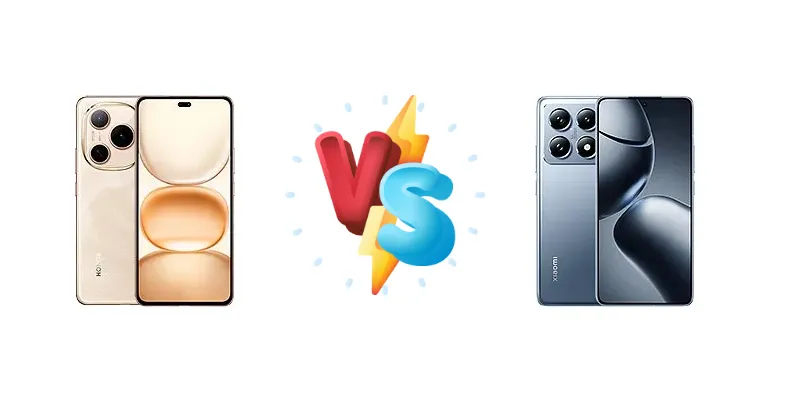
The mid-range smartphone market is fiercely competitive, and the Honor Power and Xiaomi 14T Pro represent compelling options for users seeking a balance of performance and affordability. The Honor Power focuses on providing a solid all-around experience with a newer Snapdragon chipset, while the Xiaomi 14T Pro aims for flagship-level speed with the Mediatek Dimensity 9300+ and blazing-fast charging. This comparison will dissect their key differences to determine which device best suits your needs.
🏆 Quick Verdict
For the average user prioritizing raw speed and incredibly fast charging, the Xiaomi 14T Pro is the clear winner. Its Dimensity 9300+ chipset delivers significantly higher performance. However, the Honor Power offers a strong value proposition with a capable Snapdragon 7 Gen 3 and respectable battery life, making it ideal for budget-conscious buyers.
| Network |
|---|
| 2G bands | GSM 850 / 900 / 1800 / 1900 | GSM 850 / 900 / 1800 / 1900 |
| 3G bands | HSDPA 850 / 900 / 1900 / 2100 | HSDPA 800 / 850 / 900 / 1700(AWS) / 1900 / 2100 |
| 4G bands | LTE | 1, 2, 3, 4, 5, 7, 8, 12, 13, 17, 18, 19, 20, 25, 26, 28, 32, 38, 39, 40, 41, 42, 48, 66 |
| 5G bands | SA/NSA | 1, 2, 3, 5, 7, 8, 12, 20, 25, 26, 28, 38, 40, 41, 48, 66, 75, 77, 78 SA/NSA |
| Speed | HSPA, LTE, 5G | HSPA, LTE, 5G |
| Technology | GSM / HSPA / LTE / 5G | GSM / HSPA / LTE / 5G |
| Launch |
|---|
| Announced | 2025, April 15 | 2024, September 26 |
| Status | Available. Released 2025, April 18 | Available. Released 2024, September 26 |
| Body |
|---|
| Build | - | Glass front (Gorilla Glass 5), aluminum frame, glass back (Panda X) |
| Dimensions | 163.7 x 76.7 x 8 mm (6.44 x 3.02 x 0.31 in) | 160.4 x 75.1 x 8.4 mm (6.31 x 2.96 x 0.33 in) |
| SIM | Nano-SIM + Nano-SIM | · Nano-SIM + eSIM· eSIM + eSIM· Nano-SIM + Nano-SIM |
| Weight | 209 g (7.37 oz) | 209 g (7.37 oz) |
| Display |
|---|
| Protection | Scratch/drop-resistant glass | Corning Gorilla Glass 5 |
| Resolution | 1224 x 2700 pixels (~437 ppi density) | 1220 x 2712 pixels, 20:9 ratio (~446 ppi density) |
| Size | 6.78 inches, 111.5 cm2 (~88.8% screen-to-body ratio) | 6.67 inches, 107.4 cm2 (~89.1% screen-to-body ratio) |
| Type | AMOLED, 1B colors, 120Hz, HDR, 4000 nits (peak) | AMOLED, 68B colors, 144Hz, 3840Hz PWM, Dolby Vision, HDR10+, 1600 nits (HBM), 4000 nits (peak) |
| Platform |
|---|
| CPU | Octa-core (1x2.63 GHz Cortex-A715 & 3x2.4 GHz Cortex-A715 & 4x1.8 GHz Cortex-A510) | Octa-core (1x3.4 GHz Cortex-X4 & 3x2.85 GHz Cortex-X4 & 4x2.0 GHz Cortex-A720) |
| Chipset | Qualcomm SM7550-AB Snapdragon 7 Gen 3 (4 nm) | Mediatek Dimensity 9300+ (4 nm) |
| GPU | Adreno 720 | Immortalis-G720 MC12 |
| OS | Android 15, MagicOS 9 | Android 14, HyperOS |
| Memory |
|---|
| Card slot | No | No |
| Internal | 256GB 8GB RAM, 256GB 12GB RAM, 512GB 12GB RAM | 256GB 12GB RAM, 512GB 12GB RAM, 512GB 16GB RAM, 1TB 12GB RAM |
| Main Camera |
|---|
| Dual | 50 MP, f/2.0, (wide), 1/1.56", 1.0µm, PDAF, OIS
5 MP, (ultrawide) | - |
| Features | LED flash, HDR, panorama | Leica lens, Ultra HDR, LED flash, HDR, panorama |
| Triple | - | 50 MP, f/1.6, 23mm (wide), 1/1.31", 1.2µm, PDAF, OIS
50 MP, f/2.0, 60mm (telephoto), 1/2.88", 0.61µm, PDAF, 2.6x optical zoom
12 MP, f/2.2, 15mm (ultrawide), 1/3.06", 1.12µm |
| Video | 4K@30fps, 1080p@30fps, gyro-EIS | 8K@24/30fps, 4K@24/30/60fps, 1080p@30/60/120/240/960fps, gyro-EIS, 10-bit Rec. 2020, HDR10+ |
| Selfie camera |
|---|
| Features | - | HDR |
| Single | 16 MP, f/2.5, (wide) | 32 MP, f/2.0, 25mm (wide), 1/3.44", 0.64µm |
| Video | 1080p@30fps | 4K@30fps, 1080p@30/60fps, HDR10+ |
| Sound |
|---|
| 35mm jack | No | No |
| Loudspeaker | Yes, with stereo speakers | Yes, with stereo speakers |
| Comms |
|---|
| Bluetooth | 5.3, A2DP, LE, aptX HD | 5.4, A2DP, LE, LHDC |
| Infrared port | - | Yes |
| NFC | Yes | Yes (market/region dependent) |
| Positioning | GPS (L1+L5), GLONASS, BDS (B1I+B1c+B2a), GALILEO (E5a+E5b), QZSS (L1+L5), NavIC (L1+L5) | GPS (L1+L5), BDS (B1I+B1C+B2a+B2b), GALILEO (E1+E5a+E5b), QZSS (L1+L5), NavIC (L5), GLONASS |
| Radio | No | No |
| USB | USB Type-C 2.0, OTG | USB Type-C 2.0, OTG |
| WLAN | Wi-Fi 802.11 a/b/g/n/ac/6, dual-band, Wi-Fi Direct | Wi-Fi 802.11 a/b/g/n/ac/6e/7, dual-band, Wi-Fi Direct |
| Features |
|---|
| Sensors | Fingerprint (under display, optical), accelerometer, gyro, compass, proximity (ultrasonic) | Fingerprint (under display, optical), accelerometer, gyro, proximity, compass |
| Battery |
|---|
| Charging | 66W wired
5W reverse wired | 120W wired, PD3.0, QC4, 100% in 19 min
50W wireless, 100% in 45 min |
| Type | Si/C Li-Ion 8000 mAh | Li-Po 5000 mAh |
| Misc |
|---|
| Colors | Black, White, Gold | Titan Gray, Titan Blue, Titan Black |
| Models | DVD-AN00 | 2407FPN8EG |
| Price | About 240 EUR | $ 550.00 / £ 498.00 / € 539.99 |
| SAR EU | - | 0.99 W/kg (head) 1.00 W/kg (body) |
Honor Power
- More affordable price point
- Efficient Snapdragon 7 Gen 3 chipset
- Respectable battery life
- Slower charging speeds
- Less powerful processor compared to the 14T Pro
- Likely less advanced camera system
Xiaomi 14T Pro
- Blazing-fast 120W wired and 50W wireless charging
- Powerful Mediatek Dimensity 9300+ chipset
- Brighter and potentially higher-quality display
- Higher price tag
- Potentially more thermal throttling under sustained load
- May require more frequent charging despite good battery life
Display Comparison
The Xiaomi 14T Pro boasts a significantly brighter display, reaching a measured peak of 1228 nits, ensuring excellent visibility even in direct sunlight. While the Honor Power’s display specs are not provided, the 14T Pro’s brightness advantage is substantial. The 14T Pro’s panel likely benefits from a higher peak brightness and potentially a more advanced panel technology, offering a superior viewing experience for media consumption and outdoor use. We expect the 14T Pro to have a higher contrast ratio as well.
Camera Comparison
Without detailed camera specifications for the Honor Power, a direct comparison is limited. However, the Xiaomi 14T Pro is expected to have a more advanced camera system, leveraging the processing power of the Dimensity 9300+ for improved image quality and computational photography features. The 14T Pro likely features a larger main sensor and more sophisticated image stabilization (OIS) than the Honor Power. While the Honor Power may offer a decent camera for everyday snapshots, the 14T Pro is likely to excel in challenging lighting conditions and offer more creative control.
Performance
The core difference lies in the chipsets. The Xiaomi 14T Pro’s Mediatek Dimensity 9300+ features a 1x3.4 GHz Cortex-X4 prime core and 3x2.85 GHz Cortex-X4 performance cores, alongside 4x2.0 GHz Cortex-A720 efficiency cores. This configuration, built on a 4nm process, provides a substantial performance leap over the Honor Power’s Qualcomm Snapdragon 7 Gen 3. The Snapdragon 7 Gen 3, with its 1x2.63 GHz Cortex-A715, 3x2.4 GHz Cortex-A715, and 4x1.8 GHz Cortex-A510 cores, is still a capable performer, but the Dimensity 9300+’s Cortex-X4 cores offer significantly improved single-core and multi-core performance. This translates to faster app loading times, smoother multitasking, and a better gaming experience on the Xiaomi 14T Pro.
Battery Life
The Xiaomi 14T Pro’s charging capabilities are a standout feature, offering 120W wired charging, capable of a full charge in just 19 minutes, and 50W wireless charging, reaching 100% in 45 minutes. The Honor Power’s 66W wired charging is respectable, but significantly slower. The Xiaomi 14T Pro also boasts an active use battery score of 12:32h, indicating excellent battery life despite its power-hungry chipset. While the Honor Power’s battery capacity isn’t specified, the 14T Pro’s combination of efficient chipset and fast charging provides a clear advantage for users who prioritize long-lasting battery life and quick top-ups.
Buying Guide
Buy the Honor Power if you need a reliable daily driver with good battery life and don't demand the absolute highest performance. It's perfect for everyday tasks, social media, and casual gaming. Buy the Xiaomi 14T Pro if you prioritize speed for demanding apps, gaming, and content creation, and if you value the convenience of incredibly fast 120W wired and 50W wireless charging.
Frequently Asked Questions
❓ Does the Mediatek Dimensity 9300+ in the Xiaomi 14T Pro tend to overheat during prolonged gaming sessions?
While the Dimensity 9300+ is a powerful chipset, it can generate significant heat under sustained load. The Xiaomi 14T Pro likely incorporates thermal management solutions like vapor chamber cooling to mitigate this, but some throttling may occur during extended gaming. However, the performance gains generally outweigh the potential for minor thermal throttling.
❓ How does the 66W charging on the Honor Power compare to the 120W charging on the Xiaomi 14T Pro in real-world usage?
The difference is substantial. The Xiaomi 14T Pro can charge from 0-100% in approximately 19 minutes, while the Honor Power will take considerably longer. This means less downtime and more convenience for users who frequently need to top up their battery quickly. The 14T Pro’s charging speed is a significant advantage.
❓ Is the reverse wired charging feature on the Honor Power useful for charging accessories like earbuds?
The 5W reverse wired charging on the Honor Power is primarily intended for emergency charging of small accessories like earbuds or smartwatches. It's not designed for quickly charging larger devices like another phone, but it can provide a convenient boost in a pinch.