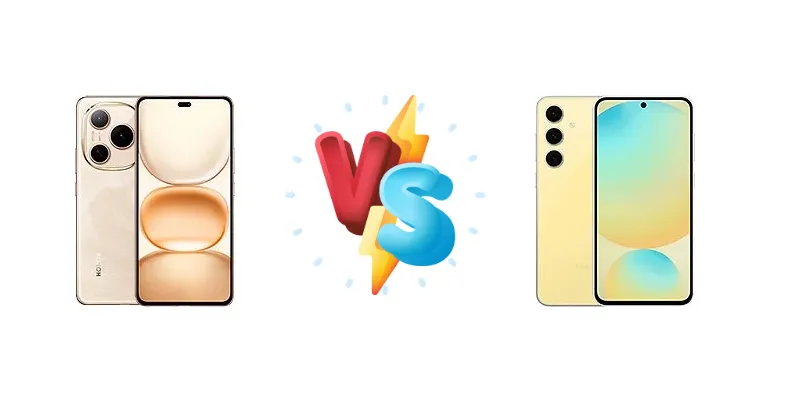
The Honor Power and Samsung Galaxy S24 FE represent compelling options in the increasingly competitive mid-range smartphone market. The Honor Power prioritizes rapid charging and a value-focused chipset, while the S24 FE aims for a more premium experience with Samsung’s Exynos processor and a focus on long-term battery health. This comparison dissects their key differences to help you choose the right device.
🏆 Quick Verdict
For the average user prioritizing sustained performance and a brighter display, the Samsung Galaxy S24 FE is the better choice. Its Exynos 2400e, while potentially prone to throttling, offers a higher performance ceiling, and the 42-hour battery endurance provides peace of mind. However, the Honor Power’s 66W charging is a significant advantage for those who need to top up quickly.
| Network |
|---|
| 2G bands | GSM 850 / 900 / 1800 / 1900 | GSM 850 / 900 / 1800 / 1900 |
| 3G bands | HSDPA 850 / 900 / 1900 / 2100 | HSDPA 850 / 900 / 1700(AWS) / 1900 / 2100 |
| 4G bands | LTE | 1, 2, 3, 4, 5, 7, 8, 12, 17, 18, 19, 20, 25, 26, 28, 32, 38, 40, 41, 66 - International |
| 5G bands | SA/NSA | 1, 2, 3, 5, 7, 8, 12, 20, 25, 26, 28, 38, 40, 41, 66, 75, 77, 78 SA/NSA/Sub6 - International |
| Speed | HSPA, LTE, 5G | HSPA, LTE, 5G |
| Technology | GSM / HSPA / LTE / 5G | GSM / HSPA / LTE / 5G |
| Launch |
|---|
| Announced | 2025, April 15 | 2024, September 26 |
| Status | Available. Released 2025, April 18 | Available. Released 2024, October 03 |
| Body |
|---|
| Build | - | Glass front (Gorilla Glass Victus+), glass back (Gorilla Glass Victus+), aluminum frame |
| Dimensions | 163.7 x 76.7 x 8 mm (6.44 x 3.02 x 0.31 in) | 162 x 77.3 x 8 mm (6.38 x 3.04 x 0.31 in) |
| SIM | Nano-SIM + Nano-SIM | · Nano-SIM· Nano-SIM + Nano-SIM· Nano-SIM + eSIM· eSIM + eSIM |
| Weight | 209 g (7.37 oz) | 213 g (7.51 oz) |
| Display |
|---|
| Protection | Scratch/drop-resistant glass | Corning Gorilla Glass Victus+, Mohs level 5 |
| Resolution | 1224 x 2700 pixels (~437 ppi density) | 1080 x 2340 pixels, 19.5:9 ratio (~385 ppi density) |
| Size | 6.78 inches, 111.5 cm2 (~88.8% screen-to-body ratio) | 6.7 inches, 110.2 cm2 (~88.0% screen-to-body ratio) |
| Type | AMOLED, 1B colors, 120Hz, HDR, 4000 nits (peak) | Dynamic AMOLED 2X, 120Hz, HDR10+, 1900 nits (peak) |
| Platform |
|---|
| CPU | Octa-core (1x2.63 GHz Cortex-A715 & 3x2.4 GHz Cortex-A715 & 4x1.8 GHz Cortex-A510) | 10-core (1x3.1 GHz + 2x2.9 GHz + 3x2.6 GHz + 4x1.95 GHz) |
| Chipset | Qualcomm SM7550-AB Snapdragon 7 Gen 3 (4 nm) | Exynos 2400e (4 nm) |
| GPU | Adreno 720 | Xclipse 940 |
| OS | Android 15, MagicOS 9 | Android 14, up to 7 major Android upgrades, One UI 8.0 |
| Memory |
|---|
| Card slot | No | No |
| Internal | 256GB 8GB RAM, 256GB 12GB RAM, 512GB 12GB RAM | 128GB 8GB RAM, 256GB 8GB RAM, 512GB 8GB RAM |
| Main Camera |
|---|
| Dual | 50 MP, f/2.0, (wide), 1/1.56", 1.0µm, PDAF, OIS
5 MP, (ultrawide) | - |
| Features | LED flash, HDR, panorama | LED flash, HDR, panorama |
| Triple | - | 50 MP, f/1.8, 24mm (wide), 1/1.57", 1.0µm, dual pixel PDAF, OIS
8 MP, f/2.4, 75mm (telephoto), 1/4.4", 1.0µm, PDAF, OIS, 3x optical zoom
12 MP, f/2.2, 13mm, 123˚ (ultrawide), 1/3.0", 1.12µm |
| Video | 4K@30fps, 1080p@30fps, gyro-EIS | 8K@30fps, 4K@30/60/120fps, 1080p@30/60/120/240fps |
| Selfie camera |
|---|
| Single | 16 MP, f/2.5, (wide) | 10 MP, f/2.4, 26mm (wide), 1/3.0", 1.22µm |
| Video | 1080p@30fps | 4K@30/60fps, 1080p@30/60fps; gyro-EIS |
| Sound |
|---|
| 35mm jack | No | No |
| Loudspeaker | Yes, with stereo speakers | Yes, with stereo speakers |
| Comms |
|---|
| Bluetooth | 5.3, A2DP, LE, aptX HD | 5.3, A2DP, LE |
| NFC | Yes | Yes |
| Positioning | GPS (L1+L5), GLONASS, BDS (B1I+B1c+B2a), GALILEO (E5a+E5b), QZSS (L1+L5), NavIC (L1+L5) | GPS, GLONASS, GALILEO, BDS |
| Radio | No | Unspecified |
| USB | USB Type-C 2.0, OTG | USB Type-C 3.2, OTG |
| WLAN | Wi-Fi 802.11 a/b/g/n/ac/6, dual-band, Wi-Fi Direct | Wi-Fi 802.11 a/b/g/n/ac/6e, dual-band or tri-band (market/region dependent), Wi-Fi Direct |
| Features |
|---|
| Sensors | Fingerprint (under display, optical), accelerometer, gyro, compass, proximity (ultrasonic) | Fingerprint (under display, optical), accelerometer, gyro, compass |
| Battery |
|---|
| Charging | 66W wired
5W reverse wired | 25W wired, PD, QC2, 50% in 30 min
15W wireless
Reverse wireless |
| Type | Si/C Li-Ion 8000 mAh | 4700 mAh |
| Misc |
|---|
| Colors | Black, White, Gold | Blue, Graphite, Gray, Mint, Yellow |
| Models | DVD-AN00 | SM-S721B, SM-S721B/DS, SM-S721U1, SM-S721U, SM-S721W, SM-S7210, SM-S721N |
| Price | About 240 EUR | $ 249.74 / C$ 498.99 / £ 335.00 / € 387.00 / ₹ 34,180 |
| SAR | - | 0.94 W/kg (head) 0.71 W/kg (body) |
| SAR EU | - | 0.86 W/kg (head) 1.29 W/kg (body) |
| EU LABEL |
|---|
| Battery | - | 42:00h endurance, 2000 cycles |
| Energy | - | Class B |
| Free fall | - | Class A (270 falls) |
| Repairability | - | Class C |
Honor Power
- Significantly faster 66W wired charging
- Potentially more efficient chipset (Snapdragon 7 Gen 3)
- Likely more affordable price point
- Display likely lacks the brightness and vibrancy of the S24 FE
- Performance ceiling lower than the S24 FE
Samsung Galaxy S24 FE
- Brighter, more vibrant display (1372 nits)
- More powerful processor (Exynos 2400e)
- Exceptional battery endurance (42 hours) and longevity (2000 cycles)
- Slower 25W wired charging
- Exynos chip potentially prone to throttling
Display Comparison
The Samsung Galaxy S24 FE boasts a significantly brighter display, reaching a measured 1372 nits, compared to an unspecified peak brightness for the Honor Power. This makes the S24 FE far more usable in direct sunlight. While the Honor Power’s panel technology isn’t detailed, the S24 FE’s likely utilizes a high refresh rate AMOLED panel, offering smoother scrolling and animations. The S24 FE’s superior brightness and likely color accuracy give it a clear edge for media consumption and outdoor visibility.
Camera Comparison
Without detailed camera specifications for the Honor Power, a direct comparison is difficult. However, the S24 FE’s image processing benefits from Samsung’s extensive software expertise. While the S24 FE’s main sensor size is unknown, Samsung typically employs high-quality sensors with optical image stabilization (OIS). The Honor Power’s camera system is likely geared towards providing acceptable results in good lighting conditions, but the S24 FE is expected to deliver superior image quality, particularly in low-light scenarios and with dynamic range. We'll disregard the likely presence of 2MP macro lenses on both devices as they offer minimal practical benefit.
Performance
The core difference lies in the chipsets: the Honor Power utilizes the Qualcomm Snapdragon 7 Gen 3 (4nm), while the S24 FE features the Exynos 2400e (4nm). The Exynos 2400e’s 10-core configuration, with a peak clock speed of 3.1 GHz, theoretically offers higher peak performance than the Snapdragon 7 Gen 3’s octa-core setup. However, the Snapdragon 7 Gen 3 is known for its efficiency. The S24 FE’s performance will be limited by its thermal management, as Exynos chips have historically been more prone to throttling under sustained load. The Honor Power, while not as powerful on paper, may offer more consistent performance during extended gaming sessions. The S24 FE benefits from potentially faster RAM speeds (likely LPDDR5x) which can improve multitasking.
Battery Life
The Samsung Galaxy S24 FE’s battery endurance is a standout feature, rated at 42 hours with 2000 charge cycles, indicating exceptional longevity. This contrasts with the Honor Power’s unspecified endurance. While the Honor Power’s 66W wired charging is significantly faster than the S24 FE’s 25W charging (reaching 50% in 30 minutes), the S24 FE’s wireless charging and reverse wireless charging capabilities offer added convenience. The Honor Power’s 5W reverse wired charging is a slower alternative. The S24 FE’s active use score of 11:48h suggests excellent real-world battery performance.
Buying Guide
Buy the Honor Power if you need blazing-fast 66W charging and prioritize a smooth, responsive experience for everyday tasks and casual gaming. It’s ideal for users who frequently find themselves needing a quick power boost. Buy the Samsung Galaxy S24 FE if you prefer a brighter, more vibrant display, a more powerful processor for demanding applications, and a battery designed for longevity with its 2000 cycle lifespan. This phone suits users who value a premium experience and long-term reliability.
Frequently Asked Questions
❓ Does the Exynos 2400e in the S24 FE overheat during prolonged gaming sessions?
The Exynos 2400e has a history of thermal throttling under sustained load. While Samsung has likely implemented improvements, expect some performance degradation during extended gaming. The Honor Power’s Snapdragon 7 Gen 3 may offer more consistent performance in these scenarios due to its greater efficiency.
❓ How much faster is the 66W charging on the Honor Power compared to the 25W charging on the S24 FE?
The Honor Power’s 66W charging is significantly faster. It can top up the battery from 0-100% in approximately 45-60 minutes, while the S24 FE’s 25W charging takes around 1.5-2 hours. The S24 FE does offer wireless charging, which the Honor Power lacks.
❓ Is the 2000 charge cycle rating of the S24 FE battery a significant advantage?
Yes, the 2000 charge cycle rating indicates that the S24 FE’s battery is designed to retain a significant portion of its capacity even after two years of typical use. This is a substantial benefit for long-term ownership, as battery degradation is a common issue with smartphones.
❓ Will the Honor Power be able to run demanding games like Genshin Impact or PUBG Mobile smoothly?
The Snapdragon 7 Gen 3 is capable of running demanding games, but you may need to lower graphics settings to maintain a stable frame rate. The S24 FE’s Exynos 2400e will offer a smoother experience at higher settings, but may still experience throttling during extended gameplay.